Quiz · Medium
Core facts about carbohydrates, fats, protein, essential nutrients and energy values for intro nutrition.
How many kilocalories does 1 gram of fat provide?
9
4
7
2
Fat provides 9 kcal/g. Carbohydrate and protein provide 4 and alcohol 7; people confuse fat with alcohol.
A snack has 20 g carbohydrate, 5 g protein and 10 g fat. About how many kcal does it contain?
130
190
170
235
20×4 = 80, 5×4 = 20, 10×9 = 90; total 190 kcal. 130 forgets that fat is 9 kcal/g; 235 counts fat as 15.
Which of these is a disaccharide made of glucose and galactose?
Sucrose
Maltose
Lactose
Fructose
Lactose = glucose + galactose. Sucrose is glucose + fructose, maltose is glucose + glucose, and fructose is a monosaccharide.
Which statement about fiber is correct?
Insoluble fiber forms a gel that lowers cholesterol.
Fiber is digested by amylase into glucose.
Fiber provides 9 kcal per gram.
Soluble fiber can lower blood LDL cholesterol and slow glucose absorption.
Soluble fiber (oats, beans, psyllium) forms a gel. Insoluble fiber mainly adds bulk. Human enzymes cannot digest fiber, though bacteria ferment some to short-chain fatty acids.
Which pair of fatty acids are essential in the human diet?
Linoleic acid and alpha-linolenic acid
Oleic acid and stearic acid
Palmitic acid and oleic acid
EPA and cholesterol
Humans cannot insert double bonds before carbon 9, so linoleic (omega-6) and ALA (omega-3) must come from food. Oleic, stearic and palmitic acid can be made by the body.
Which lipoprotein carries cholesterol from tissues back to the liver?
LDL
HDL
Chylomicron
VLDL
HDL performs reverse cholesterol transport. LDL delivers cholesterol to tissues, VLDL carries liver-made triglyceride, and chylomicrons carry dietary fat.
What is the RDA for protein for a healthy adult?
0.4 g per kg per day
1.6 g per kg per day
0.8 g per kg body weight per day
2.0 g per kg per day
The RDA is 0.8 g/kg/day. Higher intakes (1.2 to 2.0 g/kg) are suggested for some athletes, but they are not the RDA.
Which is NOT one of the nine essential amino acids?
Lysine
Tryptophan
Histidine
Tyrosine
Tyrosine is made from phenylalanine, so it is non-essential (conditionally essential in PKU). Lysine, tryptophan and histidine are essential.
Which bond links amino acids in a protein?
Peptide bond
Glycosidic bond
Ester bond
Hydrogen bond only
Peptide bonds join the carboxyl group of one amino acid to the amino group of the next. Glycosidic bonds link sugars and ester bonds join fatty acids to glycerol.
Which energy source is shown by the tallest bar?
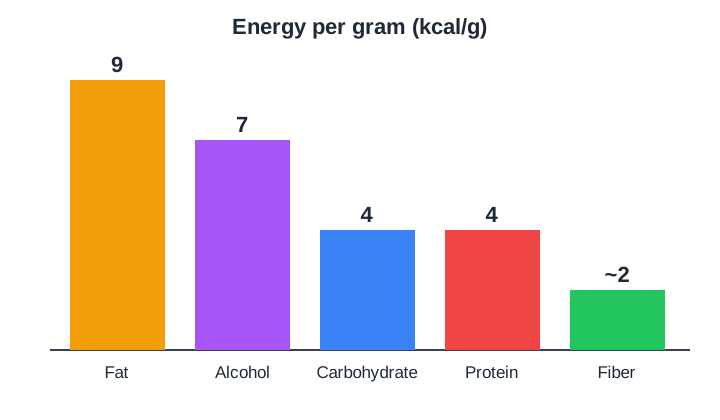
Alcohol
Fat
Carbohydrate
Protein
Fat has 9 kcal/g, more than alcohol (7) and carbohydrate or protein (4).
What is the main storage form of carbohydrate in animals?
Amylose
Cellulose
Glycogen
Glucagon
Glycogen is stored in liver and muscle. Amylose is plant starch, cellulose is structural fiber, and glucagon is a hormone (a common mix-up in the name).
Why can't humans digest cellulose?
Cellulose is a protein.
Cellulose has no glucose units.
Stomach acid destroys the fiber into fatty acids.
Human enzymes cannot break its β-1,4 bonds.
Cellulose is made of glucose units with β-1,4 linkages. Amylase only cleaves α-1,4 bonds.
Which lowers the glycemic response of a meal?
Adding soluble fiber and protein
Eating the food finely ground
Cooking pasta until very soft
Eating refined starch alone
Fiber, fat and protein slow gastric emptying and absorption. Fine grinding and overcooking increase starch digestibility and raise GI.
Complete the statement: kwashiorkor is characterized by
wasting from total energy deficiency only
edema from protein deficiency
bone softening from vitamin D deficiency
goiter from iodine deficiency
Kwashiorkor involves protein deficiency with edema and a fatty liver. Marasmus is the wasting form from total energy deficiency.
Which statement about trans fats is true?
They are essential fatty acids.
They are always cis double bonds.
They raise LDL and lower HDL.
They lower the risk of heart disease.
Trans fats raise LDL and lower HDL, increasing cardiovascular risk. They have trans double bonds and are not essential.
True or false: the brain can use fatty acids directly as a major fuel during a fast.
True
False
Fatty acids do not cross the blood-brain barrier efficiently. During fasting the liver makes ketone bodies, which the brain does use.
An adult eats 2,000 kcal per day. Within the AMDR, what is the range for protein in grams per day?
50 to 175 g
20 to 70 g
100 to 250 g
200 to 350 g
Protein AMDR is 10 to 35%: 200 to 700 kcal, divided by 4 kcal/g = 50 to 175 g.
Which amino acid is the main precursor of niacin?
Tyrosine
Tryptophan
Methionine
Glycine
About 60 mg of tryptophan yields roughly 1 mg of niacin. Tyrosine is the precursor of catecholamines and thyroid hormones.
Which is a complementary protein pair?
Rice and wheat bread
Almonds and walnuts
Rice and beans
Lentils and peas
Grains are low in lysine and legumes are low in methionine, so they complement each other. The other pairs share the same limiting amino acids.
Which enzyme begins protein digestion?
Salivary amylase
Pancreatic lipase
Lactase
Pepsin
Pepsin (activated from pepsinogen by HCl) starts protein digestion in the stomach. The others digest starch, fat and lactose.
