Quiz · Hard
Case-based questions on resistance mechanisms, MIC and breakpoints, empiric therapy and drug interactions.
A hospitalized patient has an MRSA bacteremia. Which mechanism explains the organism's resistance to oxacillin?
Production of an extended-spectrum beta-lactamase
Altered penicillin-binding protein (PBP2a) encoded by mecA
Efflux of the drug through porins
Loss of the cell wall
MRSA acquires mecA, producing PBP2a with low beta-lactam affinity. ESBLs are found in Gram-negative rods.
An isolate shows resistance to ceftriaxone but remains susceptible to meropenem and has a positive ESBL test. What is the best treatment?
Ceftriaxone at higher dose
Amoxicillin-clavulanate
Aztreonam
Meropenem
ESBLs hydrolyze penicillins, cephalosporins and aztreonam; carbapenems are stable to ESBLs.
Enterococcus faecium resists vancomycin by which mechanism?
Production of PBP2a
Efflux of vancomycin
D-Ala-D-Lac substitution in the cell wall precursor
Methylation of the 23S rRNA
Replacement of D-Ala-D-Ala with D-Ala-D-Lac lowers vancomycin binding (VanA/VanB). Treat with linezolid or daptomycin.
A 68-year-old on prednisone begins levofloxacin. Which complication is most likely to be asked about in teaching?
Tendon rupture
Hearing loss
Hyperkalemia
Orange urine
Age over 60 and corticosteroids multiply the risk of fluoroquinolone tendinopathy.
A patient on warfarin is prescribed TMP-SMX for a UTI. What should be monitored?
Digoxin levels
Serum lithium
INR, because TMP-SMX raises warfarin's effect
Blood glucose only
TMP-SMX inhibits CYP2C9 and displaces warfarin, raising INR and bleeding risk. Potassium should also be watched.
A patient with a Pseudomonas pneumonia is allergic to penicillin (severe anaphylaxis). Which agent is least likely to cross-react?
Piperacillin-tazobactam
Aztreonam
Cefepime
Imipenem
Aztreonam is a monobactam with minimal cross-reactivity. Piperacillin is a penicillin; cephalosporins and carbapenems carry a small risk.
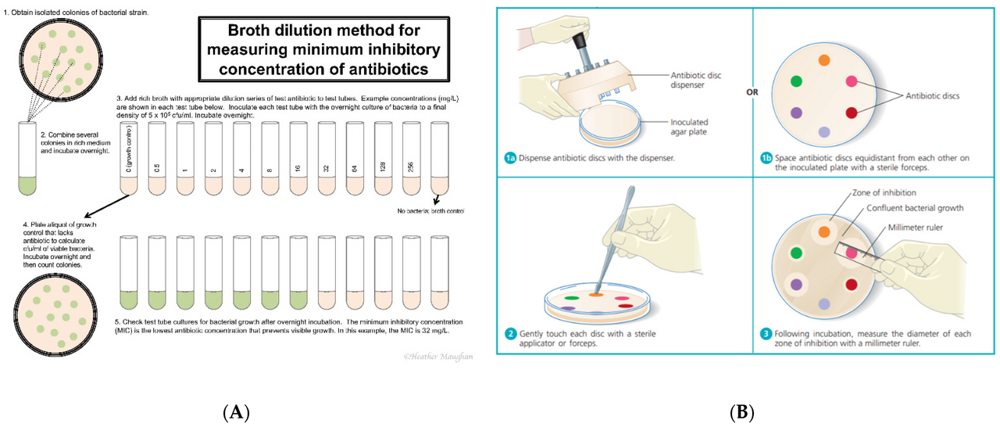
In the broth dilution method shown, how is the MIC identified?
It is the highest concentration at which any growth is seen
It is the tube with the most turbidity
It is the lowest antibiotic concentration whose tube stays clear (no visible growth)
It is the average of the clear and cloudy tubes
Tubes with increasing drug concentrations are inoculated and incubated overnight. Turbidity means growth; the lowest concentration with a clear tube is the MIC. Image: Little W, Black C, Smith AC, CC BY 4.0, via Wikimedia Commons.
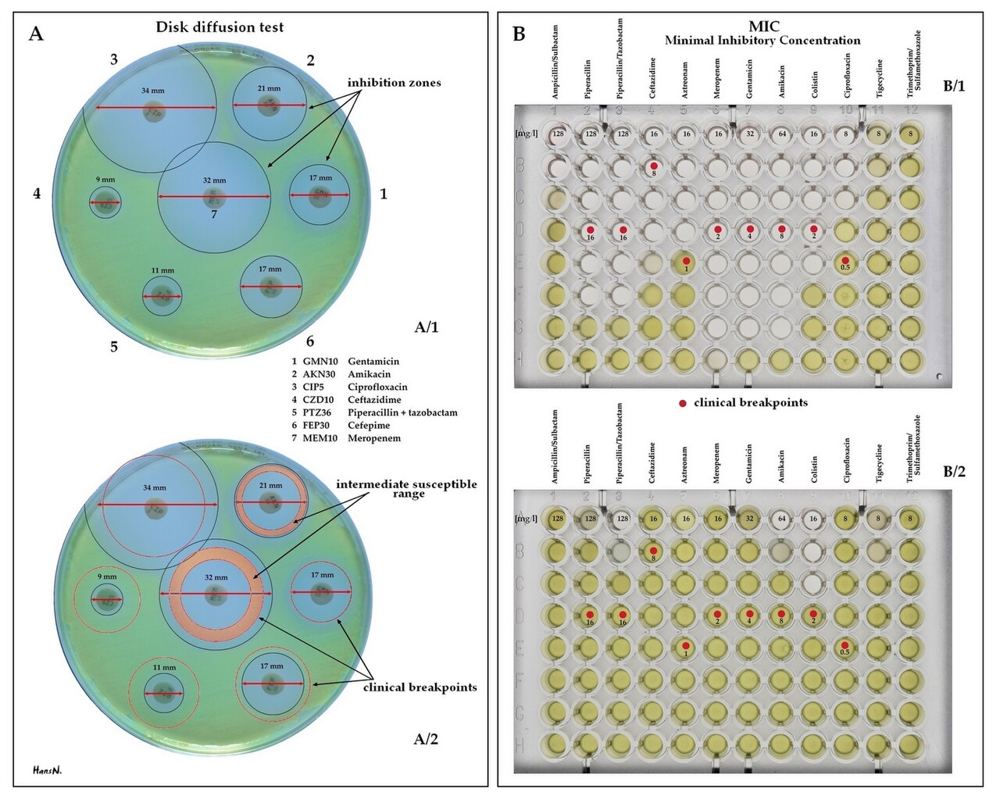
An isolate has an MIC of 4 mg/L for an antibiotic and the susceptible breakpoint is 8 mg/L. How is it reported?
Resistant
Intermediate
Susceptible
Cannot be determined without a disk test
MIC at or below the susceptible breakpoint is reported susceptible. MICs are compared with drug- and organism-specific breakpoints. Image: HansN., CC BY-SA 4.0, via Wikimedia Commons.
An elderly patient with CAP is treated with levofloxacin and also takes amiodarone. What is the main concern?
Serotonin syndrome
Aplastic anemia
QT prolongation and torsades de pointes
Red man syndrome
Fluoroquinolones and amiodarone both prolong QT. Check ECG and electrolytes or choose an alternative.
A patient started on linezolid is also taking sertraline. Which risk is increased?
Torsades de pointes
Ototoxicity
Serotonin syndrome
Aplastic anemia
Linezolid is a weak, reversible MAO inhibitor and can precipitate serotonin syndrome with SSRIs.
A 3-day-old neonate is given chloramphenicol and becomes ashen, hypotensive and has abdominal distension. Which explains this?
Immature glucuronidation causing drug accumulation (gray baby syndrome)
Penicillin allergy
Kernicterus from sulfonamide
Red man syndrome
Neonates cannot conjugate chloramphenicol, so toxic levels build up and cause cardiovascular collapse.
A patient on RIPE therapy reports difficulty distinguishing red from green. Which drug is responsible?
Rifampin
Isoniazid
Pyrazinamide
Ethambutol
Ethambutol causes optic neuritis with color vision loss and reduced acuity. Check vision at baseline and monthly.
Which scenario best fits a bacteriostatic antibiotic being a poor choice?
Uncomplicated community-acquired pneumonia
Mycoplasma pneumonia
Bacterial endocarditis in an immunocompromised patient
Acne
Endocarditis in an immunocompromised host needs bactericidal therapy because host defenses cannot clear the vegetation.
A 35-year-old woman is breastfeeding and has mastitis. Which antibiotic is a reasonable choice?
Doxycycline for 3 weeks
Ciprofloxacin
Chloramphenicol
Cephalexin or dicloxacillin
Beta-lactams are compatible with breastfeeding. The others are avoided or restricted.
A beta-lactam's activity is best predicted by which pharmacodynamic index?
Cmax/MIC
Percentage of time free drug concentration exceeds the MIC (%T>MIC)
AUC/MIC only
Post-antibiotic effect length
Beta-lactams show time-dependent killing; extended infusion improves %T>MIC. Aminoglycosides depend on Cmax/MIC.
The image shows a bacterial cell with layers labeled. Which feature explains why Gram-negative bacteria are intrinsically resistant to vancomycin?
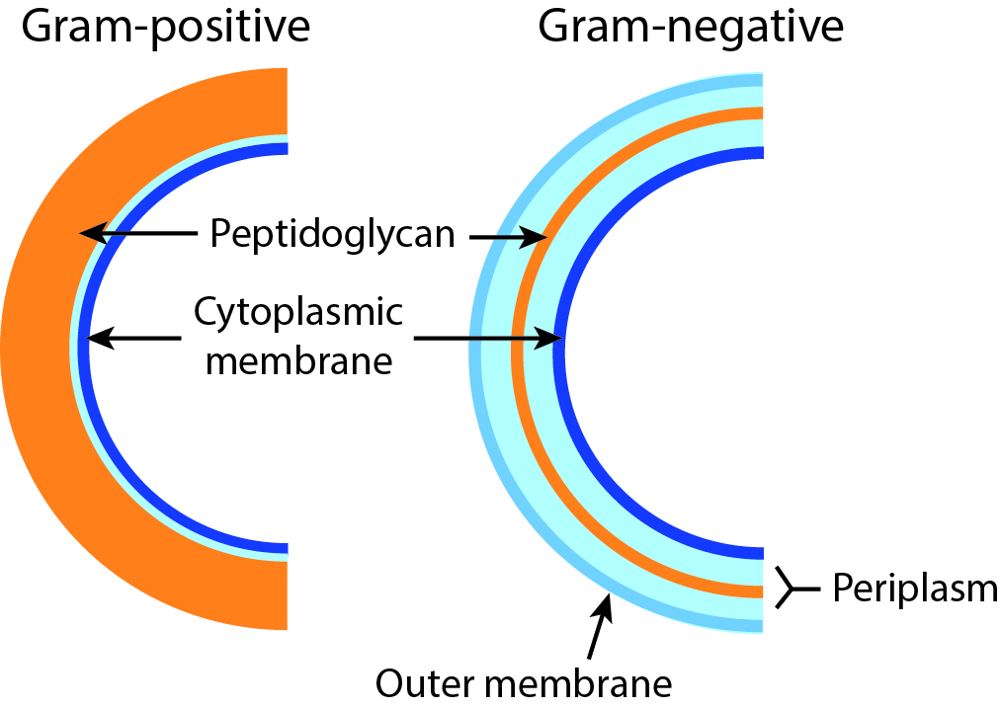
The outer membrane blocks entry of large molecules
They lack peptidoglycan
They contain mecA
They produce D-Ala-D-Lac
Vancomycin is too large to pass through porins. Peptidoglycan is present but thin in Gram-negatives. Image: Microbialmatt, CC BY-SA 4.0, via Wikimedia Commons.
