Quiz · Hard
Scenario-based questions on drowning, AEDs, anaphylaxis, hypothermia, spinal injury, overdose and triage.
A teenager collapses at a pool after being underwater for several minutes, is unresponsive and only gasping occasionally. A bystander says 'just do hands-only CPR'. What is the best advice?
Give CPR with rescue breaths, because drowning causes low oxygen
Hands-only CPR is always best
Wait for EMS before touching
Give abdominal thrusts to remove water
Drowning is an asphyxial arrest, so ventilation matters. Abdominal thrusts to remove water are not recommended.
An AED advises 'No shock advised' for an unresponsive adult. What should you do?
Stop CPR and wait for EMS
Resume CPR immediately and follow the AED prompts
Remove the pads
Give two rescue breaths only
AEDs don't shock non-shockable rhythms; the patient still needs CPR until EMS arrives or they recover.
Which scenario most needs a tourniquet?
A scraped knee
A nosebleed
Arm bleeding that soaks through dressings despite direct pressure
A paper cut
Tourniquets are for life-threatening limb hemorrhage not controlled by direct pressure.
Two rescuers perform CPR on a 4-year-old. Which ratio do they use?
15 : 2
30 : 2
5 : 1
10 : 2
Two rescuers for children use 15:2 to give more ventilations; adults always use 30:2.
A person has chest pain, sweating and nausea and is not allergic to aspirin. After calling 911, what is the best help?
Make them walk to get air
Have them rest and chew aspirin if advised, ready to start CPR
Give a large meal
Have them lie flat on the floor with no further watching
Rest reduces cardiac load; aspirin inhibits clotting. Be ready for cardiac arrest.
A person is found shivering, slurring words, with cold skin after a cold night outside. Best action?
Rub their arms and legs vigorously
Give alcohol to warm them
Move them to shelter, remove wet clothing, insulate and warm the trunk gently
Put them in a hot shower
Rubbing and hot showers can send cold blood to the heart and cause arrhythmias; alcohol dilates blood vessels and speeds heat loss.
A person with a known peanut allergy develops hives, a swollen tongue and wheezing after eating a snack. After calling 911, the first action is:
Give epinephrine in the outer thigh
Give an antihistamine and observe
Make them vomit
Give a cold drink
Epinephrine is the first-line treatment. Antihistamines alone are inadequate for airway or circulation involvement.
A child has a seizure at school lasting 7 minutes. What should happen?
Wait up to 20 minutes
Put a pen in the mouth
Hold the child down firmly
Call 911 because it exceeds 5 minutes
Seizures over 5 minutes (status epilepticus) are an emergency. Nothing should go into the mouth.
After a bicycle crash a rider is conscious but has neck pain and tingling in the hands. What is right?
Help them stand
Keep them still, support the head and neck, call EMS
Remove the helmet immediately
Give water
Neck pain and neurologic signs suggest spinal injury. Moving them can worsen damage.
A worker splashes drain cleaner in one eye. What should you do first?
Cover the eye with a pad and wait
Use eye drops for redness
Flush with running water for at least 15 minutes
Rub the eye
Immediate dilution is the priority for chemical eye injuries; rubbing worsens damage.
Which sequence correctly describes treating a conscious choking adult that becomes unresponsive?
Call 911, start CPR, check mouth for visible object before breaths
Continue back blows only
Perform blind finger sweeps
Wait for the person to wake
After becoming unresponsive, CPR compressions may dislodge the object; remove only visible objects.
In START triage, a patient who is not breathing after the airway is repositioned is categorized as:
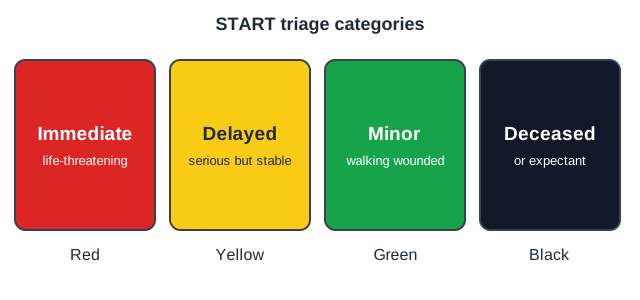
Immediate (red)
Delayed (yellow)
Minor (green)
Deceased or expectant (black)
If no breathing after opening the airway, the patient is tagged black in START; if breathing starts, immediate (red).
Which is the most accurate cooling choice for exertional heat stroke?
Sips of warm water only
Cold water immersion
Wrapping in blankets
A hot bath
Rapid cooling lowers mortality; the goal is to cool the body as fast as possible before transport.
Which burn requires emergency care even if it seems small?
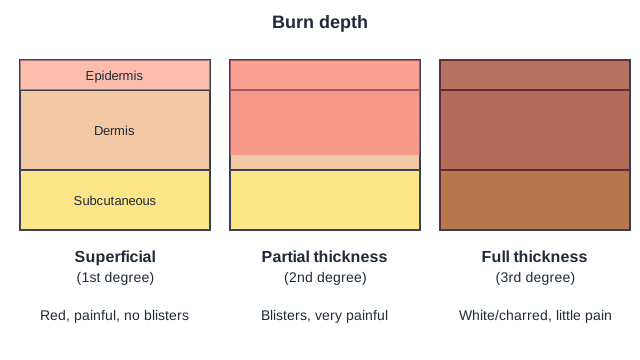
A small red sunburn on the shoulder
A single small blister from a hot pan
A circumferential burn to the hand with white, leathery skin
A mild red burn on the forearm
Full-thickness burns or burns on hands, face, feet, genitals or over joints need emergency treatment.
A person has a suspected overdose, is unresponsive and breathing slowly with pinpoint pupils. Priority actions?
Call 911, give naloxone, support breathing
Induce vomiting
Walk them around
Give coffee
These are opioid toxicity signs; naloxone reverses respiratory depression. Vomiting risks aspiration.
