Quiz · Hard
Multi-step pharmacokinetics problems and clinical scenarios on clearance, loading doses, CYP interactions and concentration-time graphs.
A 400 mg IV bolus produces an extrapolated initial plasma concentration of 8 mg/L. What is the volume of distribution?
50 L
3.2 L
32 L
0.02 L
Vd = Dose / C0 = 400 / 8 = 50 L. The other numbers come from inverting or mis-scaling the equation.
A drug has Vd 70 L and clearance 7 L/h. What is its half-life?
About 0.1 hours
About 10 hours
About 6.9 hours
About 48.5 hours
t1/2 = 0.693 x Vd / CL = 0.693 x 70 / 7 = 6.93 h. 10 h is simply Vd/CL (the mean residence time-like ratio) without the 0.693.
A drug is infused at 100 mg/h with clearance 4 L/h. What is the steady-state concentration?
0.04 mg/L
400 mg/L
25 mg/L
96 mg/L
Css = rate / CL = 100 / 4 = 25 mg/L. Inverting the ratio gives 0.04.
The target concentration is 12 mg/L, Vd is 35 L and F is 0.7. What oral loading dose is needed?
294 mg
420 mg
840 mg
600 mg
Loading dose = (C x Vd) / F = (12 x 35) / 0.7 = 600 mg. 420 mg forgets to divide by F.
Renal function falls and clearance of a renally cleared drug is halved. Which change is expected at the same maintenance dose?
Css halves and half-life halves
Css doubles but half-life stays the same
Css is unchanged because the dose is the same
Css doubles and half-life roughly doubles
Css = rate/CL, so halving CL doubles Css. t1/2 = 0.693 Vd/CL also doubles if Vd is unchanged.
Which change would NOT shorten the time to reach steady state?
Doubling the dose
Using a drug with a shorter half-life
Increasing the drug's clearance
Decreasing the volume of distribution
Time to steady state depends only on t1/2 (about 4 to 5 half-lives). Doubling the dose doubles Css but not the time to reach it.
A patient on warfarin starts rifampin. What is the expected interaction?
Higher INR because rifampin inhibits CYP2C9
Higher INR because rifampin displaces warfarin from albumin
Lower INR because CYP induction accelerates warfarin metabolism
No interaction because they use different organs
Rifampin is a broad CYP inducer, so warfarin's anticoagulant effect falls over days to weeks. The effect is slower than inhibition.
A patient stable on digoxin starts verapamil and develops nausea and visual changes. Which mechanism is most likely?
Inhibition of P-glycoprotein reduces digoxin efflux and clearance
CYP3A4 induction increases digoxin metabolism
Increased protein binding of digoxin
Reduced absorption of digoxin from the gut
Verapamil inhibits P-gp, raising digoxin levels and toxicity. Digoxin is mostly renally excreted, not CYP-metabolized.
Which statement correctly differentiates a high-extraction drug from a low-extraction drug?
High-extraction drug clearance depends mainly on protein binding
Low-extraction drugs have high first-pass loss
High-extraction drug clearance depends mainly on hepatic blood flow
High-extraction drugs are unaffected by liver blood flow changes
Propranolol and lidocaine are cleared as fast as the liver receives them. Low-extraction drugs (warfarin, phenytoin) depend on enzyme activity and binding.
A semi-log plot of plasma concentration after an IV bolus shows a steep early decline followed by a straight, shallower line. The straight line represents:
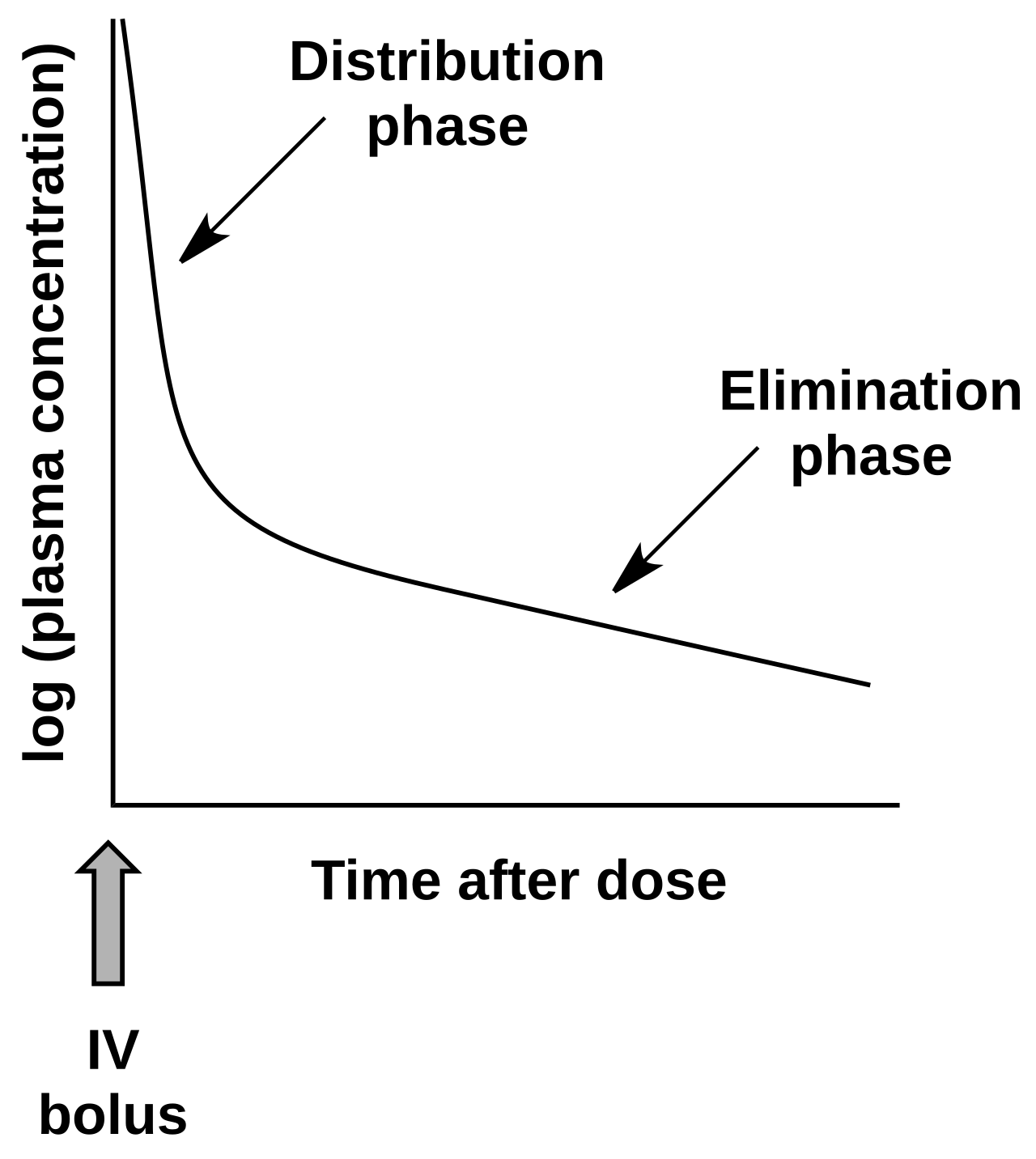
The elimination phase with first-order kinetics
The absorption phase
Saturation of elimination
The distribution phase
The early steep phase is distribution; the later straight line on a log axis is first-order elimination. Image: Boghog, CC BY-SA 3.0, via Wikimedia Commons.
Two drugs have the same dose and AUC but Drug B has a later and lower peak. Which explanation fits?
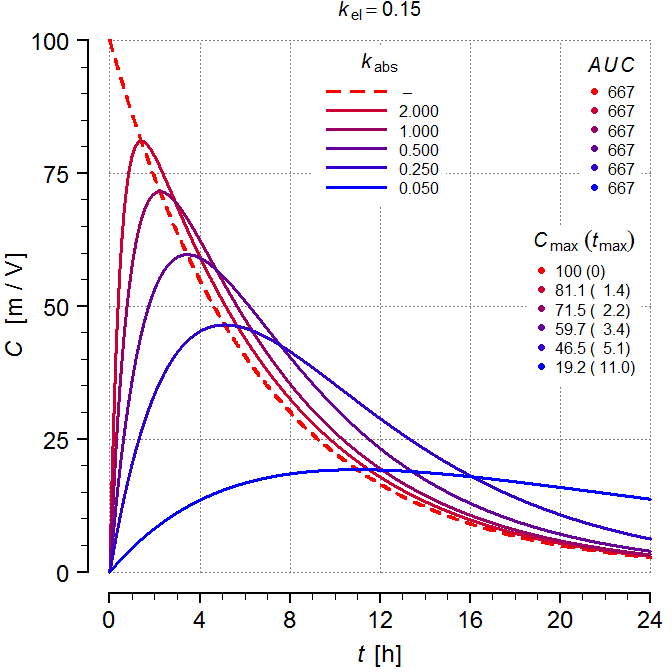
Drug B is absorbed more slowly
Drug B has lower bioavailability
Drug B has a larger clearance
Drug B was given IV
Same AUC means the same extent of absorption (F) and clearance. A slower absorption rate lowers Cmax and delays Tmax. Image: Alfie (Helmut Schütz), CC BY 4.0, via Wikimedia Commons.
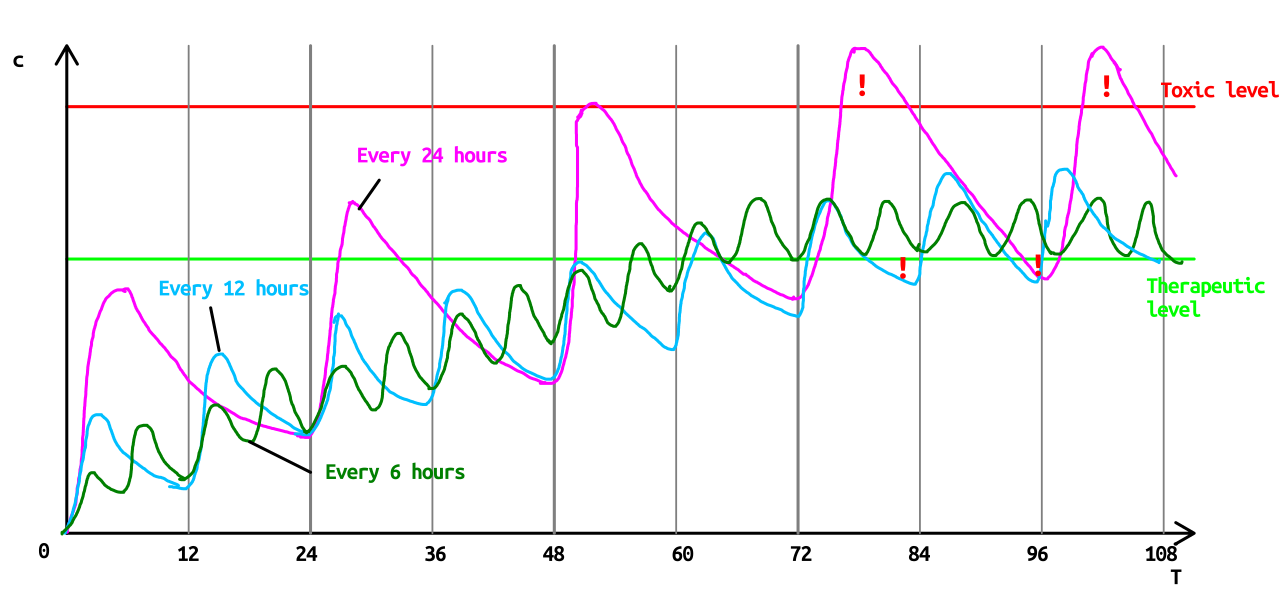
This graph shows 12-hourly and 24-hourly dosing of the same total daily dose. Which statement is true?
Both regimens reach steady state faster with larger doses
The 6-hourly regimen has the highest peaks
Dosing frequency changes the average steady-state concentration
The 24-hour regimen has larger peaks and deeper troughs, raising both toxicity and sub-therapeutic risk
Average Css depends on total dose rate and clearance. Interval changes only swing. Image: Jan Štěch, CC BY 4.0, via Wikimedia Commons.
An elderly patient with low albumin takes a highly protein-bound drug. Which finding is expected?
Higher free fraction at the same total concentration, so toxicity can occur at normal total levels
Lower free fraction
Reduced Vd for all drugs
Higher total concentration with unchanged free fraction
With less binding protein the unbound fraction rises. Total level assays can look normal while free drug is high (phenytoin is a classic example).
Which pairing of overdose and urinary pH manipulation is correct?
Aspirin overdose: acidify the urine with ammonium chloride
Phenobarbital overdose: acidify the urine
Aspirin overdose: alkalinize the urine with sodium bicarbonate
Morphine overdose: alkalinize the urine
Alkaline urine ionizes and traps weak acids (aspirin, phenobarbital). Acidifying would make them more reabsorbable. Morphine overdose is treated with naloxone, not by pH manipulation.
A child on codeine has respiratory depression. Which pharmacogenetic factor is most likely?
CYP2C19 poor metabolizer
CYP2D6 ultra-rapid metabolizer converting codeine to excess morphine
NAT2 slow acetylator
Pseudocholinesterase deficiency
CYP2D6 converts the prodrug codeine to morphine. Ultra-rapid status produces high morphine levels. Poor metabolizers get little analgesia.
A patient has a creatinine clearance of 30 mL/min. Which drug needs the biggest dose reduction in this setting?
Warfarin, which is cleared by hepatic CYP2C9
Diazepam, which is cleared by liver metabolism
Gentamicin, which is eliminated by glomerular filtration
Propranolol, a high-extraction hepatic drug
Renally cleared drugs (aminoglycosides, vancomycin, digoxin, lithium) accumulate. Hepatically cleared drugs are less affected by kidney function.
