Quiz · Medium
Terms, planes, muscle actions, contractions and levers.
Which plane divides the body into left and right halves?
Transverse
Oblique
Frontal
Sagittal
The sagittal plane gives left/right halves. The frontal plane gives front/back halves; the transverse plane gives upper/lower halves.
Abduction of the arm at the shoulder takes place mainly in which plane?
Sagittal
Transverse
Frontal
Longitudinal
Abduction and adduction occur in the frontal plane, around a sagittal-horizontal axis.
A bicep curl occurs mainly in which plane and around which axis?
Sagittal plane, frontal axis
Transverse plane, longitudinal axis
Frontal plane, longitudinal axis
Frontal plane, sagittal axis
Flexion and extension happen in the sagittal plane around a frontal (medial-lateral) axis.
The wrist is ___ to the elbow.
Distal
Superior
Proximal
Medial
Distal means farther from the trunk. Proximal would be correct if the question were reversed.
During the lowering phase of a bicep curl, the biceps performs a(n):
Isokinetic contraction
Concentric contraction
Isometric contraction
Eccentric contraction
It lengthens while resisting gravity. Concentric would be lifting; isometric is holding without a change in length.
Which lever class does the diagram's panel C represent?
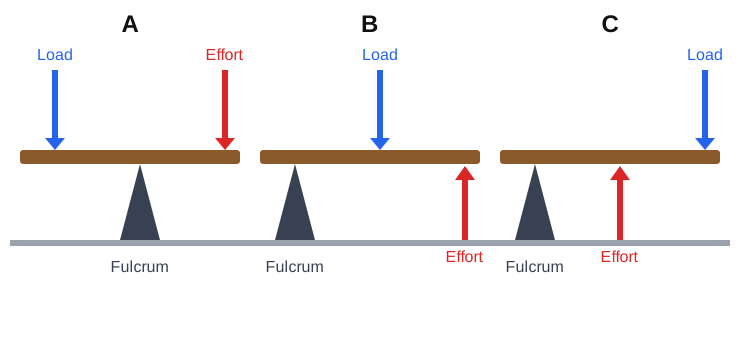
Third
Fourth
First
Second
The effort lies between the fulcrum and the load: a third-class lever, like a biceps curl.
Which lever class does the diagram's panel B represent?
First
Second
Third
It is not a lever
The load is between the fulcrum and the effort: second-class, e.g. calf raise.
The rotator cuff includes all of the following EXCEPT:
Supraspinatus
Teres major
Infraspinatus
Subscapularis
The four rotator cuff muscles are SITS: supraspinatus, infraspinatus, teres minor, subscapularis. Teres major is not part of it.
Which muscle is the primary hip extensor in sprinting and rising from a squat?
Sartorius
Rectus femoris
Gluteus maximus
Iliopsoas
Gluteus maximus is the major hip extensor. Rectus femoris is a knee extensor and hip flexor.
True or false: Henneman's size principle says the largest motor units are recruited first.
True
False
False. Smallest motor units are recruited first, then larger ones as force demand rises.
Which sensory receptor responds to muscle stretch and triggers the stretch reflex?
Free nerve ending
Golgi tendon organ
Muscle spindle
Pacinian corpuscle
The muscle spindle senses length and rate of stretch. The Golgi tendon organ senses tension.
A skater pulls her arms in during a spin and rotates faster. This is due to:
Newton's third law
Conservation of angular momentum
Magnus effect
Impulse
Reducing moment of inertia increases angular velocity because angular momentum stays constant.
Which is a closed kinetic chain exercise?
Seated knee flexion machine
Seated leg extension
Squat
Bicep curl
In a squat the feet are fixed on the ground. The others move the distal segment freely.
Which of these quantities is a vector?
Mass
Displacement
Distance
Speed
Displacement has magnitude and direction. Distance and speed are scalars.
Stable posture is best achieved with:
A high center of gravity and wide base
A moving line of gravity
A high center of gravity and narrow base
A low center of gravity and wide base
Lowering the center of gravity and widening the base of support increases stability.
What stage of motor learning is characterized by large errors and high conscious attention?
Cognitive
Retention
Autonomous
Associative
The cognitive stage is the earliest stage in the Fitts and Posner model.
Which practice schedule usually gives better long-term retention?
Random
Massed only
No practice
Blocked
Random practice (contextual interference) slows acquisition but improves retention and transfer.
Calf raises plantarflex the ankle. Which muscles are the prime movers?
Gastrocnemius and soleus
Quadriceps
Hamstrings
Tibialis anterior and fibularis tertius
The triceps surae (gastrocnemius and soleus) produce plantarflexion; tibialis anterior is the dorsiflexor.
Torque is calculated as:
Force x perpendicular distance
Mass x velocity
Work / time
Force / distance
Torque = force x moment arm. Mass x velocity is momentum.
