Quiz · Medium
Twenty basic dosage calculation questions: tablets, liquids, injections, weight-based doses, conversions, IV rates and syringe selection.
A patient weighs 176 lb. What is the weight in kg?
176 kg
387 kg
90 kg
80 kg
kg. Multiplying by 2.2 (as if converting kg to lb) gives 387.
Order: 750 mg PO. Available: 250 mg tablets. How many tablets?
3 tablets
2 tablets
1/3 tablet
4 tablets
. Dividing the other way (250/750) gives 0.33, a common inversion error.
Convert 0.2 mg to micrograms.
0.2 mcg
2,000 mcg
20 mcg
200 mcg
1 mg = 1000 mcg, so mcg. Moving the decimal the wrong way gives 0.0002 or 2,000.
Order: 250 mg PO. Stock: 125 mg per 5 mL. How many mL?
5 mL
2.5 mL
10 mL
25 mL
mL.
Order: 1,000 mL over 8 hours by pump. What rate?
100 mL/h
125 mL/h
150 mL/h
80 mL/h
mL/h.
Order: 20 mg/kg for a child weighing 15 kg. How many mg?
300 mg
35 mg
30 mg
0.75 mg
mg. Adding rather than multiplying gives 35.
Order: 1,000 mL over 8 hours by gravity. Drop factor 15 gtt/mL. How many gtt/min?
16 gtt/min
125 gtt/min
31 gtt/min
42 gtt/min
, so 31 gtt/min. 125 is the mL/h rate, not the drip rate.
Heparin 25,000 units in 500 mL. Order: 1,000 units/h. What pump rate?
50 mL/h
20 mL/h
10 mL/h
25 mL/h
Concentration: 25,000/500 = 50 units/mL. Rate: mL/h.
Order: 2.5 mg IV. Stock: 5 mg per mL. How many mL?
0.5 mL
0.25 mL
5 mL
2 mL
mL.
How many mL are in 3 teaspoons?
10 mL
3 mL
30 mL
15 mL
1 teaspoon = 5 mL, so 3 teaspoons = 15 mL (1 tablespoon).
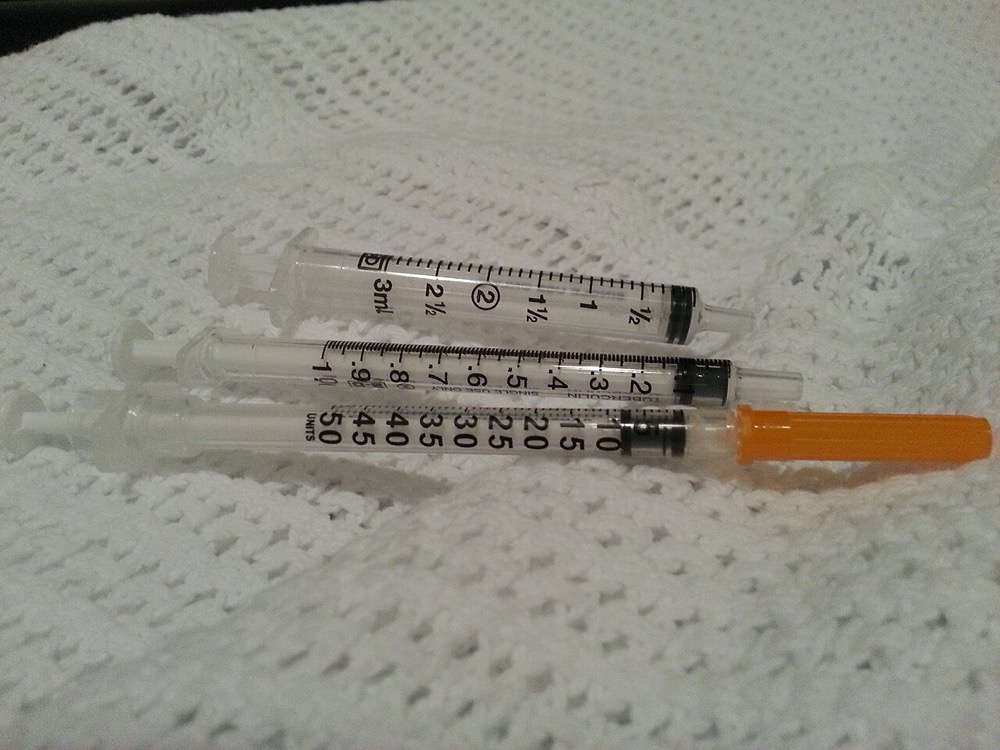
Which syringe is the safest choice to draw up 12 units of U-100 insulin?
An oral syringe
A 1 mL tuberculin syringe marked in mL
A low-dose insulin syringe marked in units
A 3 mL syringe
Insulin syringes are marked in units, so there is no conversion to get wrong. Tuberculin and 3 mL syringes are marked in mL, which risks confusing units with mL.
Image: Bron766, CC BY-SA 3.0, via Wikimedia Commons.
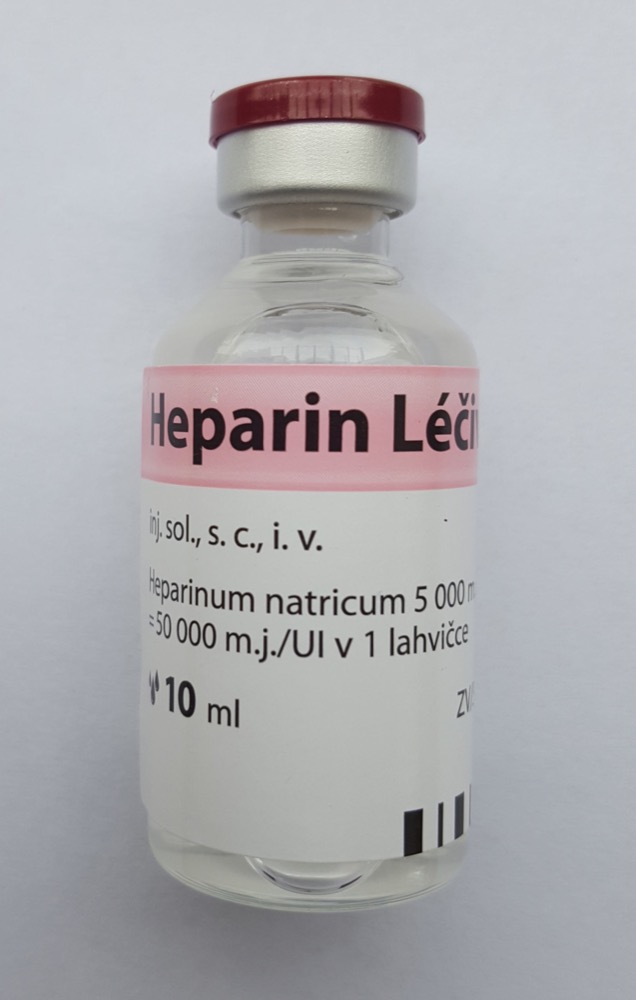
The heparin vial label shows 5,000 units per mL. The order is 6,000 units. How many mL?
1.5 mL
1.2 mL
0.83 mL
12 mL
mL. Inverting gives 0.83.
Image: Wesalius, CC BY 4.0, via Wikimedia Commons.
Convert 0.5 g to mg.
500 mg
50 mg
5,000 mg
0.0005 mg
1 g = 1000 mg, so mg.
Order: digoxin 0.125 mg. Available: 0.25 mg tablets. How many tablets?
1/4 tablet
2 tablets
1 tablet
1/2 tablet
, so half a (scored) tablet.
Order: epinephrine 0.5 mg IM from a 1:1000 ampule. How many mL?
5 mL
1 mL
0.5 mL
0.05 mL
1:1000 = 1 mg/mL, so 0.5 mg = 0.5 mL.
Order: 250 mL over 2 hours. What is the pump rate?
500 mL/h
125 mL/h
250 mL/h
62.5 mL/h
mL/h.
A microdrip set (60 gtt/mL) is used at 40 mL/h. How many gtt/min?
40 gtt/min
60 gtt/min
20 gtt/min
2,400 gtt/min
With a 60 gtt/mL set, gtt/min equals mL/h.
A 500 mL bag is running at 100 mL/h. How long will it last?
4 hours
50 minutes
6 hours
5 hours
hours.
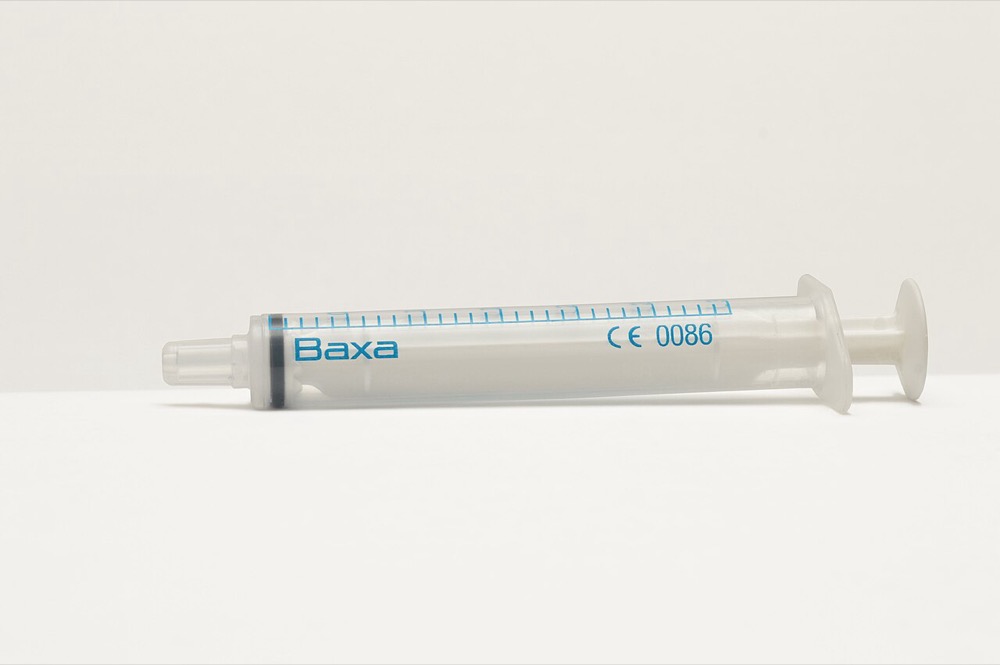
Why are oral syringes used for oral liquids in infants?
They can be used with needles
They are cheaper
They measure small volumes accurately and cannot be connected to IV lines
They are sterile like IV syringes
Oral syringes have a tip that does not fit IV connectors, preventing wrong-route errors, and measure small doses better than spoons or cups.
Image: 多多123, CC BY 4.0, via Wikimedia Commons.
Which is the correct way to write five tenths of a milligram?
5.0 mg
0.5 mg
0.50 mg
.5 mg
Use a leading zero and no trailing zero: '.5 mg' can be misread as 5 mg and '0.50' or '5.0' can be misread as 50 mg.
