Quiz · Medium
Mixed questions on planet facts, photos, Moon phases and eclipses, small bodies and basic orbit calculations.
Which planet has a day (one rotation) that is longer than its year?
Venus
Uranus
Mars
Mercury
Venus rotates once every 243 Earth days but orbits the Sun in 225. Mercury's day (59 Earth days) is shorter than its 88-day year, though its solar day (176 Earth days) is longer than its year, a common trap.
Why is Venus hotter than Mercury?
It rotates faster, producing friction heat
A dense CO2 atmosphere causes a runaway greenhouse effect
Its volcanoes heat the surface
It is closer to the Sun
Venus is about twice as far from the Sun as Mercury is, but its thick CO2 atmosphere traps heat. Mercury has almost no atmosphere and cools sharply at night.
Which statement about the Great Red Spot is correct?
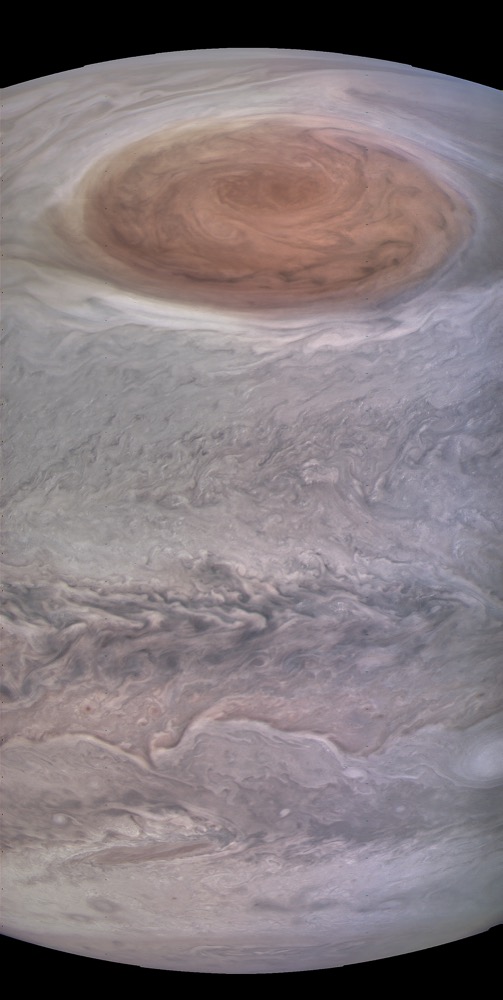
It is a volcano on Jupiter's surface
It is a permanent mountain range in Jupiter's clouds
It is a storm that has lasted for at least 150 years and has been shrinking
It is a hole in Jupiter's atmosphere revealing the solid surface
Jupiter has no solid surface; the spot is a giant anticyclone. It is wider than Earth but has been getting smaller.
Uranus appears blue-green because its upper atmosphere contains methane, which
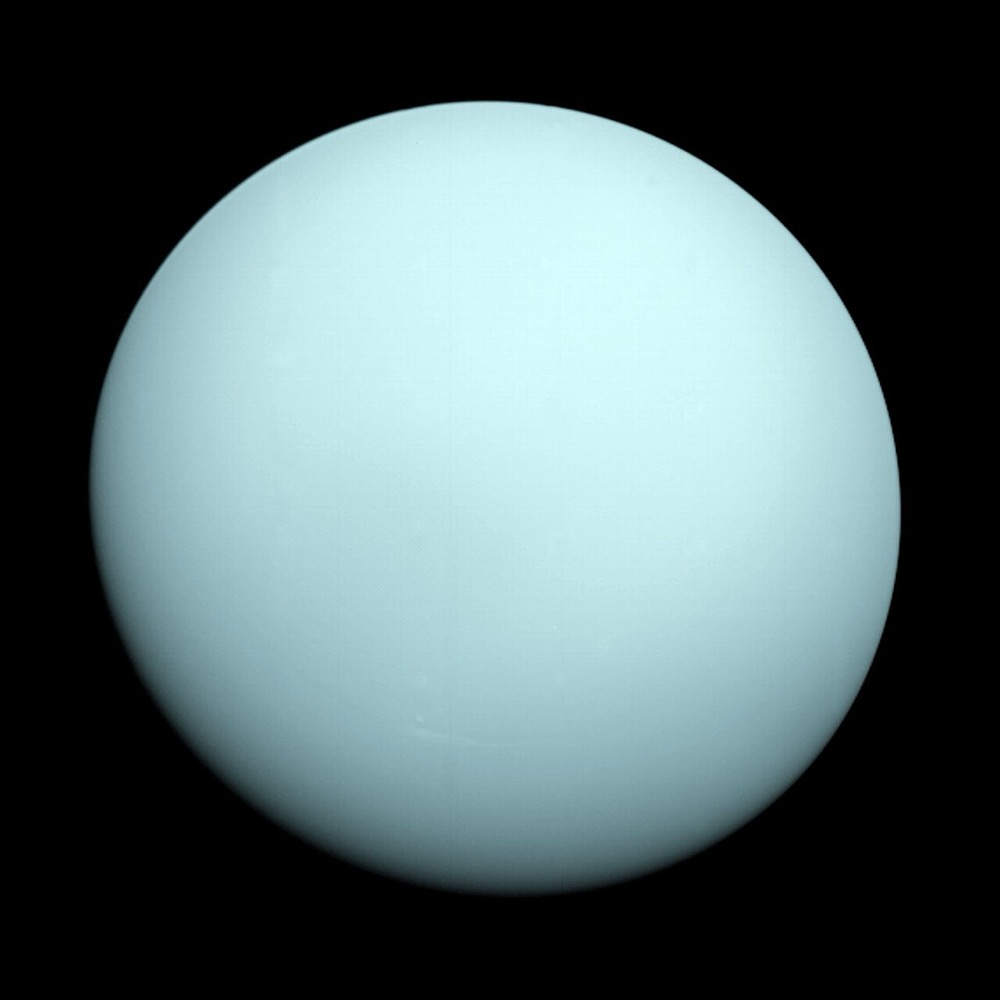
absorbs red light
scatters light like Earth's oceans do
glows from internal heat
emits blue light
Methane absorbs red wavelengths and the remaining blue-green light is reflected back. Uranus is also tilted about 98 degrees.
This image shows the largest known volcano in the solar system. On which body is it?
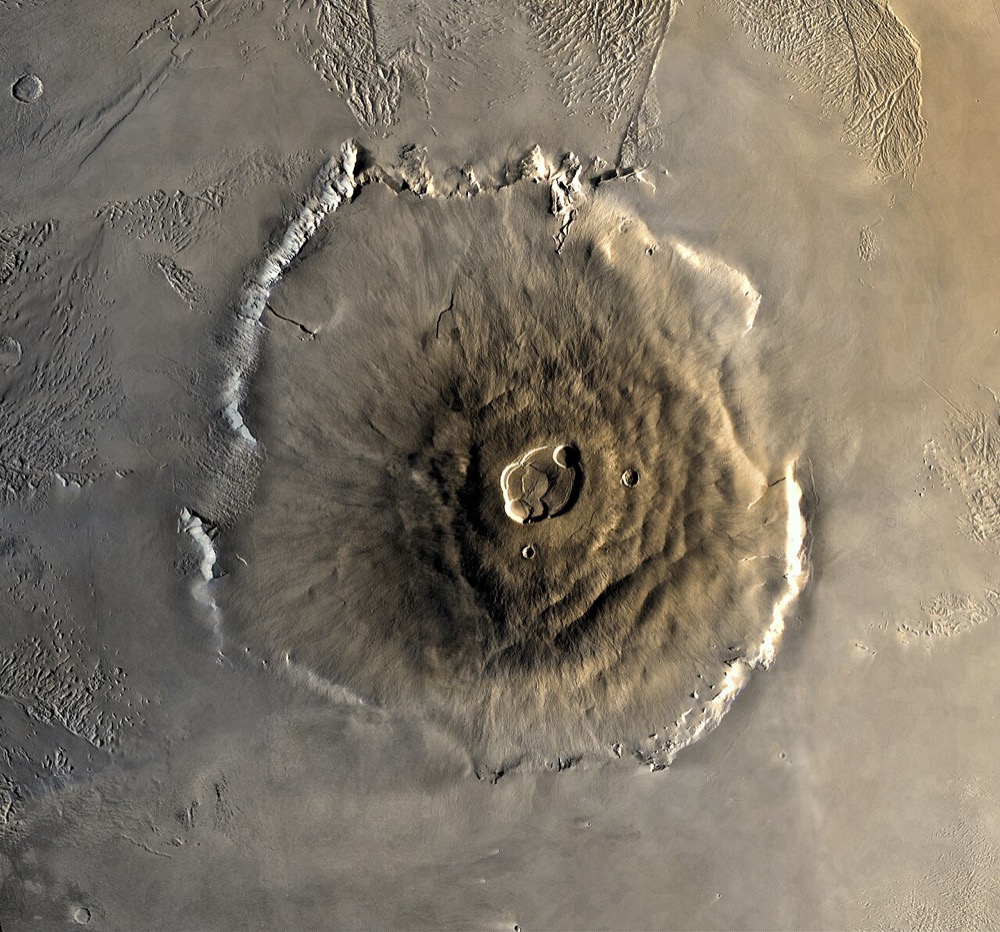
Mars
Venus
Io
Earth
Olympus Mons on Mars is about 22 km high. Io has the most active volcanoes, but not the tallest; Earth's Mauna Kea, measured from the seafloor, is far smaller.
Which moon is the largest in the solar system?
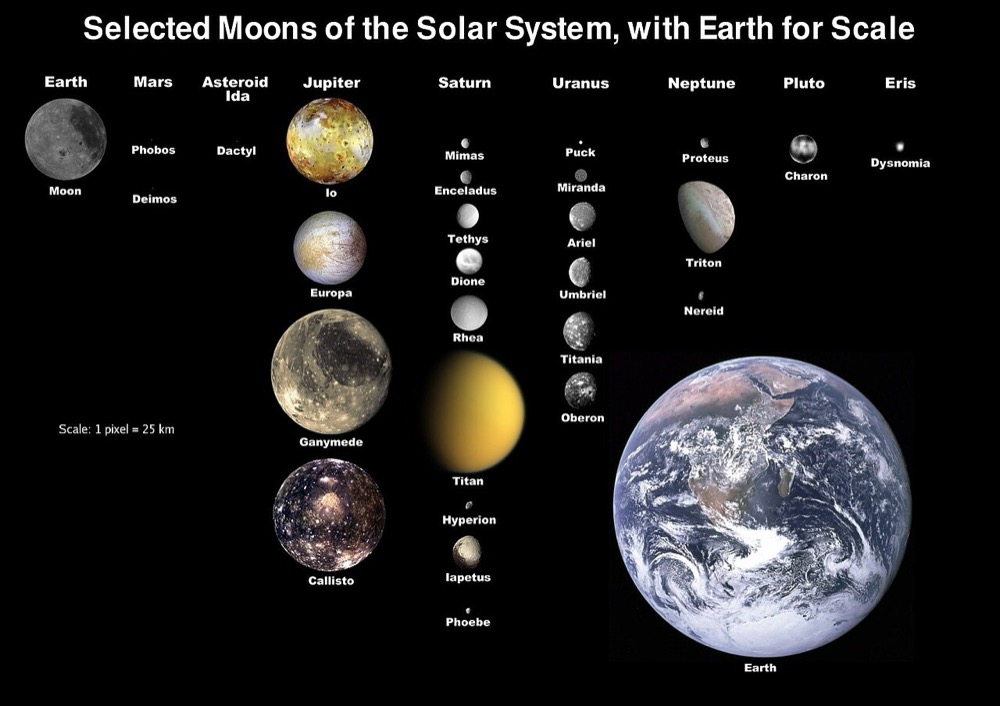
Earth's Moon
Callisto
Ganymede
Titan
Ganymede (Jupiter) is larger than Mercury by diameter. Titan is second, followed by Callisto; our Moon is fifth.
During a total solar eclipse, the Moon is at which phase?
New Moon
First Quarter
Full Moon
Last Quarter
The Moon must be between the Sun and Earth, so its lit side faces away from us: New Moon. The reverse geometry, with Earth in the middle, produces a lunar eclipse at Full Moon.
Why does a solar eclipse not happen at every New Moon?
The Moon's orbit is tilted about 5 degrees to Earth's orbit
Earth's shadow blocks the Moon
The Moon is too small to cover the Sun
The Moon only moves between Earth and Sun every 6 months by chance
At most New Moons the Moon passes slightly above or below the Sun-Earth line. Eclipses happen only near the nodes where the orbits cross.
In the image, what causes the glowing halo seen around the Moon during totality?
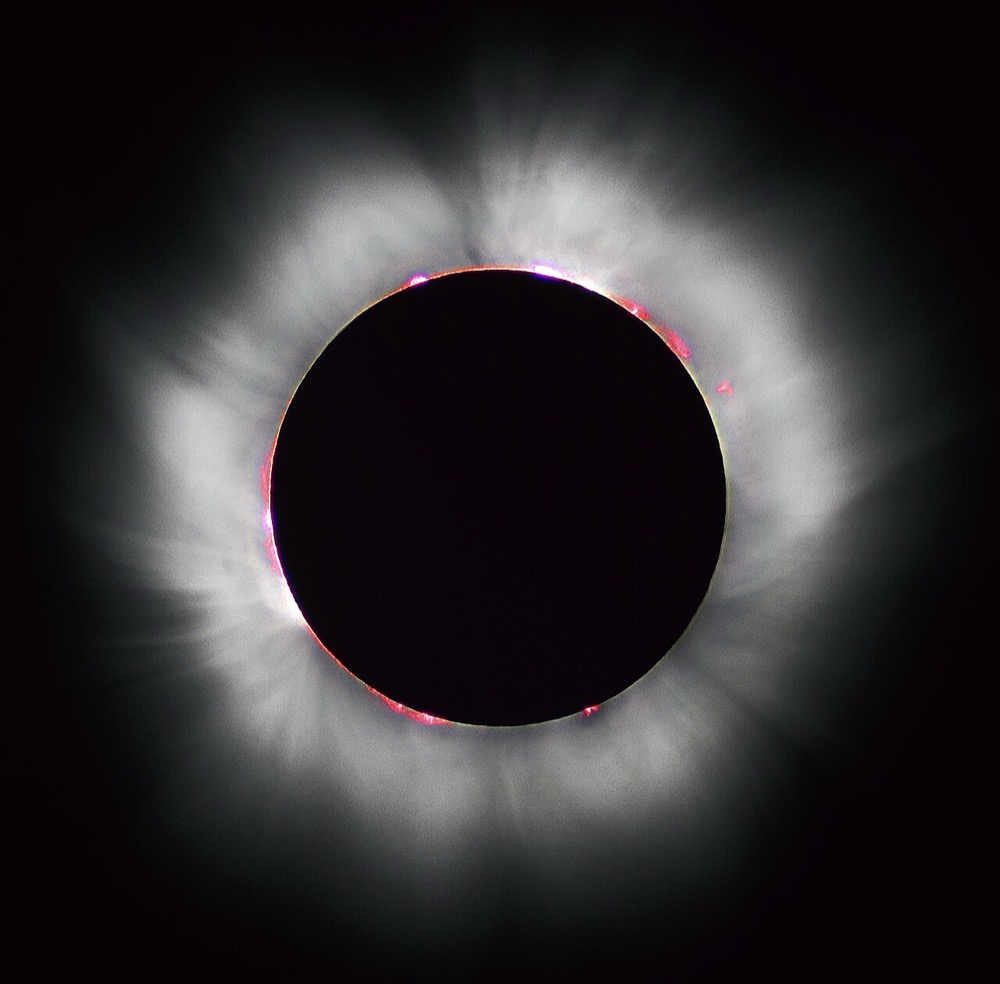
The Sun's corona, its outer atmosphere
The Sun's photosphere
Light reflected from the Moon's surface
Earth's atmosphere scattering sunlight
The corona is very hot but extremely faint, visible only when the bright photosphere is blocked.
Image: Luc Viatour, CC BY-SA 3.0, via Wikimedia Commons.
Spring tides, the largest tidal range, occur when
it is spring in the Northern Hemisphere
the Moon is at First or Last Quarter
the Moon is at apogee only
the Moon is at New or Full phase
At New and Full Moon the Sun and Moon pull along the same line and their tides add. At the quarters they partly cancel, producing neap tides.
A planet has an orbital semi-major axis of 9 AU. What is its orbital period according to Kepler's third law?
27 years
18 years
3 years
81 years
T^2 = a^3, so T = sqrt(9^3) = sqrt(729) = 27 years. Squaring the distance (81) is the tempting error; doubling it (18) ignores the power law.
A comet is moving away from the Sun. In which direction does its ion tail point?
Away from the Sun
Toward the planet it will pass next
Toward the Sun
Behind the comet along its path
The solar wind blows the ion tail directly away from the Sun regardless of the comet's direction of travel, so on the outbound leg the tail leads the comet.
Which region is the source of long-period comets?
Jupiter's Trojan points
The asteroid belt
The Oort Cloud
The Kuiper Belt
Long-period comets arrive from all directions, which suggests a spherical shell: the Oort Cloud. The Kuiper Belt is a flattened disk near the planetary plane and supplies short-period comets.
Which of these is NOT one of the IAU's three criteria for a planet?
It has cleared its orbital neighborhood
It orbits the Sun
It is massive enough to be nearly round
It has at least one moon
Mercury and Venus are planets and have no moons. Pluto fails the third criterion, which is why it is a dwarf planet.
An object streaks through the sky as a bright trail and burns up completely. It is called a
meteorite
meteor
comet
meteoroid
The light streak is the meteor. The rock in space beforehand is a meteoroid, and any remnant found on the ground is a meteorite.
The orbital speed of a planet in a near-circular orbit depends on
only the planet's radius
the planet's mass and the orbital distance
the Sun's mass and the planet's orbital distance
the Sun's brightness
v = sqrt(GM/r): it depends on the central mass M and orbital radius r. The orbiting body's own mass cancels out, which is why a feather and a satellite follow the same path at the same height.
Why is the Moon visible always showing the same face to Earth?
Its rotation period equals its orbital period (tidal locking)
Earth's gravity prevents it from spinning at all
The far side is permanently dark
It does not rotate
The Moon rotates, once every 27.3 days, exactly the time it takes to orbit. The far side gets sunlight; it is just never turned toward Earth.
Which planet was discovered by predicting its position mathematically before it was seen?
Uranus
Neptune
Saturn
Pluto
Le Verrier (and Adams) calculated Neptune's position from irregularities in Uranus's orbit; Galle found it in 1846. Uranus was discovered by chance by Herschel in 1781.
Earth is closest to the Sun during the Northern Hemisphere's summer, which is why summer is warm.
True
False
Earth is closest in early January (perihelion). Seasons are caused by the 23.4-degree axial tilt, not distance.
Which feature of the Sun produces the 11-year cycle seen in sunspot counts?
Variations in the Sun's distance from Earth
Changes in the rate of fusion in the core
The orbit of Jupiter around the Sun
Reversals and winding of its magnetic field
The cycle comes from the Sun's magnetic dynamo. The core's fusion rate is very steady over millions of years.
