Quiz · Hard
Fifteen applied questions on unstable rhythms, anticoagulation, tension pneumothorax, DKA, stroke, autonomic dysreflexia, compartment syndrome, burns and transfusion reactions.
A patient with unstable ventricular tachycardia (pulse present, BP 78/40, altered mental status) is on the monitor. What is the best treatment?
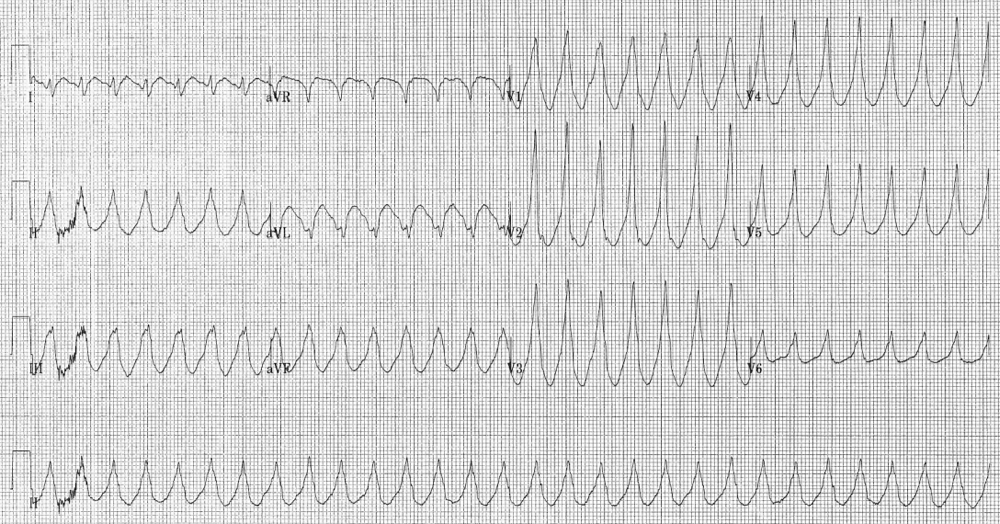
Synchronized cardioversion
Unsynchronized defibrillation
Amiodarone bolus and observe
Carotid sinus massage
Unstable tachycardia with a pulse needs immediate synchronized cardioversion. Unsynchronized shocks are for pulseless VT or VF. Sedate if time allows.
Image: Ksheka, CC BY-SA 2.5, via Wikimedia Commons.
A patient with atrial fibrillation for 3 days is scheduled for cardioversion. Which action by the nurse is most important?
Give a large meal
Withhold all medications
Verify the patient has had therapeutic anticoagulation for at least 3 weeks or a TEE excluded clot
Administer digoxin immediately before
Cardioversion can cause embolic stroke. The patient needs effective anticoagulation for 3 weeks beforehand (or a TEE) and 4 weeks afterward.
A patient with an acute inferior MI develops hypotension and clear lungs after nitroglycerin. Which finding suggests the cause?
Right ventricular involvement and preload dependence
Cardiac tamponade
Anaphylaxis
Pulmonary edema
Right ventricular infarct is preload-dependent. Nitrates drop preload and can cause severe hypotension; give IV fluids and avoid nitrates and diuretics.
A patient receiving warfarin has an INR of 5.2 and no bleeding. What is the most appropriate action?
Give protamine sulfate
Increase the warfarin dose
Hold warfarin and notify the provider; vitamin K may be ordered
Give the next dose as scheduled
INR is above target (2 to 3). Hold the drug, notify the provider and monitor for bleeding; vitamin K is the reversal agent (not protamine, which reverses heparin).
The nurse is caring for a patient with a chest tube. The tube is accidentally pulled out. What is the first action?
Send the patient for an x-ray immediately
Apply a sterile occlusive dressing to the site and notify the provider
Reinsert the tube
Clamp the tubing
Cover the opening right away with a sterile dressing and watch for respiratory distress; the provider must be notified. Do not reinsert the tube.
A patient develops sudden severe dyspnea, absent breath sounds on the right, tracheal deviation to the left, and BP 78/40. What is the priority?
Place the patient in Trendelenburg
Obtain a chest x-ray
Administer a bronchodilator
Prepare for immediate needle decompression
This is tension pneumothorax, a clinical diagnosis that needs immediate decompression. The trachea shifts away from the affected side.
A patient with an asthma exacerbation was wheezing audibly but now has no wheezing and very low air movement. What does the nurse do?
Document improvement
Recognize impending respiratory failure and call the rapid response team
Give a cough suppressant
Encourage rest
Silent chest signals near-complete obstruction. Prepare for intubation.
A patient with type 1 diabetes has glucose 580 mg/dL, pH 7.12, and Kussmaul respirations. The potassium is 3.1 mEq/L. What is the priority before starting insulin?
Give sodium bicarbonate
Start insulin right away
Give a high-dose glucose
Give potassium replacement
Insulin will lower K+ further and can cause fatal arrhythmias. With K+ below 3.3, hold insulin and replace potassium first, per protocol.
A patient with cirrhosis is confused and has asterixis. Which medication does the nurse expect to give?
Lorazepam
Furosemide
Lactulose
Morphine
Lactulose reduces ammonia absorption. Sedatives can worsen encephalopathy.
A patient with an acute ischemic stroke arrived 2 hours after symptom onset. CT shows no hemorrhage. What does the nurse expect?
Administer thrombolytic therapy if no contraindications
Give aspirin and send home
Order bed rest only
Start heparin infusion immediately
Eligible patients are treated with IV thrombolytic within 4.5 hours of last known well after hemorrhage is excluded. Anticoagulants are not started first.
A patient with a spinal cord injury at T4 suddenly has severe headache, BP 220/110, HR 48 and flushing above the injury. What is the first action?
Obtain a CT scan
Lay the patient flat
Sit the patient upright and check for a distended bladder or bowel
Give a sedative
This is autonomic dysreflexia. Raise the head to lower BP, remove the trigger (empty the bladder, check the bowel, loosen clothing), and notify the provider.
A patient with a fractured tibia reports pain unrelieved by opioids, with tense swollen calf, numbness and pain on passive toe movement. What should the nurse do?
Notify the provider immediately for suspected compartment syndrome
Loosen nothing and wait
Elevate the leg above the heart and apply ice
Give more opioid
Pain out of proportion and increased pain with passive stretch are early signs. Do not elevate above heart level or apply ice. Notify immediately because fasciotomy may be needed.
A 60 kg patient has 40% TBSA burns. Using the Parkland formula, how many mL of lactated Ringer's should be given in the first 8 hours?
9,600 mL
2,400 mL
1,200 mL
4,800 mL
in 24 hours; half (4,800 mL) is given in the first 8 hours from the time of the burn.
A patient who received a unit of packed red blood cells 10 minutes ago develops fever, chills and back pain. What should the nurse do first?
Slow the infusion and reassess in 15 minutes
Stop the transfusion and keep the IV open with 0.9% saline
Give acetaminophen and continue
Flush the line with D5W
Stop the transfusion and maintain IV access with new tubing and saline, then assess, notify the provider and blood bank, and send the bag and tubing.
After thyroidectomy the nurse notes the patient's neck dressing is saturated and the patient has noisy respirations. What is the priority?
Give pain medication
Offer ice chips
Change the dressing
Assess airway and call for help, preparing for emergency airway support
Neck hematoma can compress the trachea. Airway comes first; the surgeon and tracheostomy/intubation set are needed immediately.
