Quiz · Medium
Foundational questions on definitions, social determinants, prevention, behavior theories and health systems.
Which set lists the three core functions of public health?
Assessment, policy development, assurance
Prevention, treatment, rehabilitation
Surveillance, vaccination, education
Diagnosis, therapy, follow-up
The 1988 IOM report defined assessment, policy development and assurance. The other lists are levels of care or program activities.
Which of the following is a social determinant of health?
Blood pressure
Genetic variants in a single patient
Neighborhood safety and housing quality
A hospital's bed count
Social determinants are conditions of daily life. Blood pressure and genetics are individual biological factors.
A city adds bike lanes and parks to encourage activity. At which level of the socio-ecological model is this mainly working?
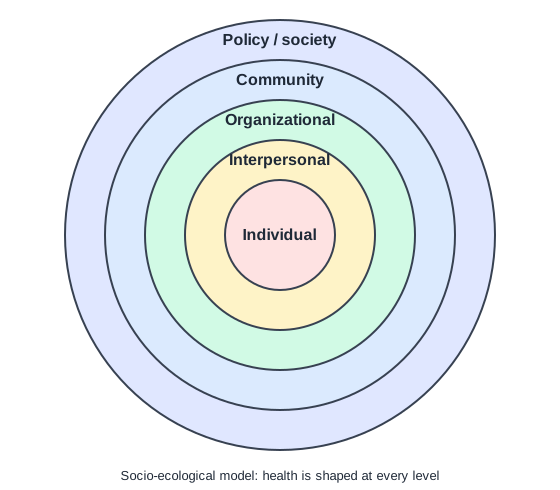
Community / built environment
Individual
Interpersonal
Policy only, never community
Changing the physical environment targets the community level, though policy decisions made it possible.
Giving every school the same funding regardless of need is an example of:
Equity
Equality, not necessarily equity
Primary prevention
Harm reduction
Equity would give more resources to schools with greater need so that outcomes become fair.
Which scenario is tertiary prevention?
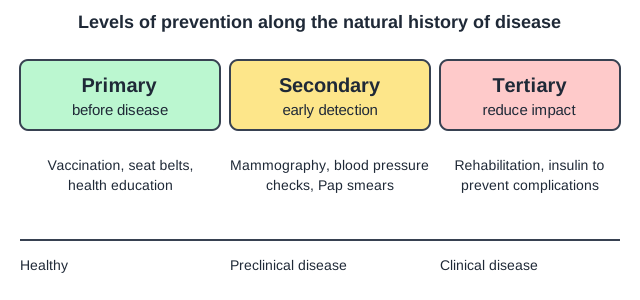
Smoking cessation education for teens
Blood pressure screening at a fair
Childhood immunization
Physical therapy after a stroke
Tertiary prevention limits disability from established disease. Immunization is primary; screening is secondary.
A person says, 'I know diabetes is serious and I could get it, but the diet changes are too hard.' Which Health Belief Model construct is being described as the obstacle?
Perceived barriers
Perceived susceptibility
Cues to action
Perceived severity
They already perceive susceptibility and severity; the difficulty of changing diet is a perceived barrier.
In the Transtheoretical Model, someone who has been exercising regularly for more than 6 months is in the:
Action stage
Preparation stage
Maintenance stage
Contemplation stage
Action covers the first six months of new behavior; after that, maintenance focuses on preventing relapse.
Medicaid differs from Medicare mainly because Medicaid:
Is only for people over 65
Is a joint federal-state program for low-income people
Is funded entirely by premiums
Is available only to veterans
Medicare is a federal program for 65+ and disabled people; Medicaid is means-tested and administered by states.
Which health system model funds care mainly through taxes with government providers, as in the UK NHS?
Beveridge
Bismarck
Out-of-pocket
National health insurance with private insurers only
Bismarck uses employer/employee sickness funds; Beveridge is tax-funded and government-run.
Under the hierarchy of controls, which is MOST effective for a workplace hazard?
Wearing respirators
Training workers
Posting warning signs
Eliminating the hazard
Elimination removes the hazard; PPE, training and signs rely on behavior and are less reliable.
Which agency was created in 1970 to set and enforce workplace safety standards?
EPA
OSHA
FDA
CMS
EPA (also 1970) handles environmental protection; FDA handles food and drugs.
Which statement about NCDs is correct?
They are the leading cause of death worldwide
They are caused mainly by infectious agents
They are only a problem in high-income countries
They have no shared risk factors
NCDs cause the majority of deaths globally and share risk factors like tobacco and diet; low- and middle-income countries carry most of the burden.
The Ottawa Charter (1986) is best known for defining:
Herd immunity
Health promotion
Primary care for all
Evidence-based medicine
Alma-Ata (1978) promoted primary health care; Ottawa addresses health promotion with five action areas.
What did Jacobson v. Massachusetts (1905) establish?
Individuals can never be required to vaccinate
Federal law bans quarantine
States may mandate vaccination under their police powers
Vaccines must be free
The Court upheld compulsory smallpox vaccination as a reasonable use of the state's police power.
DALY stands for:
Disability-adjusted life years
Death-adjusted life years
Disease and lifespan yield
Disability average life year
DALY = years of life lost plus years lived with disability.
Which disease has been declared eradicated in humans?
Polio
Measles
Malaria
Smallpox
Smallpox was declared eradicated in 1980. Polio is nearly gone from the world but still circulates in a few countries.
True or false: the WHO definition of health includes mental and social well-being, not just absence of disease.
True
False
True. The 1948 definition says 'a state of complete physical, mental and social well-being and not merely the absence of disease or infirmity'.
A smoke-free law is best described as which type of strategy?
High-risk individual strategy
Population-level, upstream intervention
Tertiary prevention
Downstream clinical treatment
It changes the environment for everyone rather than targeting only high-risk individuals, and it acts on causes rather than consequences.
Which pair is correctly matched?
Process evaluation: was the program delivered as planned?
Outcome evaluation: how many sessions were held?
Formative evaluation: did mortality fall after 10 years?
Impact evaluation: was the budget approved?
Counting sessions is process; long-term mortality is outcome; formative evaluation happens during program design.
Which action would be an 'upstream' intervention to reduce childhood asthma?
Prescribing inhalers in clinic
Treating emergency visits
Enforcing housing codes to reduce mold
Giving oral steroids during attacks
Upstream interventions target root causes in the environment. Inhalers, ER care and steroids are downstream treatments.
