Quiz · Medium
Core pharmacodynamics questions on receptor families, G proteins and agonist/antagonist behavior, including graph questions.
What is the term for rapid loss of response after repeated doses of a drug?
Potentiation
Synergism
Idiosyncrasy
Tachyphylaxis
Tachyphylaxis occurs over minutes to hours (e.g. receptor desensitization). Tolerance develops over days to weeks.
Which statement best defines pharmacodynamics?
The movement of a drug through the body
The effect of a drug on the body and its mechanism of action
The calculation of drug half-life
The study of drug formulation
PD = what the drug does to the body. Movement and half-life belong to pharmacokinetics.
Which receptor family produces the fastest response (milliseconds)?
G protein-coupled receptors
Nuclear receptors
Ligand-gated ion channels
Receptor tyrosine kinases
Ion channel receptors open directly (nicotinic, GABA-A). GPCRs act in seconds, RTKs in minutes, nuclear receptors in hours to days.
Which receptor is coupled to Gq?
Beta-1 adrenergic
Muscarinic M2
Alpha-1 adrenergic
Dopamine D2
Gq: alpha-1, M1, M3, H1, V1. Beta-1 is Gs and M2 and D2 are Gi.
Stimulation of a Gs-coupled receptor leads to which change?
Increased cAMP
Decreased cAMP
Increased IP3 only
Decreased calcium efflux
Gs activates adenylyl cyclase to raise cAMP. Gi lowers cAMP; Gq raises IP3/DAG.
Which drug class acts on intracellular (nuclear) receptors?
Beta agonists
Benzodiazepines
Local anesthetics
Corticosteroids and thyroid hormone
Lipophilic hormones cross membranes and alter gene transcription over hours to days. Benzodiazepines act on GABA-A channels.
A drug binds a receptor but produces only a submaximal response even at full occupancy. What is it?
Full agonist
Competitive antagonist
Partial agonist
Inverse agonist
Partial agonists have lower intrinsic activity. Full agonists reach Emax; competitive antagonists give no response alone.
Which drug is a partial agonist at the mu opioid receptor?
Morphine
Naloxone
Fentanyl
Buprenorphine
Buprenorphine is a partial agonist (ceiling effect). Morphine and fentanyl are full agonists; naloxone is an antagonist.
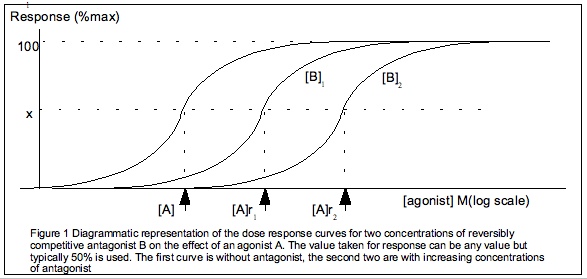
What does a competitive antagonist do to an agonist's dose-response curve?
Shifts it left
Lowers Emax and keeps EC50
Shifts it to the right without changing Emax
Increases Emax
Competition is surmountable with more agonist, so the maximum can still be reached. Irreversible antagonists lower Emax. Image: Dylan2106, CC BY-SA 4.0, via Wikimedia Commons.
Naloxone is given to a patient with opioid overdose. How does it act?
It irreversibly destroys opioid receptors
It competitively blocks mu receptors
It inhibits opioid metabolism
It binds the opioid in plasma
Naloxone has high affinity but no intrinsic activity at mu receptors and displaces opioids.
Epinephrine is used in anaphylaxis to counter histamine effects by acting on different receptors. What type of antagonism is this?
Competitive antagonism
Physiological antagonism
Chemical antagonism
Pharmacokinetic antagonism
Epinephrine does not bind histamine receptors; it produces opposite effects through adrenergic receptors.
Protamine reverses heparin by binding it directly. What type of antagonism is this?
Competitive
Physiological
Chemical antagonism
Noncompetitive
Protamine is positively charged and neutralizes heparin in plasma without receptors.
A patient on propranolol for years stops it suddenly and develops tachycardia and hypertension. Which mechanism explains this?
Beta-receptor downregulation
Drug-induced enzyme induction
Tachyphylaxis
Beta-receptor upregulation
Chronic antagonist exposure upregulates receptors, so withdrawal leaves unopposed sensitive receptors.
Which statement about an inverse agonist is correct?
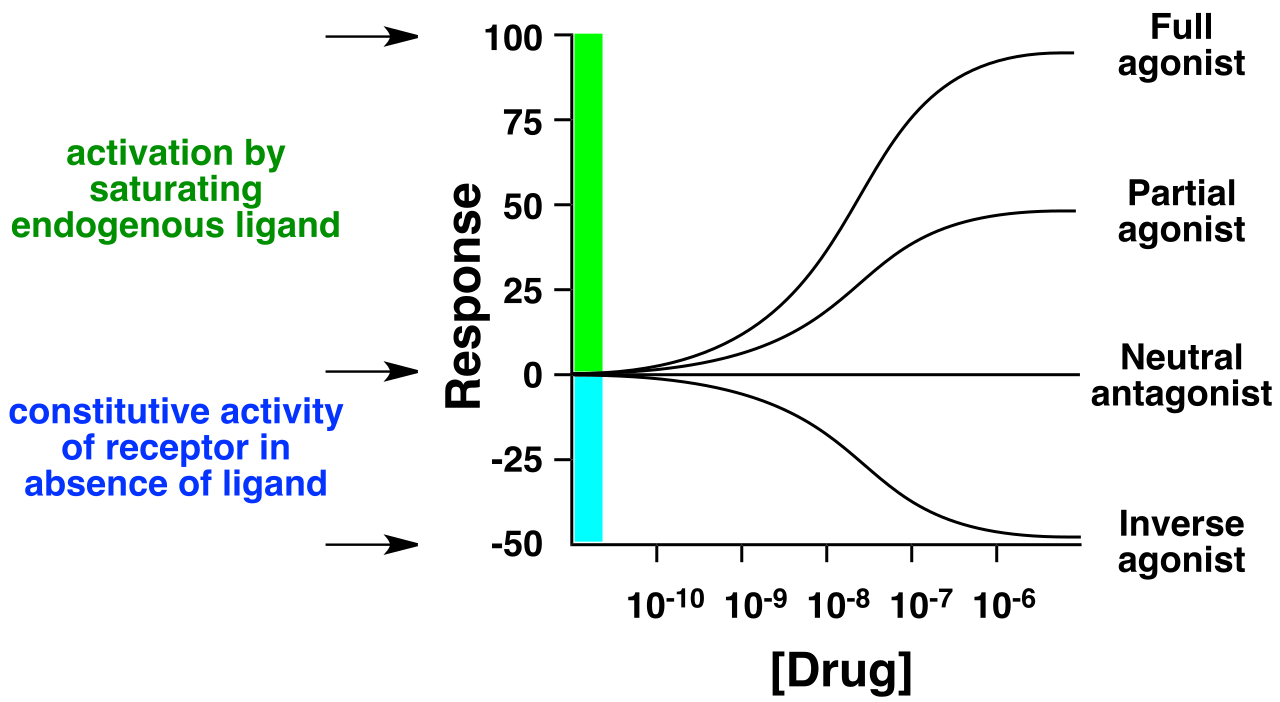
It reduces receptor activity below baseline
It produces no effect on constitutive activity
It acts only at intracellular receptors
It always has higher affinity than agonists
A neutral antagonist leaves baseline activity unchanged; an inverse agonist drops it below baseline. Image: Boghog, CC BY-SA 4.0, via Wikimedia Commons.
Which receptor type is activated by insulin?
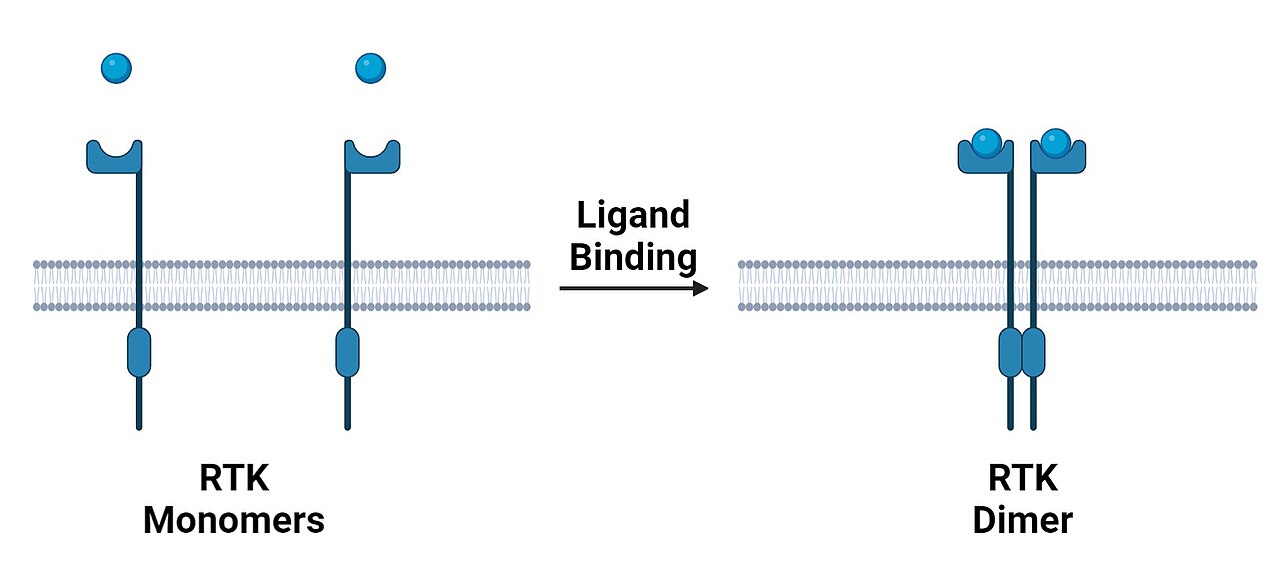
Receptor tyrosine kinase
G protein-coupled receptor
Ligand-gated ion channel
Nuclear receptor
Insulin binding causes RTK dimerization and autophosphorylation. Image: Mehakk12, CC BY-SA 4.0, via Wikimedia Commons.
Benzodiazepines act on which type of target?
A G protein-coupled receptor
A ligand-gated chloride channel (GABA-A) as positive allosteric modulators
A nuclear receptor
An enzyme
They increase the frequency of Cl- channel opening in the presence of GABA.
Which pair is correct for the effects of sildenafil with nitrates?
Both lower cAMP, causing bradycardia
Sildenafil blocks guanylyl cyclase, so nitrates fail
Both raise cGMP, risking profound hypotension
They are safe to combine because they act on different receptors
Nitrates raise cGMP via NO and guanylyl cyclase; sildenafil blocks PDE5, preventing cGMP breakdown. The combination is contraindicated.
Which statement about receptor reserve (spare receptors) is true?
A maximal response can occur with less than 100% receptor occupancy
Spare receptors always reduce the response
They are found only on nuclear receptors
They increase Kd
With receptor reserve an agonist's EC50 is lower than its Kd, so it appears more potent than its affinity suggests.
