Quiz · Medium
Calculation and concept questions on sensitivity, predictive values, NNT, bias, study design and tests, in the style of Step 1.
A new test has a sensitivity of 95% and specificity of 90%. What is the positive likelihood ratio?
9.5
1.05
0.5
19
LR+ = sensitivity/(1 - specificity) = 0.95/0.10 = 9.5.
Which prevention level is mammography screening?
Secondary prevention
Primary prevention
Quaternary prevention
Tertiary prevention
Screening detects disease early; vaccination is primary.
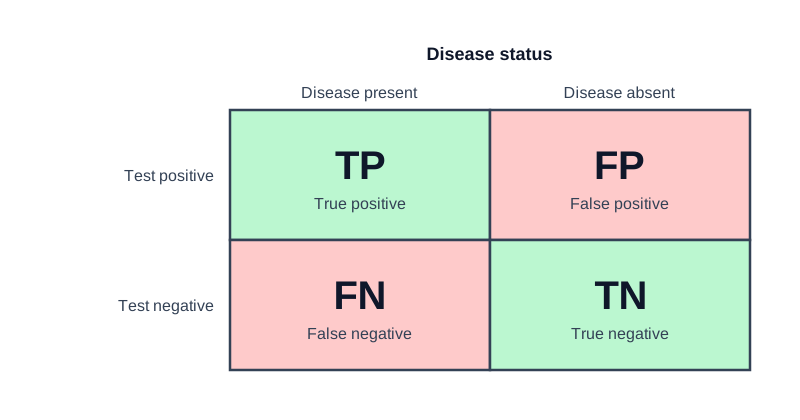
A screening test has 90 true positives, 10 false negatives, 20 false positives and 80 true negatives. What is its sensitivity?
80%
45%
90%
82%
Sensitivity = TP/(TP+FN) = 90/100. Specificity = 80/100 = 80%.
Using the same data (TP 90, FN 10, FP 20, TN 80), what is the positive predictive value?
82%
90%
47%
80%
PPV = TP/(TP+FP) = 90/110 = 82%.
A test is used for rapid screening to rule out a serious disease. Which characteristic is most important?
High positive predictive value
High sensitivity
High specificity
High prevalence
A negative result in a highly sensitive test effectively rules out disease (SNNOUT).
Prevalence of a disease in a population rises. Which statement is true?
PPV increases and NPV decreases
Sensitivity increases
Specificity decreases
Both PPV and NPV increase
Sensitivity and specificity are properties of the test. PPV rises and NPV falls with higher prevalence.
A new drug lowers the risk of stroke from 8% to 6%. What is the number needed to treat?
25
20
50
100
ARR = 2% = 0.02; NNT = 1/0.02 = 50.
Which study design is best for a rare disease with multiple exposures?
Randomized controlled trial
Cross-sectional study
Cohort study
Case-control study
Case-control starts with cases and finds controls, efficient for rare diseases; yields odds ratios.
Which measure is obtained from a case-control study?
Odds ratio
Incidence
Attributable risk
Relative risk
Because incidence cannot be calculated when sampling is based on disease status.
A screening program shows longer survival after diagnosis but no change in mortality. Which bias?
Berkson bias
Lead-time bias
Recall bias
Length-time bias
Earlier detection increases apparent survival time without changing the time of death.
In a study, patients with lung cancer recall more past asbestos exposure than controls do. Which bias is present?
Confounding
Observer bias
Selection bias
Recall bias
Cases search memory harder; this occurs mainly in case-control studies.
A study with 100 patients found no difference between two treatments (p = 0.20) though a true difference exists. What error?
Confounding
Selection bias
Type II error
Type I error
Failing to reject a false null hypothesis is a type II (beta) error; often due to low power.
A 95% confidence interval for a relative risk is 0.8 to 1.6. What can be concluded?
The sample size is large
The treatment is protective
The RR is significant at p less than 0.05
The result is not statistically significant
The interval includes 1.0, the null value for ratios.
Which statistical test compares the mean of a continuous variable among three groups?
Pearson correlation
Chi-square test
t-test
ANOVA
Use ANOVA for 3 or more groups; t-test for two.
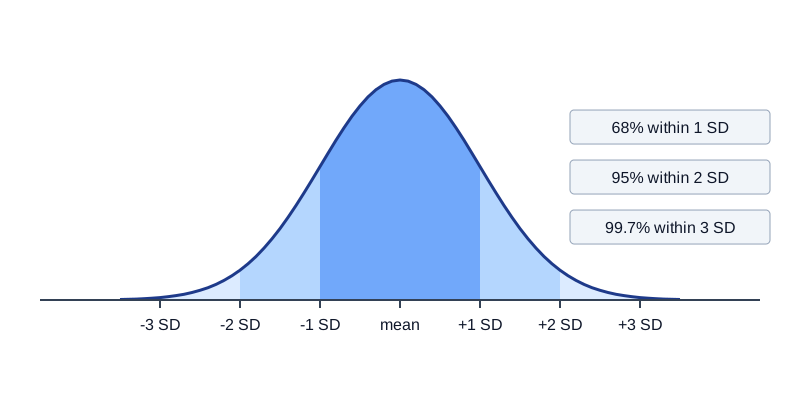
A normally distributed variable has a mean of 100 and an SD of 15. About what percent of values lie between 70 and 130?
99.7%
50%
95%
68%
70 and 130 are 2 SD from the mean; about 95% lie within 2 SD.
In a randomized trial some patients cross over and receive the other treatment. Which analysis preserves randomization?
As-treated
Intention-to-treat
Per-protocol
Subgroup analysis
Intention-to-treat analyzes patients in their originally assigned groups.
A drug trial tests safety in a small group of healthy volunteers. Which phase?
Phase 1
Phase 4
Phase 2
Phase 3
Phase 1: safety/pharmacokinetics; Phase 2: efficacy in patients.
Which describes the standard error of the mean?
Mean divided by SD
Variance divided by n squared
SD divided by the square root of n
SD multiplied by n
SEM decreases as sample size increases.
Which ethical principle is violated by performing a procedure without consent?
Justice
Beneficence only
Autonomy
Nonmaleficence only
Autonomy is the patient's right to decide; informed consent protects it.
Sensitivity changes as the prevalence of disease changes.
True
False
Sensitivity and specificity are intrinsic to the test; only the predictive values depend on prevalence.
