Quiz · Medium
Murmurs, signs, special tests, order of draw, consent, capacity and communication, for OSCEs and clerkships.
Which step comes second in SPIKES?
Perception (what does the patient know?)
Knowledge
Emotions
Strategy
Setting, Perception, Invitation, Knowledge, Emotions, Strategy.
Which abdominal region contains the cecum and appendix?
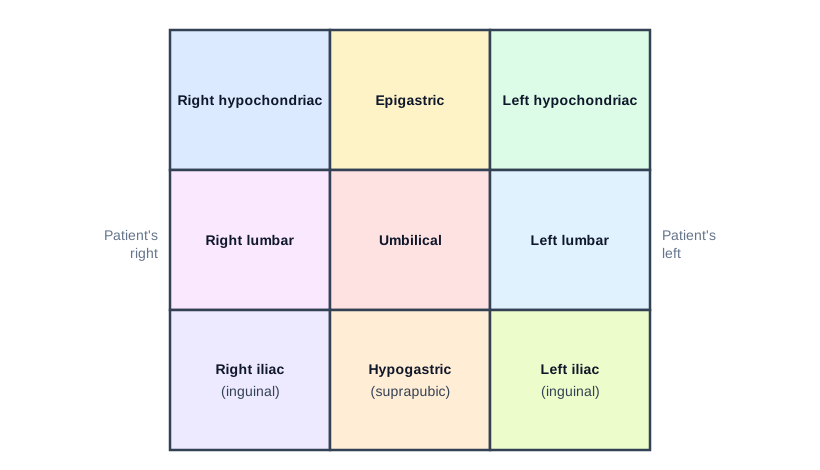
Right hypochondriac region
Right iliac (inguinal) region
Hypogastric region
Right lumbar region
McBurney point lies in the right iliac fossa, one-third from the ASIS to the umbilicus.
A murmur is heard best at the left lower sternal border, is holosystolic, and the patient is a child. Most likely?
Patent ductus arteriosus
Ventricular septal defect
Mitral stenosis
Aortic stenosis
VSD gives a harsh holosystolic murmur at the LLSB; PDA gives a continuous machinery murmur; AS is crescendo-decrescendo at the right upper sternal border.
Which examination technique most increases the murmur of hypertrophic cardiomyopathy?
Squatting
Passive leg raise
Valsalva maneuver
Handgrip
Decreasing preload (Valsalva, standing) increases the dynamic outflow obstruction; squatting and leg raise reduce it.
A patient has a systolic crescendo-decrescendo murmur that radiates to the carotids. Which maneuver makes it louder?
Standing quickly
Valsalva
Amyl nitrite
Squatting
Squatting increases venous return and afterload, which intensifies most murmurs including AS; HOCM and mitral valve prolapse are the exceptions.
Which sign suggests acute cholecystitis?
Rovsing sign
Murphy sign
Psoas sign
Cullen sign
Inspiratory arrest on right upper quadrant palpation.
A test in which pain in the RLQ is produced by palpating the LLQ is called:
Murphy sign
Rovsing sign
Obturator sign
Kehr sign
Referred pain on palpation of the opposite quadrant suggests appendicitis.
Which test evaluates the anterior cruciate ligament?
Valgus stress test
Lachman test
McMurray test
Thessaly test
Anterior translation of the tibia with the knee at 20-30 degrees of flexion.
Which of the following is the correct order of draw?
Green, red, blood culture, lavender
Red, lavender, light blue, green
Lavender, light blue, green, red
Blood culture, light blue, red or gold, green, lavender
This minimizes additive carryover. Blood cultures go first to maintain sterility.
The maximum safe dose of plain lidocaine is:
4.5 mg/kg
1 mg/kg
10 mg/kg
7 mg/kg
7 mg/kg is the limit with epinephrine.
A patient is told to sit with eyes closed and the examiner notes loss of balance only when eyes are closed. This is a positive:
Babinski sign
Romberg sign
Trendelenburg sign
Hoover sign
It indicates sensory (proprioceptive) ataxia.
Which patient lacks decision-making capacity?
One who makes a decision the physician disagrees with
One who refuses treatment based on religious belief
One who cannot appreciate that the illness applies to them
One who is a minor in all states
Capacity is about the decision-making process, not the outcome.
A 14-year-old requests testing for STI without parental knowledge. What is appropriate?
Refuse without parental consent
Call parents first
Test only with court order
Provide confidential care, as minors can consent for STI care in most states
Most states allow minors to consent to STI testing and treatment.
Who should interpret for a patient with limited English proficiency?
The patient's teenage child
Use hand gestures and cues
A qualified medical interpreter
A bilingual staff member who is available
Family members risk errors and breach confidentiality.
Which isolation is needed for a patient with suspected pulmonary tuberculosis?
Contact precautions
Droplet precautions
Airborne precautions with an N95 and a negative-pressure room
Standard precautions only
TB nuclei remain suspended in air.
Which murmur is best described as a mid-diastolic rumble following an opening snap?
Mitral valve prolapse
Mitral stenosis
Pulmonic stenosis
Aortic regurgitation
Rheumatic heart disease; associated with left atrial enlargement and AF.
Pulses in the leg are rated 0 to 4. A normal pulse is graded:
4
2
3
0
2+ is normal; 3 is increased and 4 is bounding.
In the nine-region scheme, which organ lies largely in the left hypochondriac region?
Gallbladder
Spleen
Appendix
Urinary bladder
Spleen is in the left upper quadrant, deep to ribs 9-11.
A patient has loss of the forehead sparing? No: a patient with left facial droop including the forehead and inability to close the left eye has what?
Left peripheral (lower motor neuron) facial palsy
Left central facial palsy
Right middle cerebral artery stroke
Trigeminal neuralgia
Forehead involvement indicates an LMN lesion.
A patient has a left facial droop that includes the forehead and cannot close the left eye. Which lesion?
Left central facial palsy
Trigeminal neuralgia
Right middle cerebral artery stroke
Left peripheral (lower motor neuron) facial palsy
Forehead involvement indicates a lesion of the facial nerve itself (Bell palsy) rather than cortical input.
Pulse oximetry accurately detects carbon monoxide poisoning.
True
False
It reads carboxyhemoglobin as oxyhemoglobin; use co-oximetry.
