Quiz · Hard
Continuity, Bernoulli, Torricelli, Venturi and Pitot calculations, Reynolds number, Poiseuille and Stokes laws, drag, surface tension, capillarity and lift, with diagram questions.
Water flows at 1.5 m/s in a 4.0 cm diameter pipe that narrows to 2.0 cm diameter. What is the speed in the narrow section?
12 m/s
3.0 m/s
6.0 m/s
0.75 m/s
Area scales as diameter squared, so the area ratio is 4 and m/s.
Water in a horizontal pipe speeds up from 2.0 m/s to 6.0 m/s in a constriction. By how much does the pressure fall?
4.0 kPa
16 kPa
32 kPa
64 kPa
kPa.
Water leaves a small hole 3.2 m below the surface of an open tank. What is the speed of the jet?
7.9 m/s
11 m/s
63 m/s
5.6 m/s
m/s.
In this Venturi tube, which statement is correct?
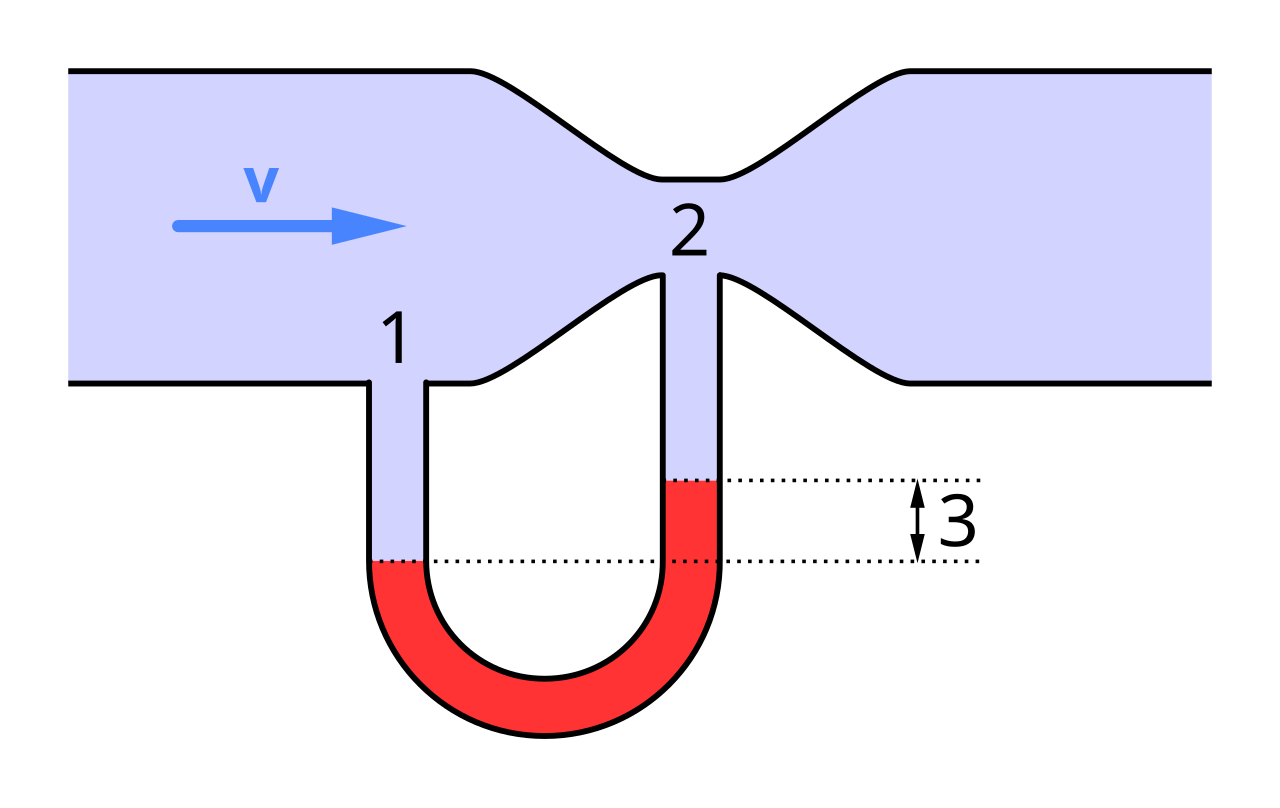
The pressure at point 2 is higher because the pipe is narrower
The pressure is equal at both points
The speed is lower at point 2
The pressure at point 2 is lower than at point 1 because the speed is higher
Continuity: narrower section, faster flow. Bernoulli: faster flow, lower pressure. Image: MikeRun, CC BY-SA 4.0, via Wikimedia Commons.
A Pitot tube measures a dynamic pressure of 800 Pa in air (1.2 kg/m³). What is the airspeed?
About 18 m/s
About 26 m/s
About 37 m/s
About 52 m/s
m/s.
Water (ρ = 1000 kg/m³, η = 1.0×10⁻³ Pa·s) flows at 2.0 m/s in a 5.0 cm diameter pipe. What is the Reynolds number and the flow type?
, turbulent
, turbulent
, laminar
, laminar
, well above 4000: turbulent.
Which of these pictures shows laminar flow in a pipe?
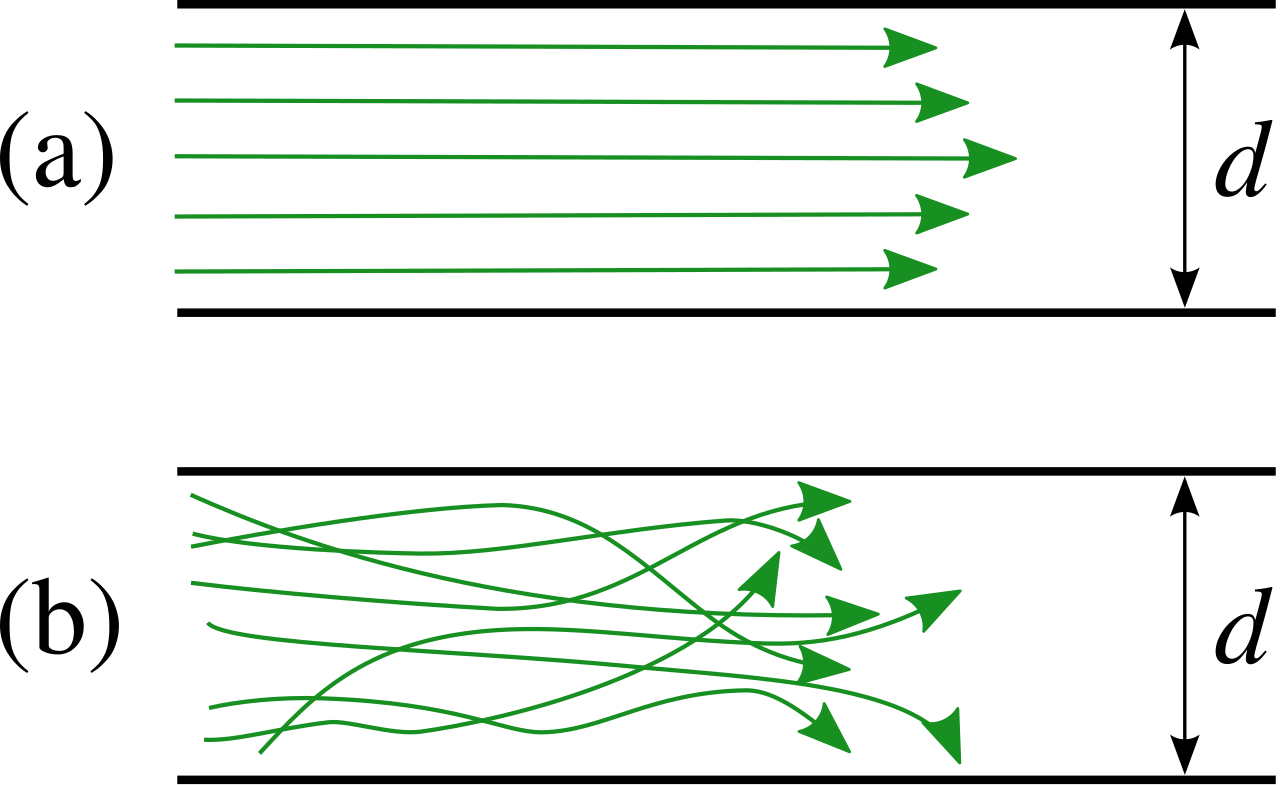
Panel (a): straight, parallel streamlines
Panel (b): crossing, irregular streamlines
Both
Neither
Laminar flow moves in smooth, parallel layers; turbulent flow mixes chaotically. Image: Dubaj and Guillaume Paumier, public domain, via Wikimedia Commons.
A blood vessel's radius shrinks by 20% (to 0.8 of its original value) with the same pressure drop. By roughly what percentage does the laminar flow rate fall?
80%
20%
36%
59%
Poiseuille: , so of the original, a fall of about 59%.
The radius of a small sphere falling through a viscous liquid is doubled (same material). What happens to its terminal speed?
It stays the same
It doubles
It increases fourfold
It increases eightfold
Stokes: .
A car's speed increases from 20 m/s to 40 m/s. By what factor does the power needed to overcome air drag increase?
4
8
16
2
Drag (×4) and power = force × speed (×2 more), so ×8.
How does the viscosity of water change as it is heated from 20 °C to 80 °C?
It decreases
It stays the same
It doubles
It increases
Liquid viscosity falls with temperature (water: about 1.0 mPa·s at 20 °C and 0.35 mPa·s at 80 °C).
In a capillary tube of radius r water rises to height h. If the tube radius is halved, the water rises to about
4h
h/2
h
2h
.
What does this picture show about water and mercury in glass tubes?
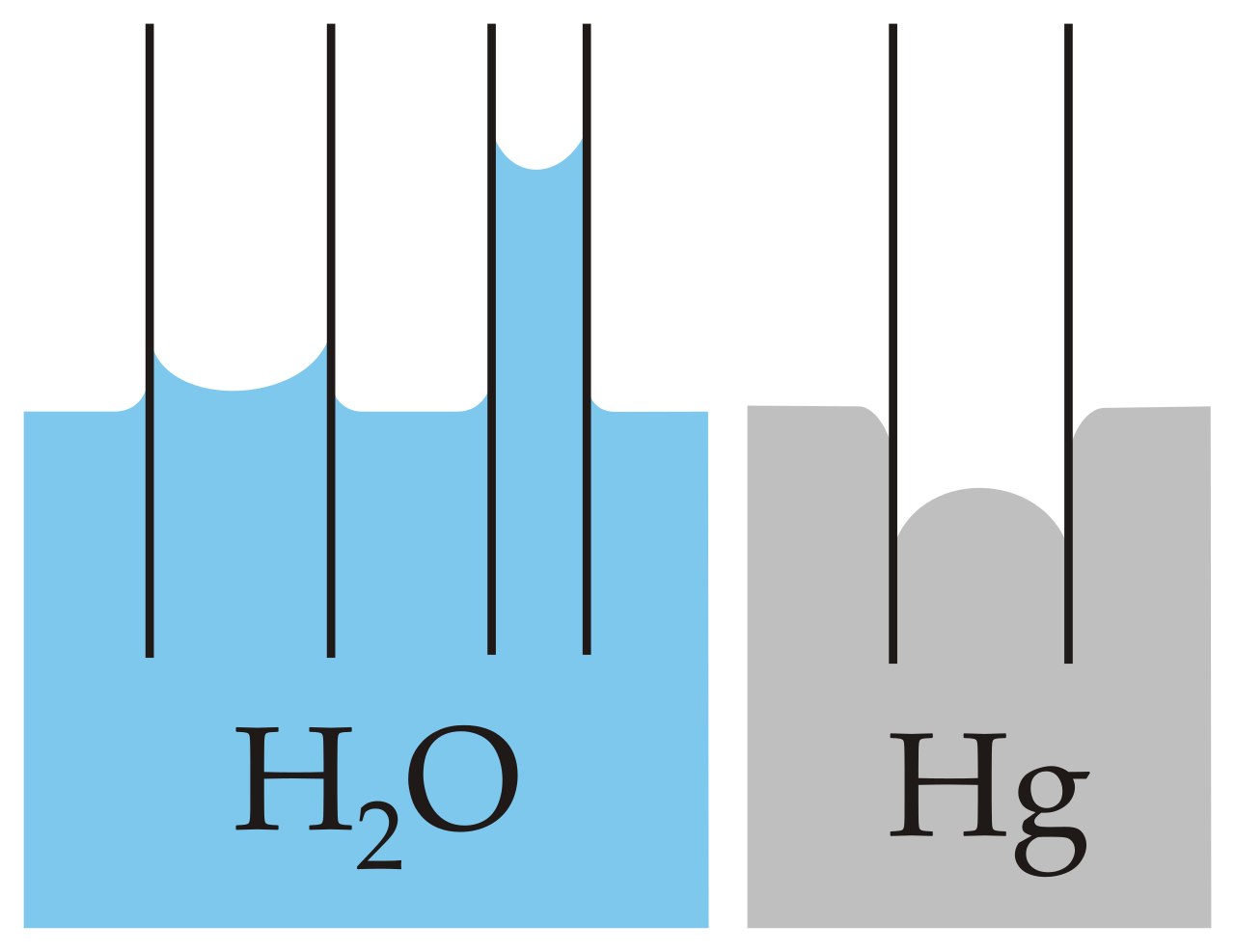
Neither moves
Water is depressed and mercury rises
Water rises with a concave meniscus; mercury is depressed with a convex meniscus
Both rise equally
Water wets glass (adhesion exceeds cohesion), mercury does not. Image: MesserWoland, CC BY-SA 2.5, via Wikimedia Commons.
What is the excess pressure inside a soap bubble of radius 1.0 cm with surface tension 0.025 N/m (two surfaces)?
5.0 Pa
10 Pa
20 Pa
2.5 Pa
Pa.
In this spinning-ball diagram, in which direction does the Magnus force act?
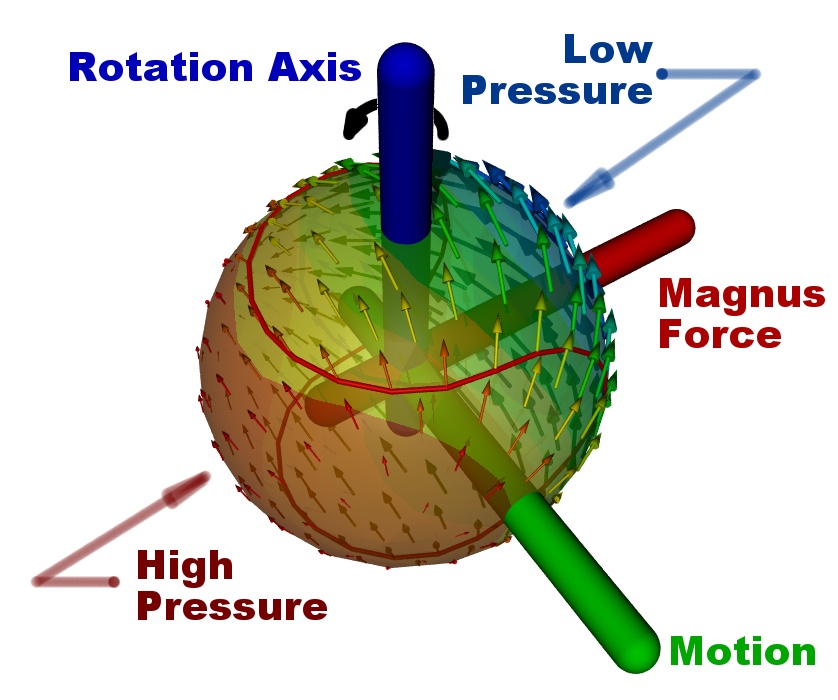
Toward the low-pressure side
Toward the high-pressure side
Along the direction of motion
Opposite to the direction of motion
The net force is directed from high to low pressure, perpendicular to both the spin axis and the velocity. Image: Syguy, CC BY 3.0, via Wikimedia Commons.
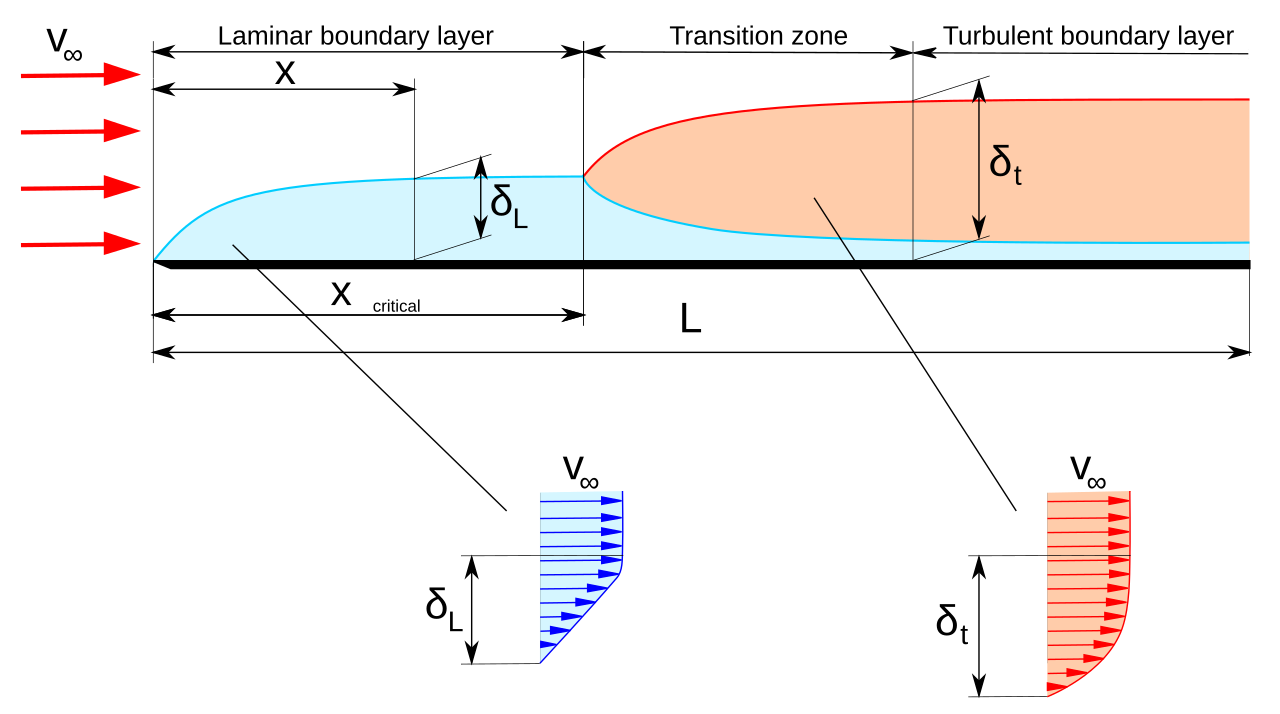
Compared with a laminar boundary layer, a turbulent boundary layer typically
Has no velocity gradient
Has lower shear stress at the wall
Is thinner and separates earlier
Is thicker and stays attached longer
Turbulent mixing re-energises the near-wall flow so separation is delayed, which is why golf-ball dimples reduce drag. Image: Bernard de Go Mars, CC BY-SA 4.0, via Wikimedia Commons.
Vortices shed behind a 2.0 cm diameter cylinder in a 5.0 m/s wind with Strouhal number 0.2 have a frequency of about
5 Hz
10 Hz
50 Hz
500 Hz
Hz.
Which common explanation of wing lift is incorrect?
Air flows faster over the top, giving lower pressure
Air over the top and bottom must meet again at the trailing edge, so the longer path means a faster speed
Circulation around the wing contributes to lift
Air is deflected downward by the wing
The 'equal transit time' idea is false: the air over the top actually arrives well ahead of the air underneath.
In this picture of streamlines around an airfoil, what do the closely spaced streamlines above the wing indicate?
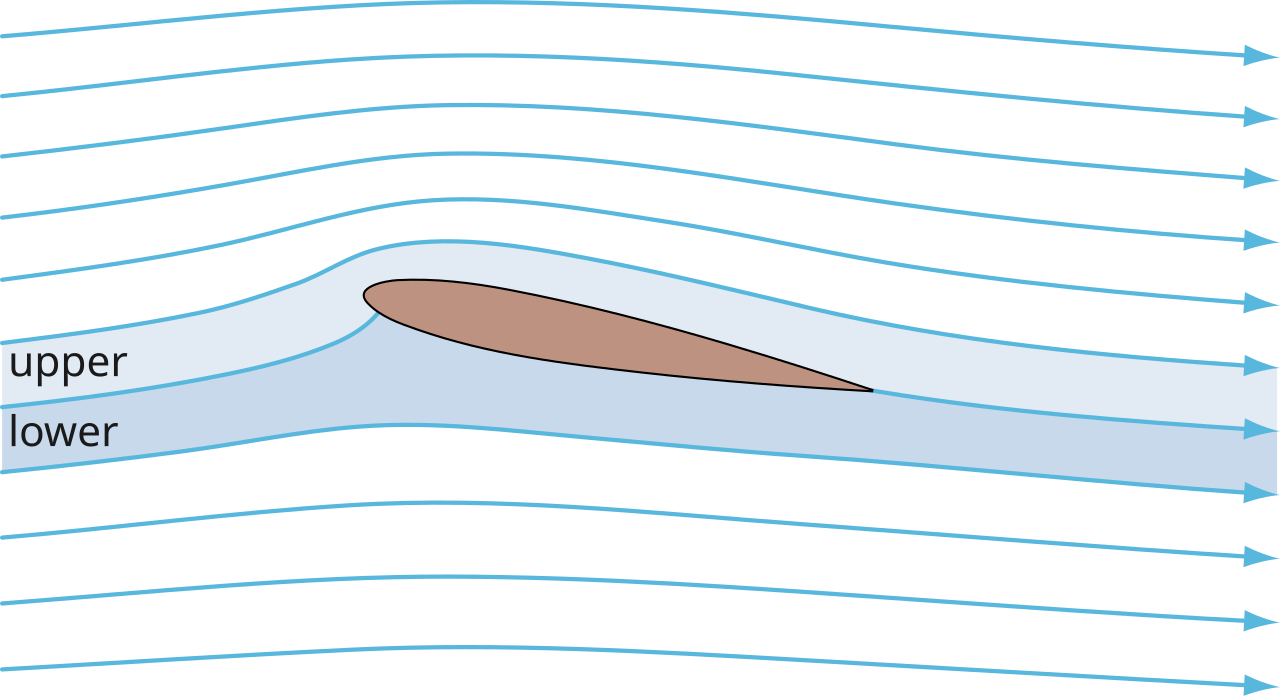
Faster flow and lower pressure
No flow
A stalled wing
Slower flow and higher pressure
By continuity, closer streamlines mean the fluid speeds up; by Bernoulli the pressure there is lower. Image: Michael Belisle, public domain, via Wikimedia Commons.
Blood flows through the aorta (radius 1.0 cm) at 0.30 m/s. The capillaries have total cross-section about 2500 cm². What is the approximate blood speed in the capillaries?
3.8 mm/s
38 mm/s
0.38 m/s
0.38 mm/s
cm/s = 0.38 mm/s.
