Quiz · Medium
Mixed clinical vignettes and ECG strips on rhythms, myocardial infarction, murmurs, heart failure and hypertension for medical students.
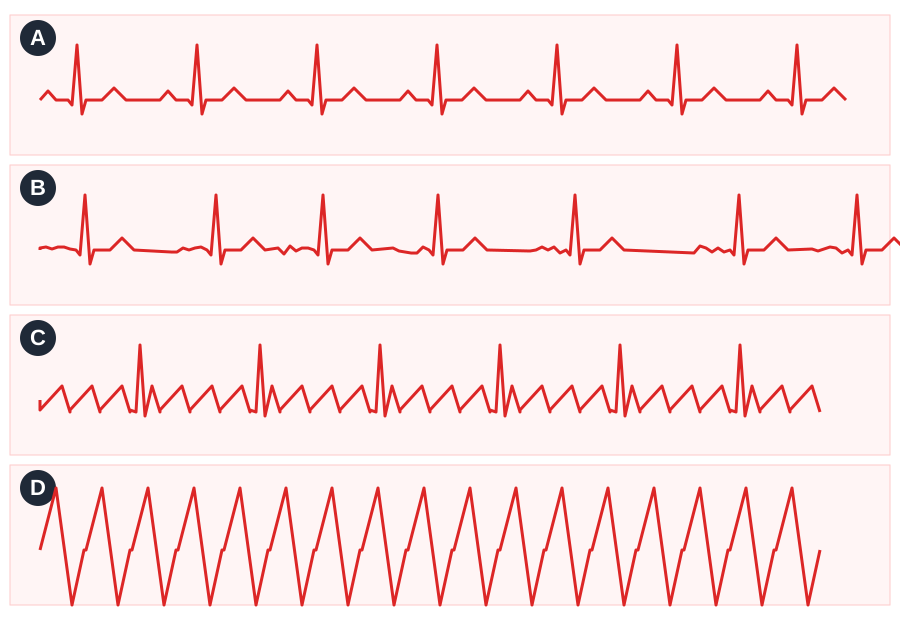
Which strip shows atrial fibrillation?
Strip A
Strip B
Strip C
Strip D
Strip B has irregularly irregular RR intervals and no true P waves. A is normal sinus rhythm, C is flutter with a sawtooth baseline, and D is a wide-complex tachycardia.
Which strip shows atrial flutter?
Strip A
Strip B
Strip C
Strip D
Strip C has the sawtooth flutter waves with regular conduction. Strip B is irregular, which points to AF instead.
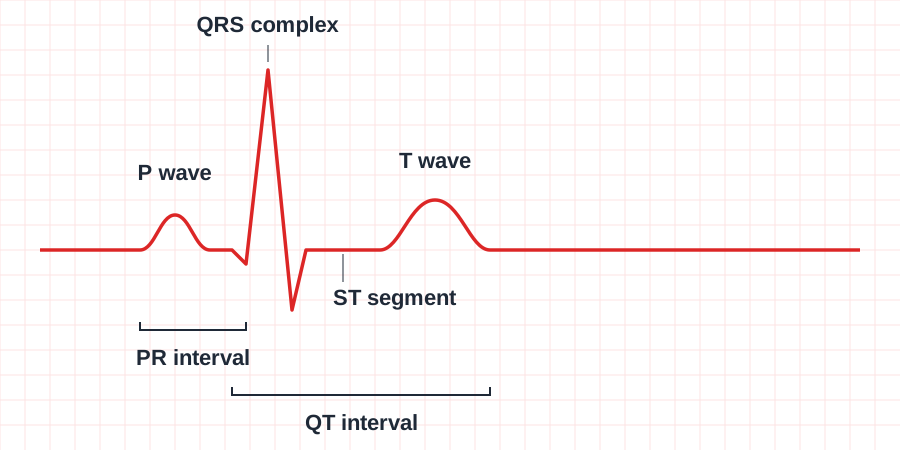
What does the part of the ECG labeled by the PR interval measure?
AV conduction time
Ventricular depolarization
Atrial repolarization
Ventricular repolarization
PR interval runs from the start of the P wave to the start of the QRS: atrial depolarization plus the AV nodal delay. Ventricular repolarization is the T wave and QT interval.
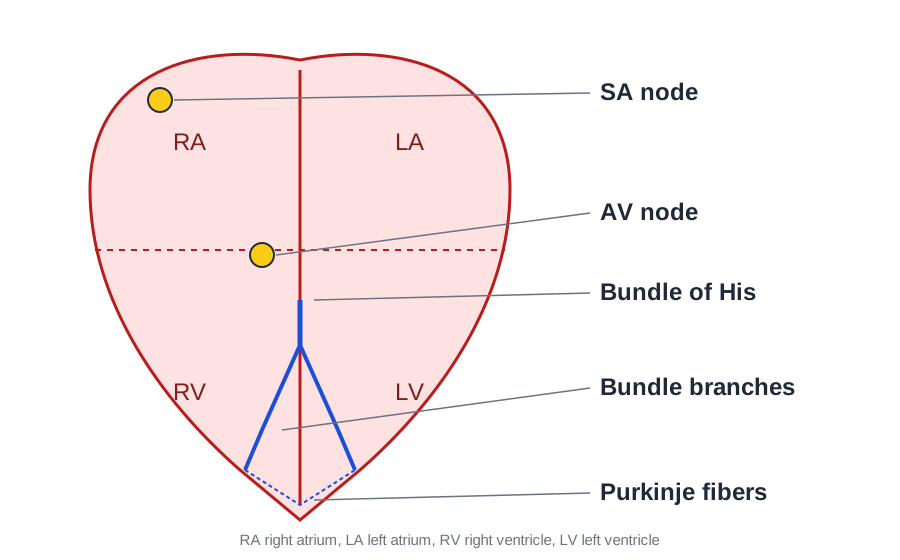
Which structure of the conduction system is the normal pacemaker of the heart?
Bundle of His
SA node
Purkinje fibers
AV node
The SA node has the fastest intrinsic rate and overrides the others. The AV node takes over only if the SA node fails (junctional rhythm at 40 to 60).
A 58-year-old man has crushing chest pain for 40 minutes. ECG shows 3 mm ST elevation in II, III and aVF. Which artery is most likely occluded?
Left anterior descending
Left circumflex
Right coronary artery
Left main
II, III and aVF are the inferior leads, supplied by the RCA in most people. LAD causes anterior changes (V1 to V4) and LCx lateral changes.
Which drug combination is contraindicated in a patient who took sildenafil yesterday and now has angina?
Metoprolol
Atorvastatin
Aspirin
Nitroglycerin
Nitrates plus PDE-5 inhibitors cause severe hypotension. Aspirin, beta blockers and statins are unaffected.
Which test is the most useful for diagnosing reinfarction 4 days after an MI?
CK-MB
Myoglobin
AST
Troponin I
CK-MB returns to baseline within 2 to 3 days, so a new rise suggests reinfarction. Troponin remains high for up to 2 weeks and cannot distinguish a new event.
A 65-year-old woman 5 days after anterior MI develops sudden pulmonary edema and a new loud holosystolic apical murmur radiating to the axilla. What is the cause?
Ventricular free-wall rupture
Papillary muscle rupture
Dressler syndrome
Aortic dissection
Papillary muscle rupture causes acute severe mitral regurgitation 3 to 7 days after MI. Free-wall rupture causes tamponade, and Dressler syndrome is pericarditis weeks later.
Which murmur is a crescendo-decrescendo systolic murmur at the right upper sternal border radiating to the carotids?
Mitral stenosis
Mitral regurgitation
Aortic stenosis
Aortic regurgitation
That describes aortic stenosis. Mitral regurgitation is holosystolic at the apex, and aortic regurgitation is early diastolic.
Which maneuver increases the murmur of hypertrophic cardiomyopathy?
Sustained handgrip
Squatting
Passive leg raise
Valsalva strain
Valsalva reduces preload and shrinks the ventricle, increasing the outflow obstruction. Squatting and leg raise increase preload and soften it.
Which drug class reduces mortality in heart failure with reduced ejection fraction?
Beta blockers such as carvedilol
Digoxin
Loop diuretics
Non-dihydropyridine calcium channel blockers
Evidence-based beta blockers improve survival. Loop diuretics and digoxin relieve symptoms or hospitalizations but not mortality; verapamil and diltiazem worsen HFrEF.
Which ECG finding is the earliest sign of hyperkalemia?
Prolonged QT
Peaked T waves
U waves
Delta wave
Peaked, narrow-based T waves come first, followed by PR prolongation, QRS widening and a sine-wave pattern. U waves occur in hypokalemia.
A patient has fever, a new murmur, and painful nodules on the finger pads. What are the nodules called?
Splinter hemorrhages
Janeway lesions
Osler nodes
Roth spots
Osler nodes are painful and immune complex mediated. Janeway lesions are painless macules on the palms or soles.
True or false: aspirin plus oxygen should be given to every patient with suspected ACS regardless of oxygen saturation.
True
False
False. Oxygen is only recommended when saturation is below about 90%; routine oxygen may increase infarct size. Aspirin is given to all unless contraindicated.
A 70-year-old man with AF and a mechanical mitral valve needs anticoagulation. Which agent?
Aspirin alone
Apixaban
Rivaroxaban
Warfarin
Warfarin is the only recommended oral anticoagulant for mechanical valves; DOACs had higher thromboembolic events in trials.
A patient with a regular narrow-complex tachycardia at 180 per minute is stable. Vagal maneuvers fail. Next best step?
IV adenosine
Immediate defibrillation
IV amiodarone
Oral digoxin
Adenosine briefly blocks the AV node and terminates AVNRT. Defibrillation is for unstable patients, and digoxin has a slow onset.
Pulsus paradoxus with elevated JVP and hypotension. What is the most appropriate immediate treatment?
Diuresis
Pericardiocentesis
Beta blocker
Nitroglycerin
These findings suggest cardiac tamponade, which needs drainage. Diuretics and nitrates reduce preload and can cause collapse.
Which feature distinguishes acute pericarditis from STEMI on ECG?
T wave inversion
ST elevation
Diffuse concave ST elevation with PR depression
Q waves
Pericarditis shows diffuse changes not limited to a coronary territory with PR depression. STEMI shows territorial convex ST elevation with reciprocal depression.
Which arrhythmia is most associated with prolonged QT and treated with IV magnesium?
AVNRT
Mobitz I
Atrial flutter
Torsades de pointes
Torsades is polymorphic VT from long QT; magnesium stabilizes the membrane even with normal serum levels.
A blood pressure of 195/125 mmHg with new confusion and papilledema is best described as?
Hypertensive emergency
Stage 1 hypertension
White coat hypertension
Hypertensive urgency
Severe elevation with acute end-organ damage (encephalopathy) is an emergency requiring IV therapy.
