Quiz · Medium
Lorentz factor, time dilation, length contraction, velocity addition, relativistic energy, the twin paradox, GPS, black holes and gravitational waves, with diagram and image questions.
What is the Lorentz factor for an object moving at 0.6c?
0.80
1.00
1.25
1.67
. The value 0.80 is .
A muon has a proper lifetime of 2.2 μs and moves at 0.995c (). About how far does it travel in the Earth frame before decaying (on average)?
660 m
6.6 km
66 km
2.2 km
Lab lifetime μs; distance km. Without dilation it would be only about 660 m.
A 50 m (proper length) spaceship passes Earth at 0.8c. What length do Earth observers measure?
30 m
50 m
83 m
40 m
m. Only the length along the direction of motion contracts.
An astronaut's clock on a probe moving at 0.6c records 6.0 years. How much time passes on Earth?
10 years
4.8 years
6.0 years
7.5 years
years.
Two rockets leave a station in opposite directions, each at 0.9c as measured from the station. At what speed does one rocket see the other receding?
1.8c
0.9c
0.994c
1.0c exactly
. Speeds never add past c.
An electron moves at 0.866c (). What is its kinetic energy?
2.04 MeV
0.511 MeV
1.02 MeV
0.256 MeV
MeV.
A proton (rest energy 938 MeV) has . What is its kinetic energy?
1.88 GeV
2.81 GeV
0.47 GeV
938 MeV
MeV ≈ 1.88 GeV. The total energy is 2.81 GeV.
A particle has total energy 5 GeV and momentum 4 GeV/c. What is its rest energy?
4.5 GeV
9 GeV
1 GeV
3 GeV
, so GeV.
Which of these quantities has the same value for all inertial observers?
The time between two events
The length of a moving rod
The speed of light in vacuum
Whether two distant events are simultaneous
The invariance of c is Einstein's second postulate. Time intervals, lengths and simultaneity depend on the observer.
A traveller journeys 12 light-years to a star at 0.6c and returns at 0.6c. How much does the traveller age during the round trip?
50 years
32 years
40 years
24 years
Earth-frame time years. The traveller's proper time is years.
What is the Schwarzschild radius of a 10-solar-mass black hole ( km per solar mass)?
3 km
30 km
300 km
0.3 km
scales with mass: 10 × 2.95 km ≈ 30 km.
In the moving light clock shown, which relation follows from the geometry (D is the slanted path, L the mirror separation, the tick time in the frame where the clock moves)?
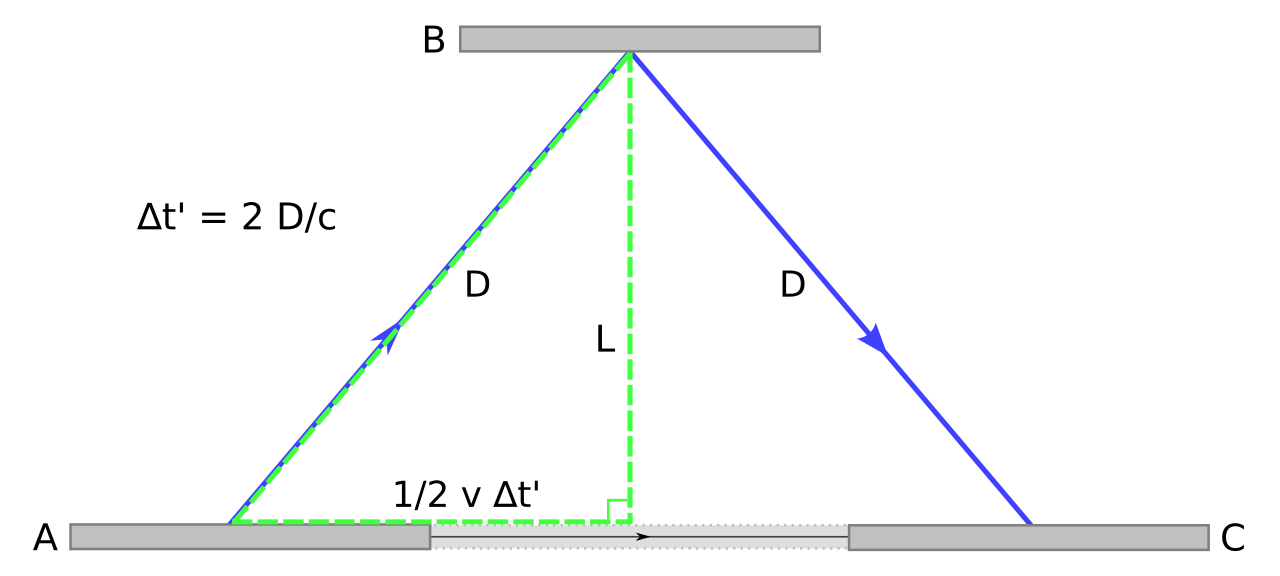
The slanted path is the hypotenuse of a right triangle with legs L and . Combined with this gives . Image: Mdd4696, public domain, via Wikimedia Commons.
From the graph of the Lorentz factor, roughly what is at ?
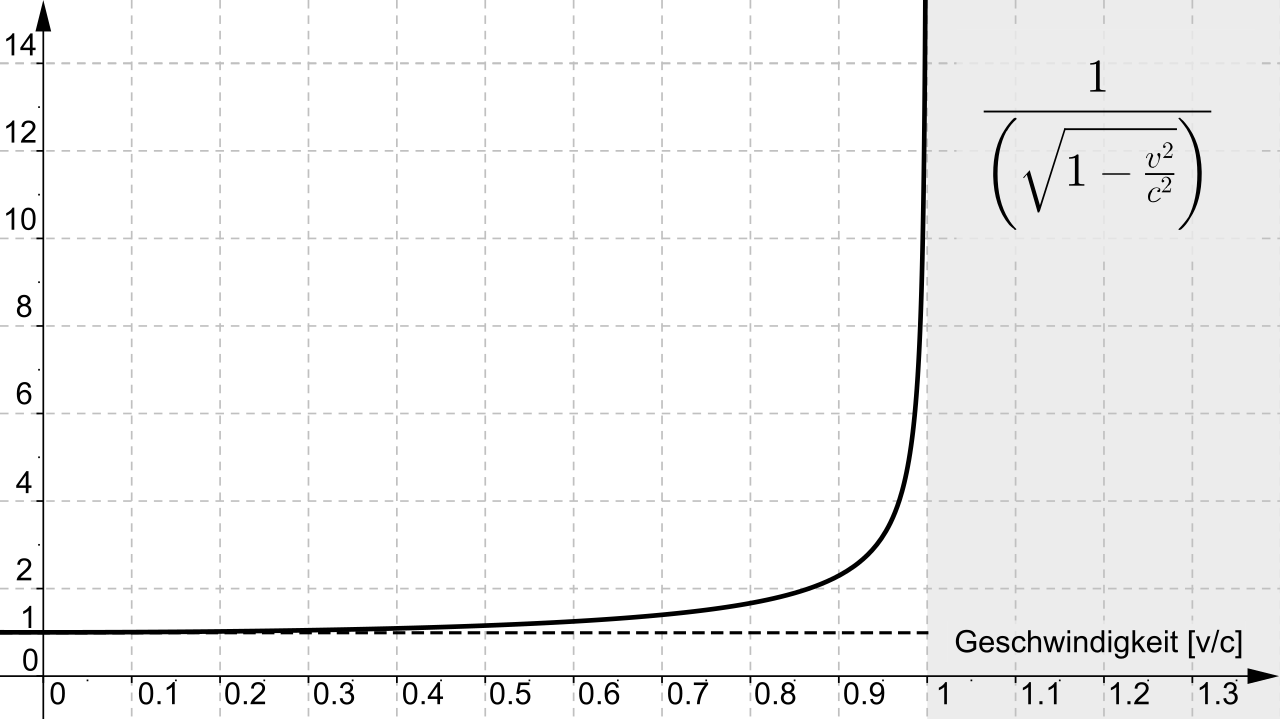
7.1
1.1
1.4
2.3
. It reaches 7.1 only at 0.99c. Image: Klamann and MikeRun, public domain, via Wikimedia Commons.
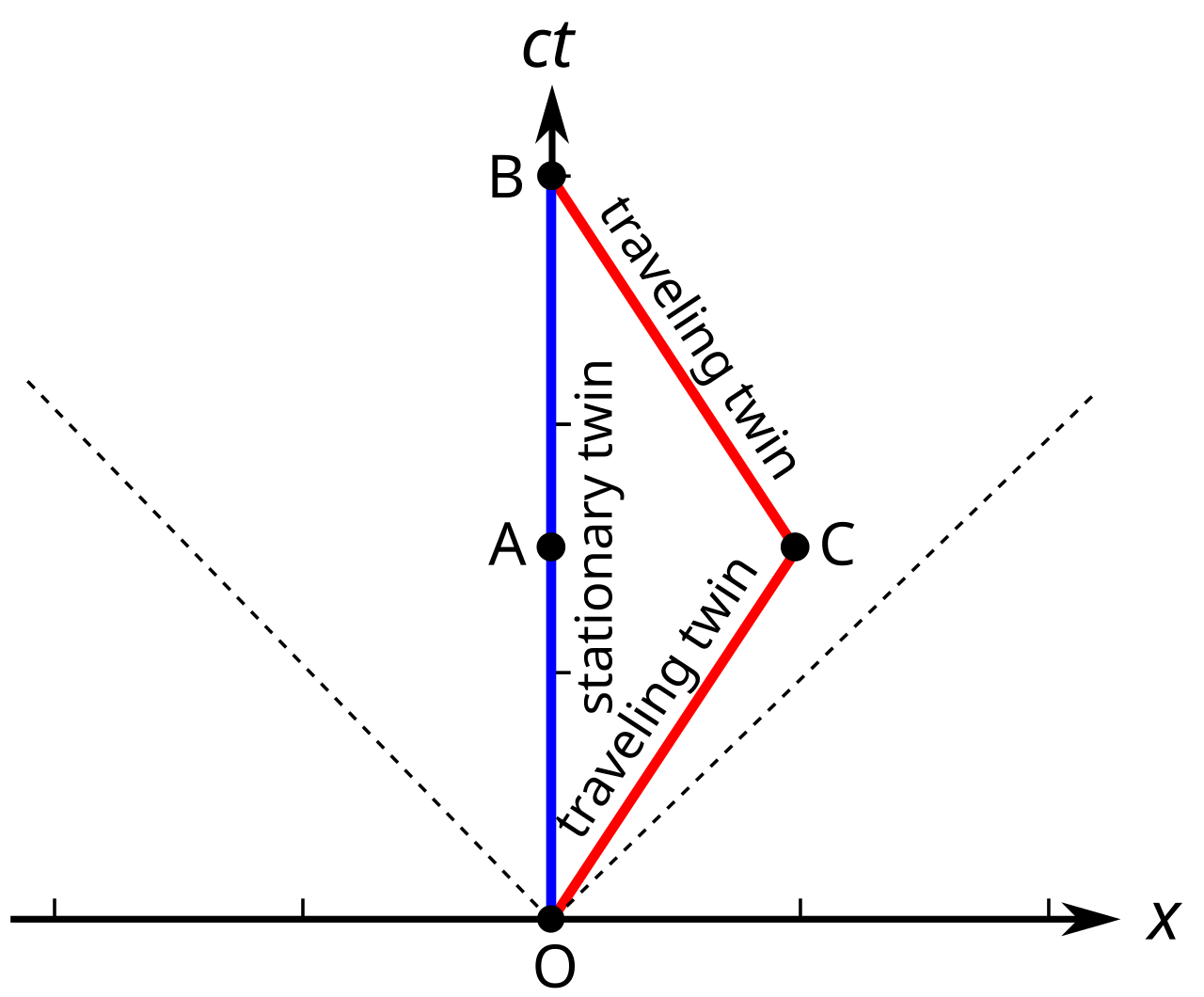
In this spacetime diagram of the twin paradox, which statement is correct?
The stationary twin is younger at B.
Proper time is the same along any path between O and B.
The travelling twin's worldline O→C→B has less proper time than the stationary twin's O→A→B.
Both twins age the same amount because the situation is symmetric.
The traveller changes inertial frames at C, breaking the symmetry; the straight worldline has the greatest proper time. Image: Stigmatella aurantiaca, CC BY-SA 4.0, via Wikimedia Commons.
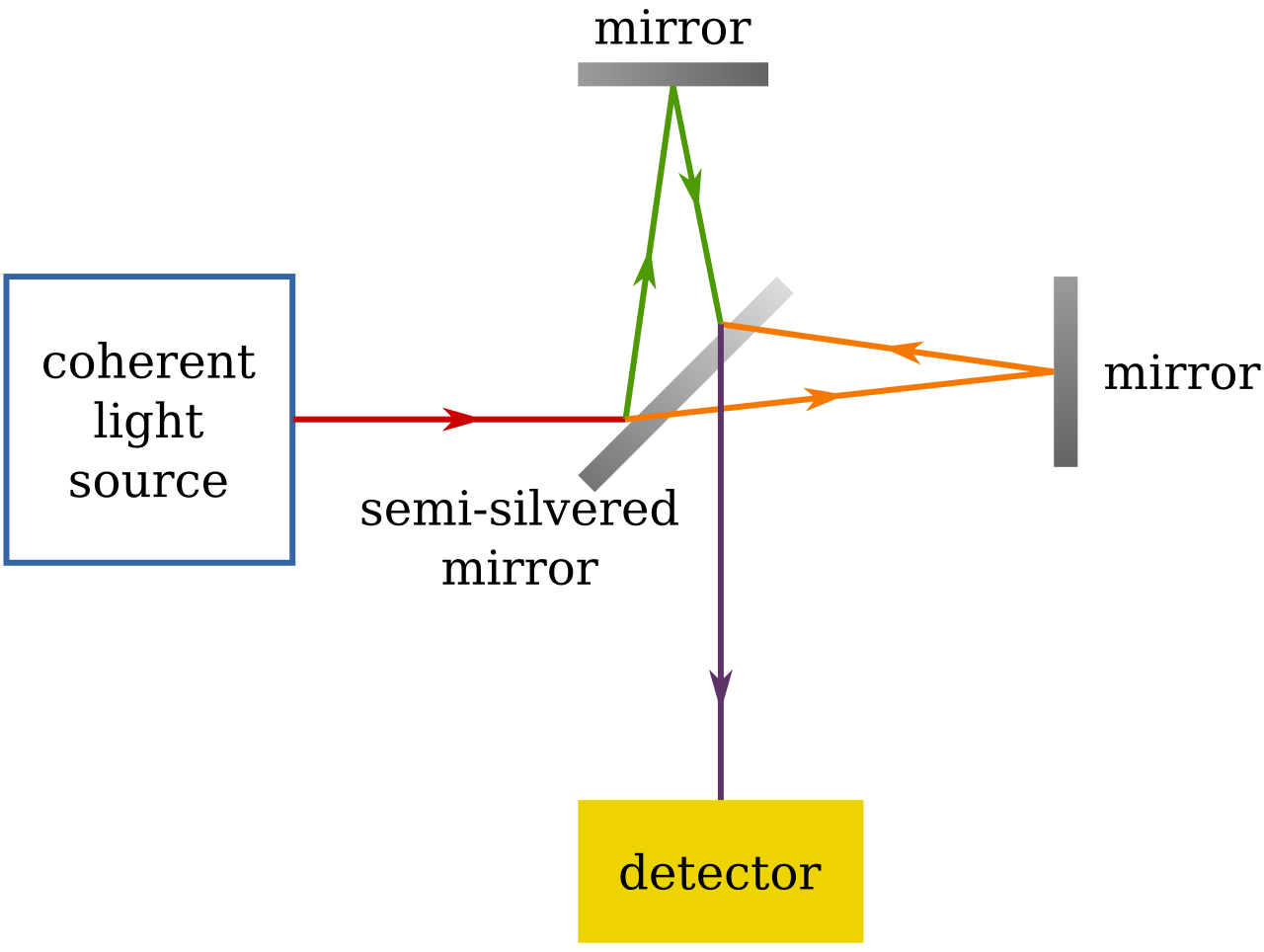
The Michelson–Morley experiment, sketched here, looked for a shift in interference fringes when the apparatus was rotated. What did it find?
A large shift, confirming the ether
No significant shift, so no ether wind was detected
A shift proportional to time of year only
Fringes disappeared entirely
The null result undermined the idea of a stationary luminiferous ether and was consistent with the constancy of c. Image: Benjamin D. Esham, public domain, via Wikimedia Commons.
Why does the single quasar in this Hubble image appear as four bright points around a central blob?
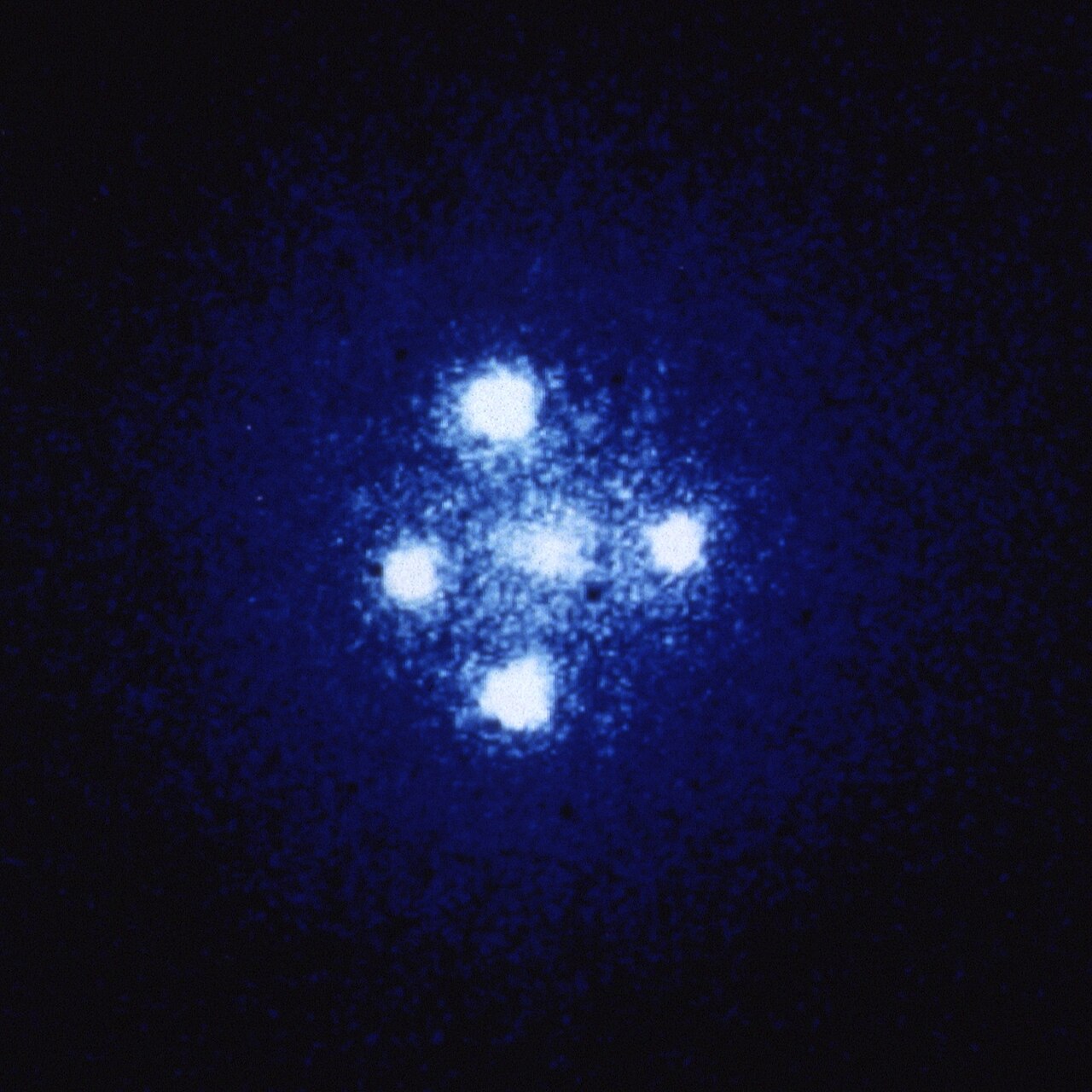
A foreground galaxy's gravity bends the quasar's light, creating multiple images
The camera has a diffraction artefact
The quasar is exploding in four directions
Four separate quasars happen to line up
This is gravitational lensing (the Einstein Cross, Q2237+0305), predicted by general relativity. Image: NASA, ESA and STScI, public domain, via Wikimedia Commons.
What does the dark central region of this Event Horizon Telescope image of the M87 black hole represent?
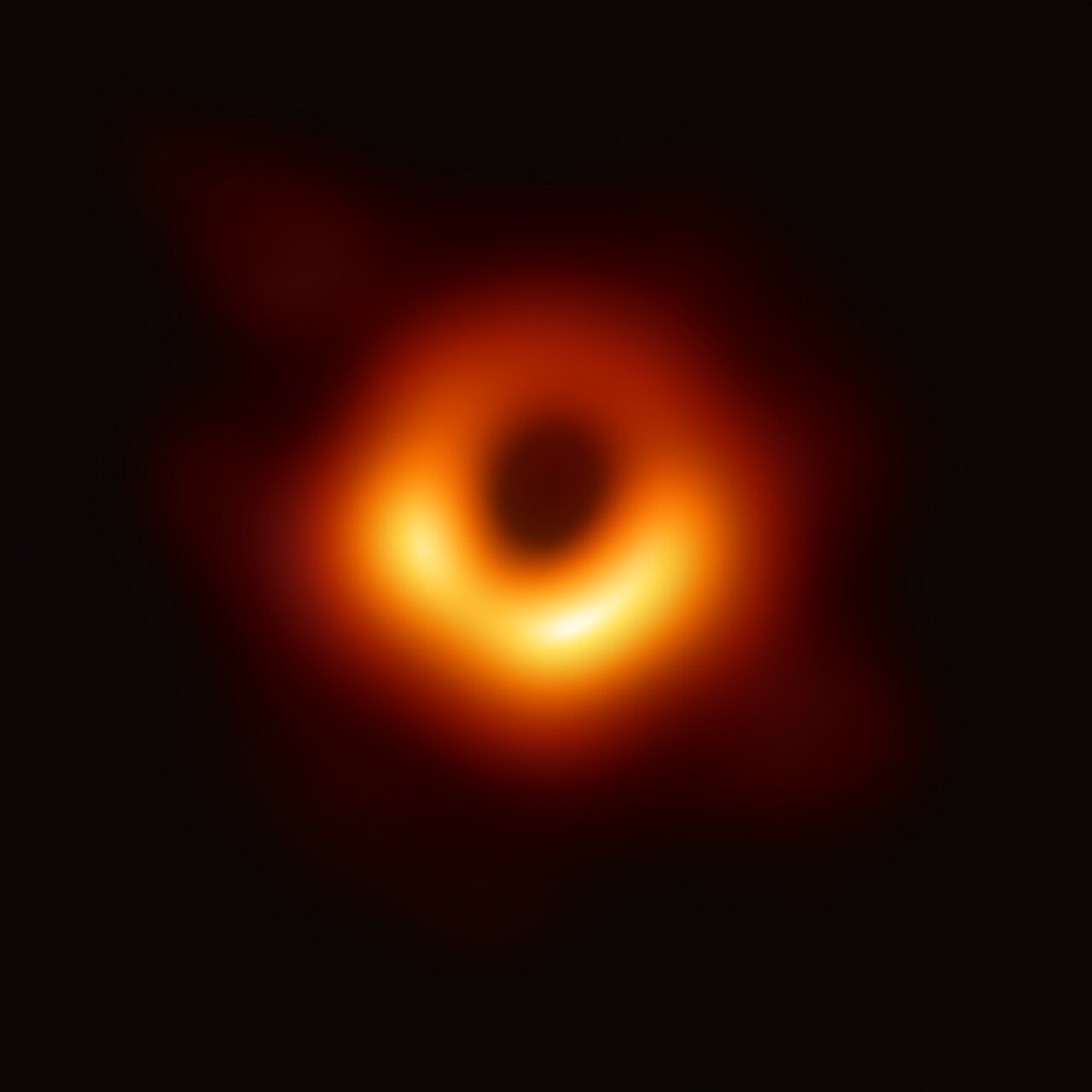
A hole in the telescope's detector
Empty space with no gas
A nearby dark star
The black hole's shadow, bounded by the bright ring of lensed light from hot gas
The shadow is the region from which light cannot reach us, roughly 2.5 times the Schwarzschild radius across. Image: Event Horizon Telescope collaboration, CC BY 4.0, via Wikimedia Commons.
GPS satellite clocks run about 38 μs per day faster than ground clocks. Which effect dominates?
The Doppler shift of the signal
Atmospheric refraction
Gravitational time dilation (clocks run faster higher in the gravitational field), larger than the velocity slowdown
Velocity time dilation only
GR gives about +45 μs/day and special relativity about −7 μs/day for the satellite clocks.
A nuclear reaction releases energy while its products have 0.001 kg less rest mass than the reactants. About how much energy is released?
J
J
J
J
J.
What did LIGO first detect in 2015?
Neutrinos from a supernova
Dark matter particles
X-rays from a quasar
Gravitational waves from a merging pair of black holes
GW150914, from two black holes of about 36 and 29 solar masses about 1.3 billion light-years away.
Which observation is a classic confirmation of general relativity involving Mercury?
Its gravitational redshift
Its moons orbit retrograde
The anomalous precession of its perihelion, about 43 arcseconds per century
Its mass defect
Newtonian perturbations from other planets explain most of Mercury's perihelion precession; the remaining 43″ per century is accounted for by GR.
