Quiz · Medium
Twenty-five NCLEX-style questions covering GTPAL, fundal height, fetal monitoring, labor, postpartum assessment and newborn care.
A client's last menstrual period began on April 12. Using Naegele's rule, what is her estimated date of delivery?
January 12
February 5
December 30
January 19
Naegele's rule: subtract 3 months (April 12 becomes January 12), add 7 days (January 19), and the year moves forward by one. Adding 7 days, not 14, is the common slip.
A woman is pregnant for the third time. She has one child born at 39 weeks, and one miscarriage at 10 weeks. How is her history recorded in GTPAL?
G2 T1 P0 A1 L1
G3 T1 P1 A0 L1
G3 T1 P0 A1 L1
G3 T2 P0 A0 L1
Gravida counts every pregnancy including the current one (3). One term birth, no preterm birth, one abortion (loss before 20 weeks) and one living child. A miscarriage before 20 weeks is an abortion in GTPAL.
Which finding is a POSITIVE (diagnostic) sign of pregnancy?
Amenorrhea
Positive urine hCG test
Fetal heart tones heard by Doppler
Softening of the cervix
Only signs that come from the fetus are positive signs: fetal heartbeat, fetal movement felt by the examiner, and ultrasound visualization. Amenorrhea is presumptive; hCG and Goodell's sign are probable.
The nurse measures fundal height on a woman at 28 weeks of gestation. Which result is expected?
About 20 cm
About 28 cm (plus or minus 2 cm)
About 36 cm
At the level of the umbilicus
Between 20 and 36 weeks the fundal height in centimeters approximately equals the gestational age in weeks. The fundus reaches the umbilicus at about 20 weeks.
Which instruction should the nurse give a pregnant woman who becomes dizzy and pale when lying flat on her back?
Lie on her right side
Elevate her legs above her head
Sit upright with her legs straight
Turn to the left side
Supine hypotensive syndrome is caused by compression of the inferior vena cava by the gravid uterus. The left lateral position takes the weight off the vena cava and restores venous return.
A client at 10 weeks of gestation asks why she should take folic acid. What is the best response?
It reduces the risk of neural tube defects such as spina bifida.
It prevents gestational diabetes.
It prevents the baby from developing jaundice.
It increases the production of breast milk.
Folic acid (at least 400 mcg daily) taken before conception and early in pregnancy lowers the risk of neural tube defects. It does not prevent diabetes, jaundice or affect lactation.
A prenatal client has a maternal serum AFP that is markedly elevated. The nurse understands this finding is associated with which fetal condition?
Down syndrome
Cystic fibrosis
Neural tube defect
Turner syndrome
High MSAFP points to neural tube defects (or incorrect dates, multiples). Low MSAFP, with low estriol and high hCG and inhibin A, suggests Down syndrome.
Which finding indicates a reactive nonstress test?
No accelerations after 40 minutes
Late decelerations after contractions
A baseline of 170 bpm with absent variability
Two accelerations of at least 15 bpm for 15 seconds or longer in 20 minutes
A reactive NST has at least two accelerations of at least 15 beats per minute lasting at least 15 seconds within a 20-minute window, indicating adequate fetal oxygenation. Late decelerations are assessed in the contraction stress test.
Which assessment finding is the earliest sign of magnesium sulfate toxicity?
Urine output of 50 mL/hr
Respiratory rate of 18 per minute
Absent deep tendon reflexes
Blood pressure of 120/70
Loss of deep tendon reflexes comes first, before respiratory depression (rate below 12) and cardiac problems. Urine output should be at least 30 mL/hr. The antidote is calcium gluconate.
A woman at 34 weeks presents with painless, bright red vaginal bleeding and a soft, nontender uterus. What should the nurse do FIRST?
Perform a sterile vaginal examination to check cervical dilation
Start an oxytocin infusion
Encourage ambulation to promote labor
Assess maternal vital signs and fetal heart rate and notify the provider; do not perform a vaginal exam
Painless bright red bleeding suggests placenta previa. A digital vaginal exam may provoke hemorrhage and is contraindicated until previa is ruled out by ultrasound.
Which finding differentiates placental abruption from placenta previa?
Bright red vaginal bleeding
Rigid, board-like abdomen with severe pain
A soft relaxed uterus
Bleeding in the third trimester
Abruption classically causes painful, dark red or concealed bleeding and a rigid, tender uterus. Previa causes painless bright red bleeding with a soft uterus. Both occur in late pregnancy.
Which image shows the position of the placenta in placenta previa?
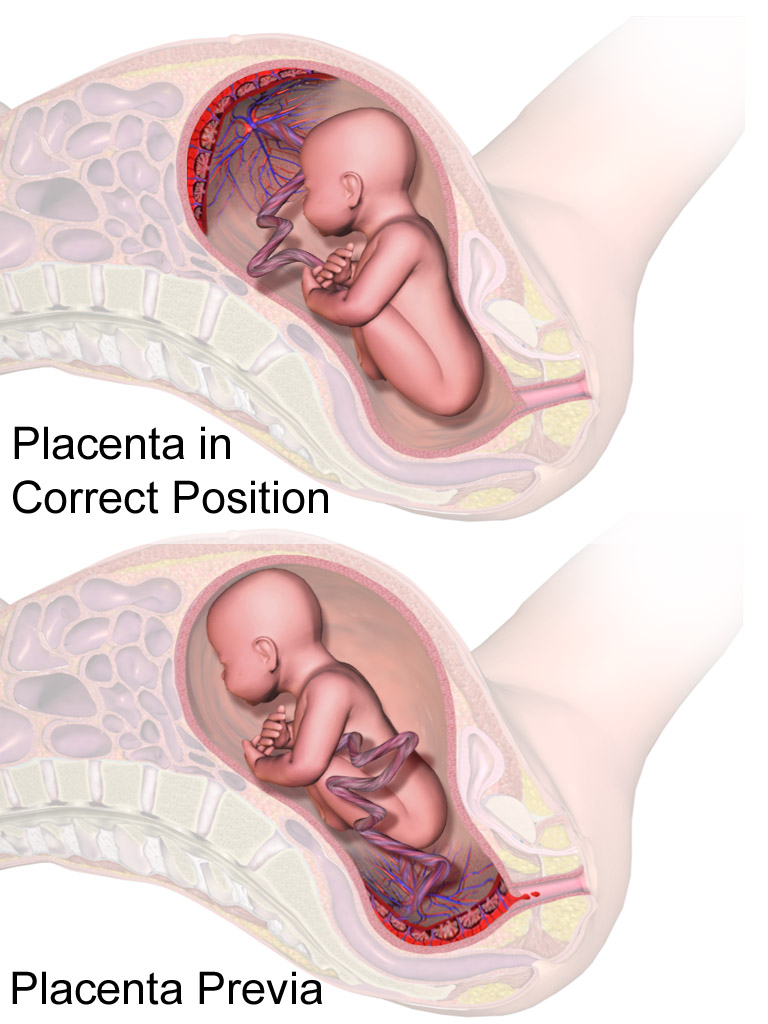
The lower drawing, with the placenta covering the cervical opening
The upper drawing, with the placenta at the top of the uterus
Neither drawing
Both drawings
In the lower drawing the placenta sits low and covers or approaches the internal os. The upper drawing shows a normally implanted placenta in the fundus. Image: BruceBlaus, CC BY-SA 4.0, via Wikimedia Commons.
A client's Leopold's maneuver finds a firm, round, ballotable mass above the symphysis pubis. What does this indicate?
The fetal buttocks are presenting
The fetal head is presenting
The fetal back is on the left
The fetus is in a transverse lie
In the third maneuver the examiner grasps the part just above the symphysis. A firm, round, movable part is the head; a soft, irregular part is the buttocks.
During labor the nurse notes the fetal heart rate decreases after the peak of each contraction and returns to baseline after the contraction ends. Which is the priority action?
Document as an expected pattern
Increase the oxytocin infusion rate
Have the client push
Reposition the client to her left side and give oxygen
A late deceleration reflects uteroplacental insufficiency. Turn the woman to her side, give oxygen, increase IV fluids, stop oxytocin and notify the provider.
Which FHR pattern is caused by fetal head compression and requires no intervention?
Variable decelerations
Late decelerations
Early decelerations
Prolonged decelerations
Early decelerations mirror the contraction and are caused by head compression with vagal stimulation. Variable decelerations indicate cord compression; lates indicate placental insufficiency.
A woman who is 8 cm dilated becomes irritable, nauseated and says she cannot go on. Which phase of labor is this?
Latent phase
Transition
Second stage
Third stage
Transition (8 to 10 cm) is the most intense: strong contractions every 2 to 3 minutes, nausea, shaking, irritability and the urge to push. Coaching and breathing support are needed.
Which sign indicates the placenta has separated from the uterine wall?
A soft, flat uterine fundus
Decreasing blood pressure
Lengthening of the umbilical cord and a gush of blood
The baby cries
Signs of separation: lengthening of the cord, a gush of blood, and the uterus becoming firm and globular and rising. The nurse should never pull on the cord.
Thirty minutes after delivery the nurse finds a boggy uterus. What is the first action?
Administer a stool softener
Massage the fundus
Apply ice to the perineum
Place the woman in the Trendelenburg position
A boggy uterus is a sign of atony, the leading cause of postpartum hemorrhage. Fundal massage is the first intervention, followed by checking the bladder and giving uterotonics.
On day 2 postpartum, which lochia finding is expected?
Red to pink-red discharge with a fleshy odor
Yellow-white discharge
Foul-smelling discharge with fever
Clots larger than a golf ball
Days 1 to 3: lochia rubra, bright red. Lochia serosa is pink-brown (days 4 to 10); alba is yellow-white. A foul odor or large clots needs follow-up.
A newborn has a heart rate of 130, a strong cry, active movement, a pink body with blue hands and feet, and cries vigorously when stimulated. What is the Apgar score?
10
9
8
7
Heart rate over 100 (2), respiratory effort (2), active motion (2), reflex irritability: vigorous cry (2), body pink with blue extremities (1) = 9. Acrocyanosis is normal and loses one point for color.
Which newborn finding in the first 24 hours is MOST concerning?
Jaundice
Acrocyanosis of the hands and feet
Lanugo over the shoulders
Milia on the nose
Jaundice in the first 24 hours is pathologic until proven otherwise (hemolysis from Rh/ABO incompatibility, infection). Physiologic jaundice appears after 24 hours.
Why is vitamin K administered to newborns?
To prevent infection from group B Streptococcus
To increase surfactant production
To prevent hemorrhagic disease of the newborn
To prevent ophthalmia neonatorum
Newborns have sterile intestines and cannot synthesize vitamin K, so clotting factors II, VII, IX and X are low. Erythromycin ointment prevents ophthalmia neonatorum.
Which newborn behavior is a normal reflex?
The infant arches the back and screams when held
The infant lifts the head and chest when prone and stays up for one minute
The infant sits unsupported
The infant turns toward a stroked cheek and opens the mouth
This is the rooting reflex. It helps the baby find the nipple and fades by about 3 to 4 months. Lifting the head for sustained periods and sitting are later milestones.
Which of Leopold's maneuvers is shown, and what does it assess?
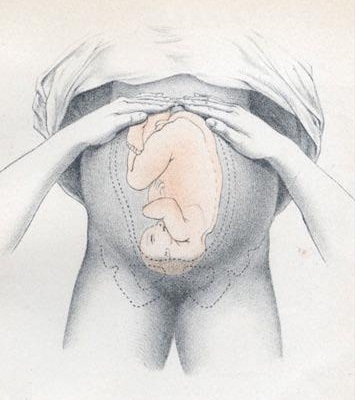
First maneuver: palpating the fundus to find which fetal part lies in the top of the uterus
Fourth maneuver: assessing the degree of descent into the pelvis
Second maneuver: locating the fetal back
Third maneuver: determining the part over the pelvic inlet
Both hands cup the fundus in the first maneuver (head is hard and round, buttocks soft and irregular). The second uses the sides of the abdomen, the third a single-handed grip above the symphysis, and the fourth faces the woman's feet. Image: Leopold and Spörlin (1894), public domain, via Wikimedia Commons.
This fetal monitor tracing is printed on paper. Which two measurements does the machine display on the strip?
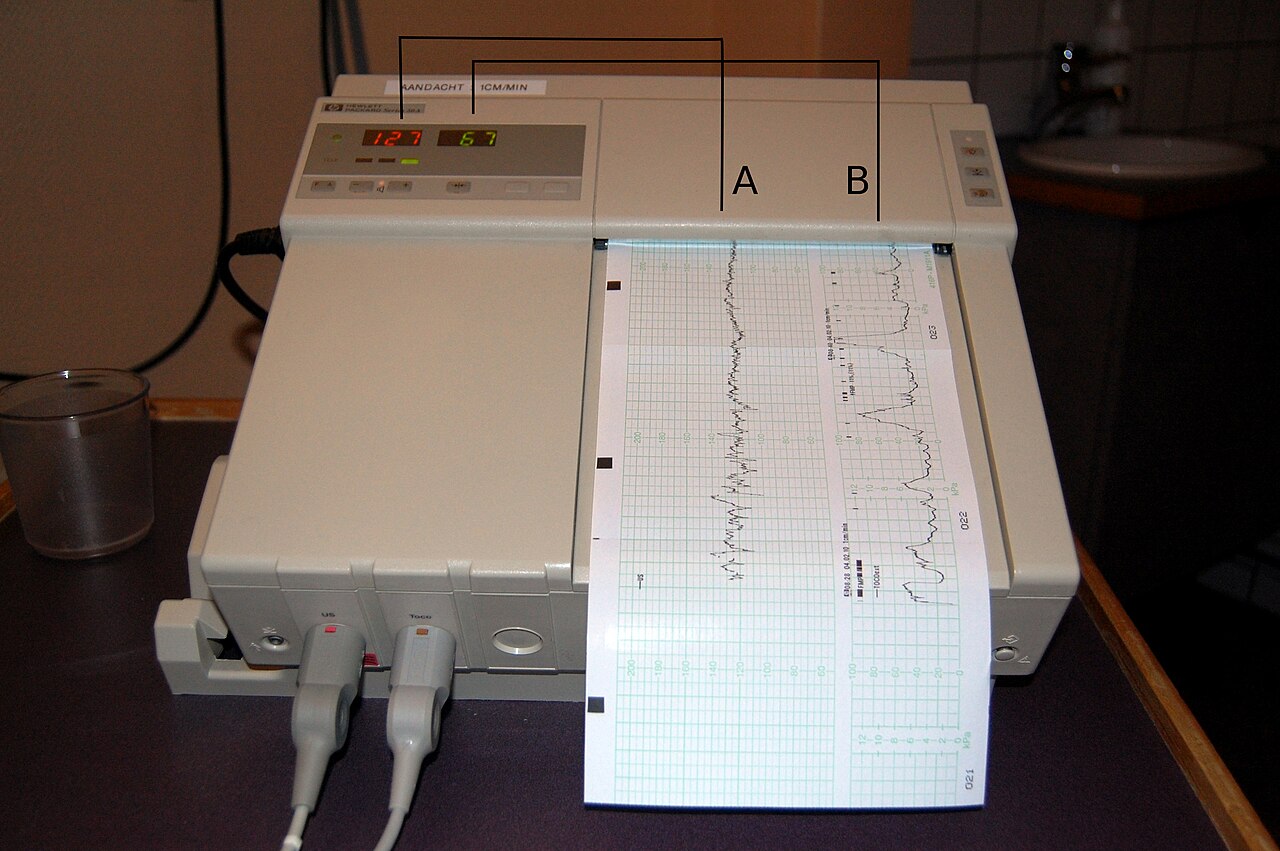
Fetal heart rate and uterine contractions
Maternal blood pressure and pulse
Fetal oxygen saturation and fetal temperature
Amniotic fluid index and cervical dilation
The ultrasound transducer records the fetal heart rate (normal 110 to 160 bpm) and the tocodynamometer records contraction timing. Strength is only estimated unless an intrauterine catheter is used. Image: Steven Fruitsmaak, CC BY 3.0, via Wikimedia Commons.
