Quiz · Hard
Photoelectric effect, de Broglie wavelength, uncertainty, infinite wells, Bohr energy levels, hydrogen spectra, quantum numbers and the Standard Model, with diagram questions.
What is the energy in eV of a photon of wavelength 500 nm?
0.62 eV
1.24 eV
2.48 eV
4.96 eV
eV.
Ultraviolet light of wavelength 250 nm falls on zinc (work function 4.3 eV). What is the maximum kinetic energy of the photoelectrons?
0 eV (no emission)
0.66 eV
4.96 eV
9.26 eV
eV; eV.
In a photoelectric experiment above the threshold frequency, the light intensity is doubled at constant frequency. What happens?
The photocurrent doubles and is unchanged
doubles and the current is unchanged
Both double
Nothing changes
Doubling intensity doubles the number of photons, hence of electrons, but each photon has the same energy hf.
What is the threshold wavelength for a metal with work function 2.3 eV?
270 nm
1080 nm
310 nm
540 nm
nm. Longer wavelengths have too little energy per photon.
Light of wavelength 400 nm illuminates a metal of work function 2.3 eV. What stopping potential is needed?
5.4 V
2.3 V
0.8 V
3.1 V
eV so eV and V.
In the stopping-voltage graph for zinc shown, the red line leaves the horizontal axis at about 10.4×10¹⁴ Hz. What does this frequency represent?
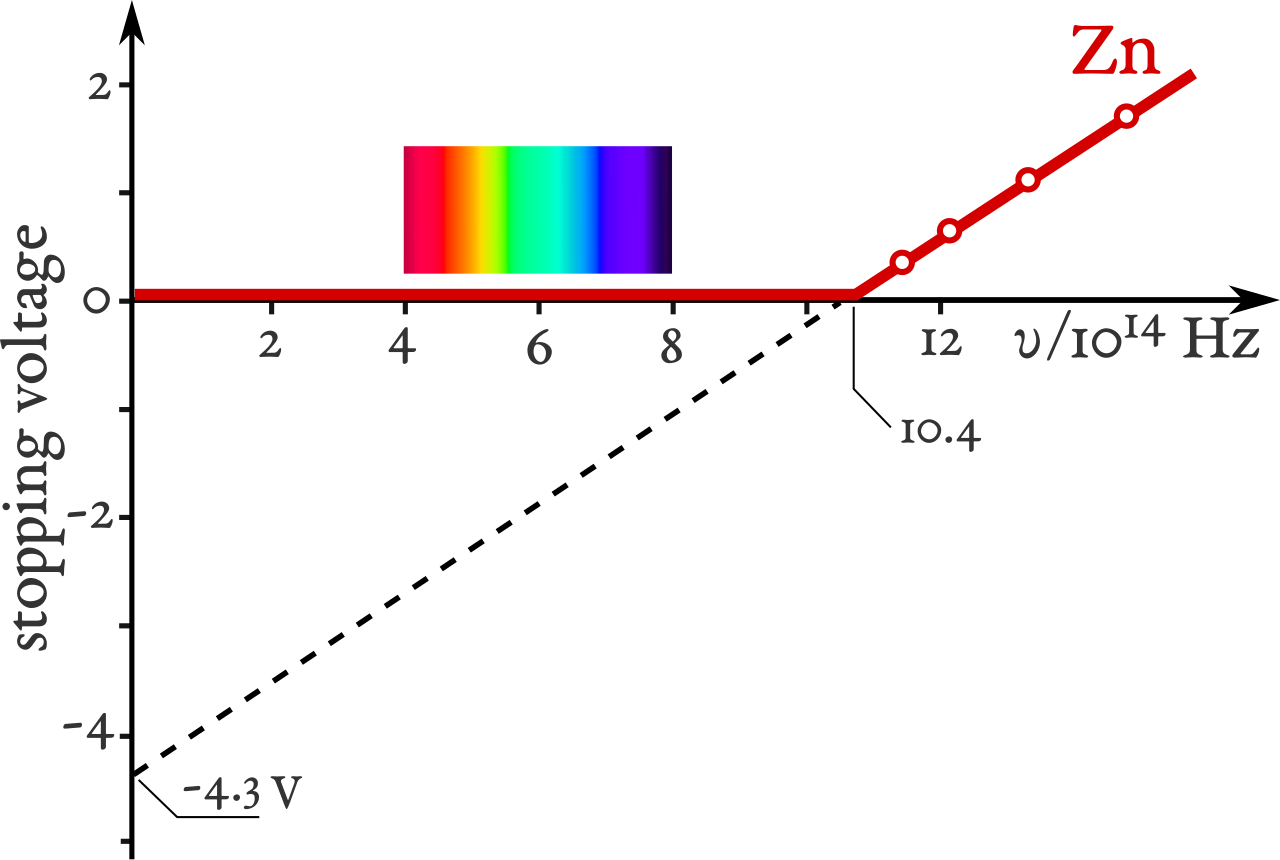
The saturation current
The threshold frequency
The maximum frequency of visible light
The frequency at which the metal melts
Below it, no photoelectrons are emitted. The work function is eV. Image: Ponor, CC BY-SA 4.0, via Wikimedia Commons.
What is the de Broglie wavelength of an electron accelerated through 100 V (non-relativistic)?
0.123 nm
1.23 nm
12 nm
0.012 nm
nm.
An electron and a proton have the same kinetic energy. Which has the longer de Broglie wavelength?
The proton, because it is heavier
They are equal
The proton, because it has more charge
The electron, because its momentum is smaller
, so the lighter electron has smaller momentum and so a longer wavelength.
An electron is confined to a region m. What is the minimum uncertainty in its velocity ( J·s)?
m/s
m/s
m/s
m/s
kg·m/s, so m/s.
An electron in a 1.0 nm infinite well drops from n = 2 to n = 1 ( eV). What is the wavelength of the emitted photon?
About 110 nm
About 1.1 μm
About 330 nm
About 3.3 μm
eV, so nm.
What is the energy of the n = 3 level of hydrogen?
−1.51 eV
−0.85 eV
−13.6 eV
−4.53 eV
eV.
How much energy is needed to ionise a hydrogen atom that is in the n = 2 state?
1.9 eV
13.6 eV
10.2 eV
3.4 eV
The electron must go from −3.4 eV to 0.
The hydrogen Balmer line produced by the transition n = 4 → n = 2 has a wavelength closest to
1875 nm
656 nm
486 nm
122 nm
m⁻¹, so nm (blue-green, Hβ).
Which hydrogen series, labelled in this diagram, has lines in the visible region?
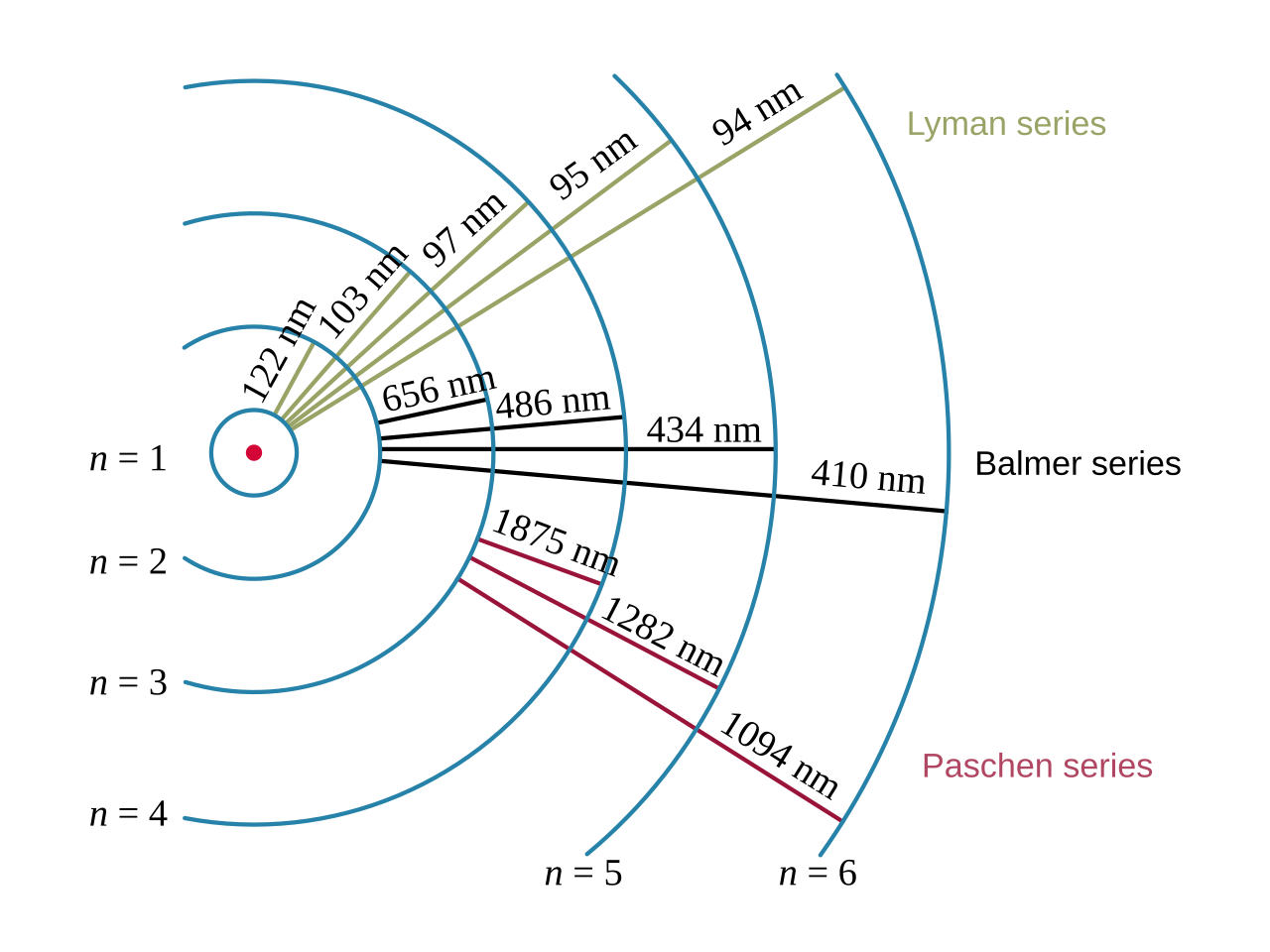
Lyman
Balmer
Paschen
None of them
Balmer lines (n → 2) at 656, 486, 434 and 410 nm are visible; Lyman is ultraviolet and Paschen infrared. Image: Szdori and OrangeDog, CC BY 2.5, via Wikimedia Commons.
In Rutherford's gold foil experiment, the rare alpha particles scattered backwards showed that
Positive charge and most of the atom's mass are concentrated in a tiny nucleus
Gold foil is a perfect crystal
Alpha particles are electrons
Electrons are very massive
A uniform plum-pudding atom could not exert a strong enough force to reverse an alpha particle.
Which set of quantum numbers is NOT allowed for an electron in an atom?
must be less than : for n = 2, can only be 0 or 1.
What is the maximum number of electrons in the n = 4 shell?
8
18
32
16
.
The quark content of a neutron is
ddd
udd
uud
uds
Charge: . A proton is uud.
In this Standard Model chart, which particle has spin 0?
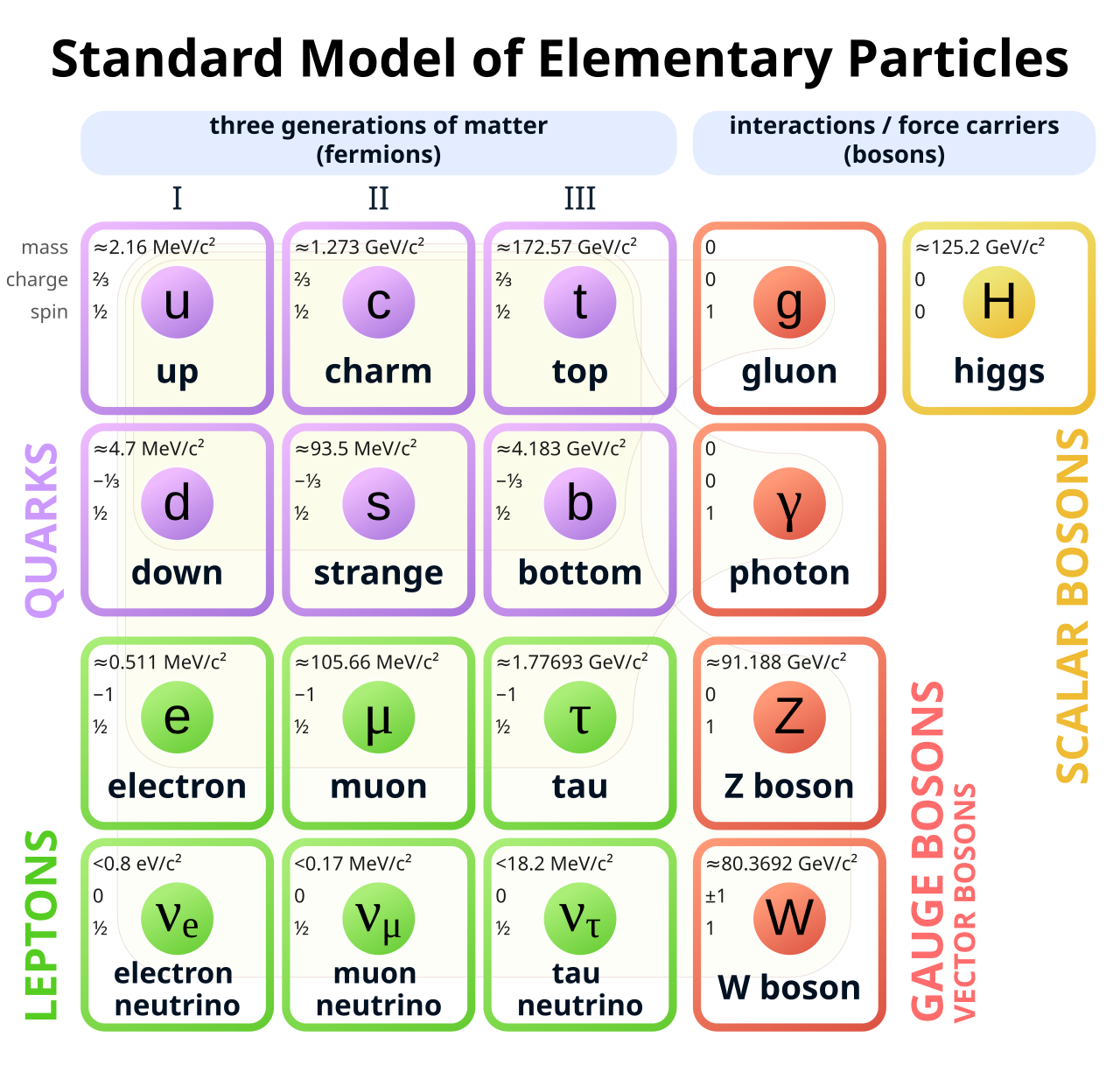
Higgs boson
W boson
Photon
Gluon
The Higgs is the only scalar boson; gauge bosons have spin 1. Image: MissMJ and Cush, public domain, via Wikimedia Commons.
What is the minimum photon energy needed for electron–positron pair production?
938 MeV
13.6 eV
0.511 MeV
1.022 MeV
MeV, and a nearby nucleus is required to absorb momentum.
Which property is NOT characteristic of laser light?
Coherence
Narrow wavelength range
Low directionality (spreads widely)
Produced by stimulated emission
Laser light is highly directional with small beam divergence.
A star's spectrum peaks at about 290 nm. Using Wien's law ( m·K), what is its surface temperature?
About 3,000 K
About 10,000 K
About 29,000 K
About 5,800 K
K.
What does this Stern–Gerlach experiment show about silver atoms?
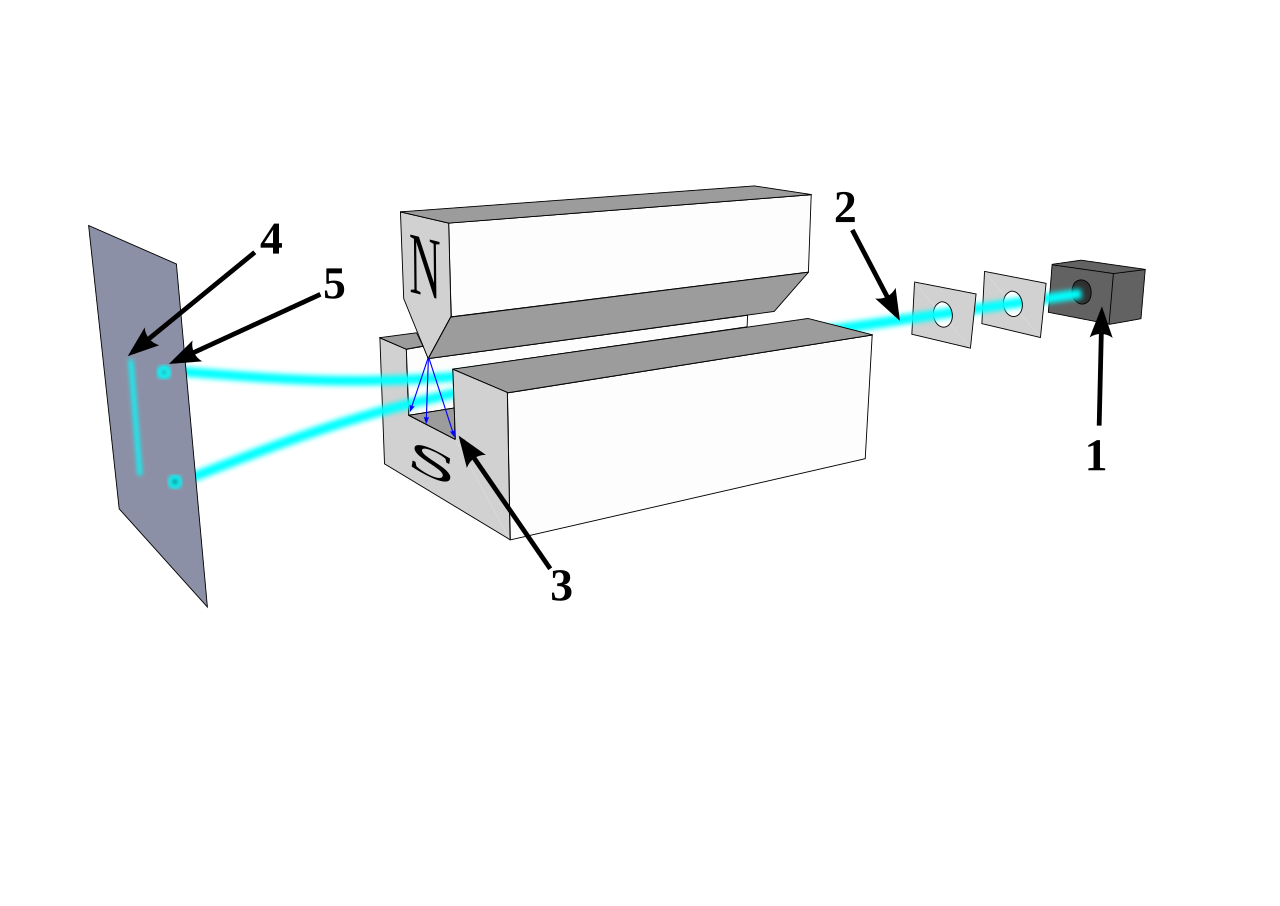
Their spin takes only discrete orientations, giving two beams
Their mass is quantised
They have no magnetic moment
They are deflected continuously
A classical magnetic moment would give a continuous smear (item 4); two spots (item 5) were observed. Image: Tatoute, CC BY-SA 4.0, via Wikimedia Commons.
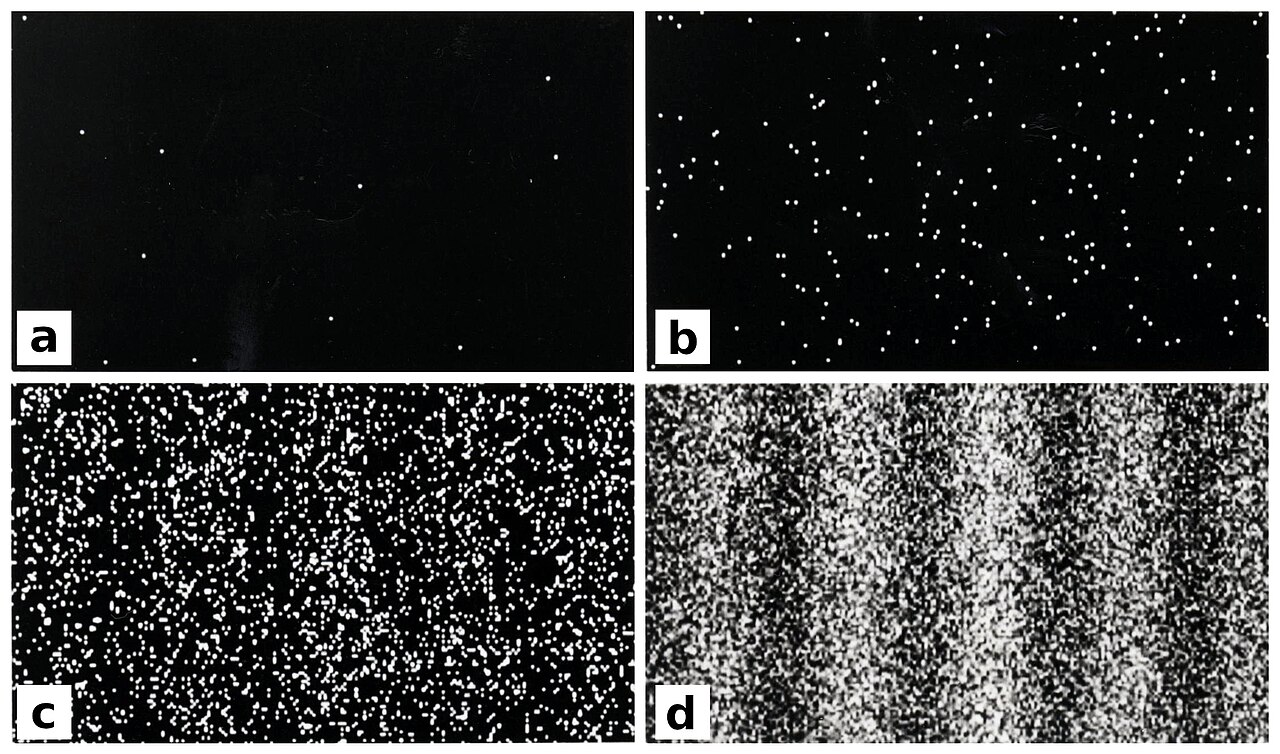
The electron double-slit pattern builds up one detection at a time. What is the main conclusion?
The detector creates the fringes
Electrons are only waves
Electrons are only particles
Electrons are detected as particles, but their arrival probabilities follow a wave interference pattern
Wave–particle duality: individual detections are random dots, yet the distribution shows interference fringes. Image: Belsazar and MikeRun after Tonomura et al., CC BY-SA 3.0, via Wikimedia Commons.
