Quiz · Medium
First actions for cardiac arrest, arrhythmias, trauma, burns and toxic ingestions.
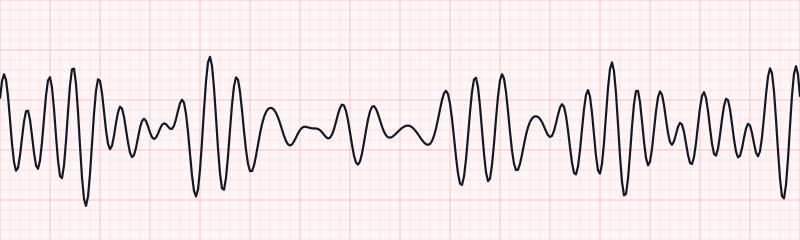
A pulseless patient has the rhythm shown. What is the immediate treatment?
Atropine 1 mg
Synchronized cardioversion
Defibrillation
Adenosine 6 mg
Ventricular fibrillation is shockable and requires unsynchronized defibrillation plus CPR. Synchronized shocks are for tachyarrhythmias with a pulse.
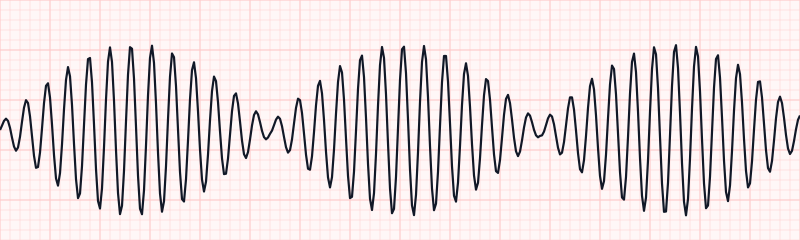
This waveform shows a twisting amplitude pattern in a patient taking sotalol. First-line drug?
Amiodarone
Magnesium sulfate
Lidocaine
Procainamide
Torsades de pointes is treated with IV magnesium. Amiodarone and procainamide prolong QT and can worsen it.
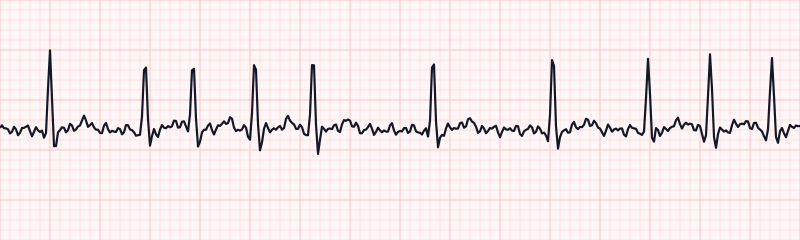
Irregularly irregular rhythm with no P waves. What is the first priority in a hypotensive patient?
Diltiazem
Digoxin
Heparin only
Synchronized cardioversion
Hemodynamic instability mandates synchronized cardioversion. Rate control drugs are for stable patients.
A patient arrests with PEA. Which is the best immediate drug?
Atropine 1 mg
Amiodarone 300 mg
Calcium gluconate in every case
Epinephrine 1 mg IV
Non-shockable rhythm: epinephrine as soon as possible, and search for reversible causes. Atropine is no longer recommended for PEA/asystole.
A patient with severe symptomatic bradycardia has a heart rate of 36 and BP 70/40. First drug?
Adenosine 6 mg
Amiodarone 150 mg
Lidocaine
Atropine 1 mg IV
Atropine is first-line; if ineffective, transcutaneous pacing or dopamine/epinephrine infusion.
A 26-year-old has HR 190, narrow regular complexes and is stable. Vagal maneuvers fail. Next?
Synchronized cardioversion at 200 J
Adenosine 6 mg rapid IV push
Atropine
Amiodarone infusion
Stable SVT: vagal maneuvers, then adenosine. Cardioversion is reserved for instability.
A man in a motor collision has hypotension, distended neck veins, absent right breath sounds and tracheal deviation. What is the first intervention?
Needle or finger decompression of the right chest
Intubation with positive pressure
Pericardiocentesis
Chest radiograph
Tension pneumothorax is a clinical diagnosis; delaying for imaging is deadly. Positive pressure ventilation worsens it.
After a stab wound to the chest a man is hypotensive with muffled heart sounds and JVD. Diagnosis?
Cardiac tamponade
Hemorrhagic shock without chest injury
Tension pneumothorax
Aortic dissection
Beck triad. Breath sounds are present, unlike tension pneumothorax.
A 20-year-old has an anaphylactic reaction after a bee sting. Which is first?
Epinephrine IM in the thigh
Diphenhydramine IV
Methylprednisolone IV
Albuterol nebulizer
Epinephrine is the only first-line treatment; others are adjuncts.
Which intravenous fluid is used for burn resuscitation according to the Parkland formula?
Albumin in the first 8 hours
5% dextrose in water
Lactated Ringer
0.45% saline
4 mL/kg/%TBSA, half in the first 8 hours.
A 40-year-old firefighter has a headache and confusion, SpO2 99 percent. What is the diagnostic test?
Pulse oximetry repeated
Methemoglobin level
Co-oximetry (carboxyhemoglobin level)
Arterial lactate only
Pulse oximetry cannot distinguish carboxyhemoglobin from oxyhemoglobin. Treat with 100 percent oxygen.
What is the antidote for acetaminophen overdose?
Flumazenil
Physostigmine
Fomepizole
N-acetylcysteine
NAC replenishes glutathione; use the Rumack-Matthew nomogram.
An alcoholic man presents with metabolic acidosis, an elevated osmolar gap and visual changes. Treatment?
Fomepizole
Deferoxamine
Naloxone
Pralidoxime
Methanol; fomepizole blocks alcohol dehydrogenase.
ECG shows peaked T waves and a widening QRS in a dialysis patient. First step?
IV calcium
Furosemide
Kayexalate
Insulin and dextrose
Calcium stabilizes the myocardium immediately; insulin and dextrose shift K but do not protect the heart acutely.
Which is a contraindication to nitroglycerin in chest pain?
Inferior MI with right ventricular involvement
Anterior MI
Hypertension
Heart rate 100
RV infarction is preload dependent; nitrates cause profound hypotension. Also avoid after PDE5 inhibitors.
A patient presents 30 minutes after a STEMI at a hospital without PCI capability; PCI transfer would take over 2 hours. What is best?
Stress test
Wait for transfer without therapy
Fibrinolysis within 30 minutes
Heparin only
Door-to-needle under 30 minutes when PCI cannot be done in 120 minutes.
A 22-year-old has sudden severe unilateral scrotal pain, absent cremasteric reflex. Next step?
Scrotal ultrasound after 24 hours
Antibiotics for epididymitis and discharge
Urgent urology consultation and surgical exploration
Wait for urinalysis
Testicular torsion has a 6-hour salvage window.
A 70-year-old with atrial fibrillation has severe abdominal pain with a soft abdomen and lactate 5. Diagnosis?
Acute mesenteric ischemia
Cholecystitis
Diverticulitis
Gastroenteritis
Pain out of proportion; CT angiography then surgery.
Which patient is classified immediate (red) in START triage?
Not breathing after airway repositioning
Respiratory rate 20, cap refill 1 second, follows commands, cannot walk
Cannot walk, respiratory rate 34, follows commands
Walking with arm fracture
A respiratory rate over 30 makes the patient immediate. Walkers are green and non-breathers after repositioning are black.
A GCS of 8 in a trauma patient most closely suggests:
Routine discharge
Minor head injury
Observation only
Need for definitive airway
GCS 8 or less indicates severe injury and inability to protect the airway.
Which paralytic can cause life-threatening hyperkalemia in a patient with a crush injury three days old?
Vecuronium
Rocuronium
Succinylcholine
Cisatracurium
Upregulated extrajunctional receptors lead to potassium efflux; use rocuronium.
In stable regular narrow-complex tachycardia, adenosine is given only after vagal maneuvers fail.
True
False
Start with vagal maneuvers, then adenosine.
