Quiz · Easy
Eighteen foundational questions on molar mass, the mole map, mole ratios, simple limiting-reactant diagrams, percent yield and molarity.
What is the molar mass of Al₂(SO₄)₃ (Al 26.98, S 32.06, O 16.00)?
278.1 g/mol
450.2 g/mol
342.1 g/mol
315.1 g/mol
2(26.98) + 3(32.06) + 12(16.00) = 53.96 + 96.18 + 192.00 = 342.14 g/mol. The subscript 3 multiplies S and all four O atoms inside the parentheses.
How many moles of atoms are in 1.00 mol of Ca(NO₃)₂?
9
5
4
3
1 Ca + 2 N + 6 O = 9 mol of atoms.
Which sample contains the most molecules?
10.0 g of H₂O
10.0 g of CO₂
10.0 g of NH₃
10.0 g of CH₄
With equal masses, the smallest molar mass gives the most moles. CH₄ (16.04 g/mol) gives 0.623 mol, versus 0.587 mol (NH₃), 0.555 mol (H₂O) and 0.227 mol (CO₂).
How many oxygen atoms are in 0.250 mol of Na₂SO₄?
1.20 × 10²⁴
2.41 × 10²⁴
6.02 × 10²³
1.51 × 10²³
0.250 mol × 4 O × 6.022 × 10²³ = 6.02 × 10²³. Forgetting the factor of 4 gives 1.51 × 10²³.
In N₂ + 3H₂ → 2NH₃, how many moles of NH₃ form from 4.5 mol H₂ (excess N₂)?
1.5 mol
3.0 mol
6.75 mol
9.0 mol
4.5 × (2/3) = 3.0 mol. 6.75 uses the ratio upside down.
For 2H₂ + O₂ → 2H₂O, Mixture A in the diagram has 4 H₂ and 3 O₂ molecules. What happens?
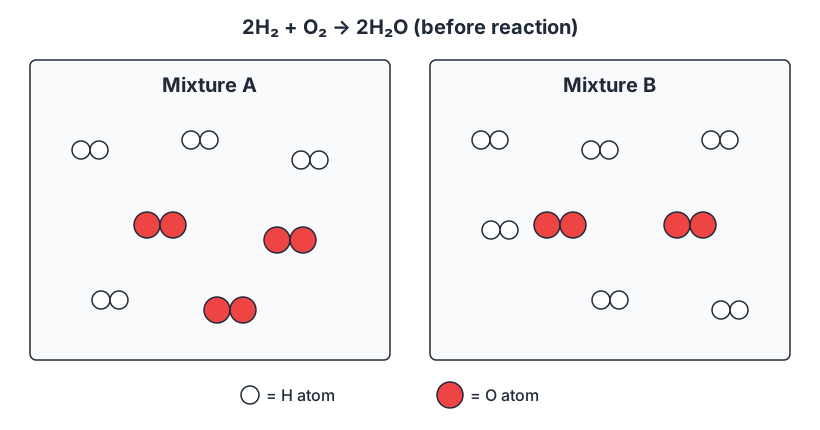
O₂ is limiting and H₂ is left over
Both are used up completely
No reaction occurs
H₂ is limiting and one O₂ is left over
4 H₂ need only 2 O₂. With 3 O₂ present, one O₂ is left over and H₂ is the limiting reactant.
What mass of CO₂ forms when 12.0 g of carbon burns completely in excess O₂ (C + O₂ → CO₂)?
12.0 g
22.0 g
32.0 g
44.0 g
12.0 g C is 1.00 mol (12.01 g/mol), which gives 1.00 mol CO₂ = 44.0 g.
A reaction should give 20.0 g of product, but only 15.0 g is collected. The percent yield is:
25.0%
5.0%
75.0%
133%
15.0/20.0 × 100 = 75.0%. 133% inverts actual and theoretical yield.
What is the molarity when 20.0 g NaOH (40.00 g/mol) is dissolved to make 500. mL of solution?
0.0400 M
1.00 M
0.500 M
2.00 M
n = 20.0/40.00 = 0.500 mol; M = 0.500 mol / 0.500 L = 1.00 M. Using 500 (mL) instead of 0.500 L is a unit error.
What volume of 12.0 M HCl is needed to make 250 mL of 1.50 M HCl?
31.3 mL
8.0 mL
3.13 mL
125 mL
V₁ = M₂V₂/M₁ = (1.50 × 250)/12.0 = 31.25 mL ≈ 31.3 mL.
An oxide of nitrogen contains 63.2% O by mass (N 14.01, O 16.00). Its empirical formula is:
N₂O₃
NO
NO₂
N₂O
N: 36.8/14.01 = 2.63 mol; O: 63.2/16.00 = 3.95 mol. Ratio 1 : 1.50, so multiply by 2 to get N₂O₃. NO₂ would be 69.6% O.
Which sequence converts grams of a substance to number of molecules (mole map)?
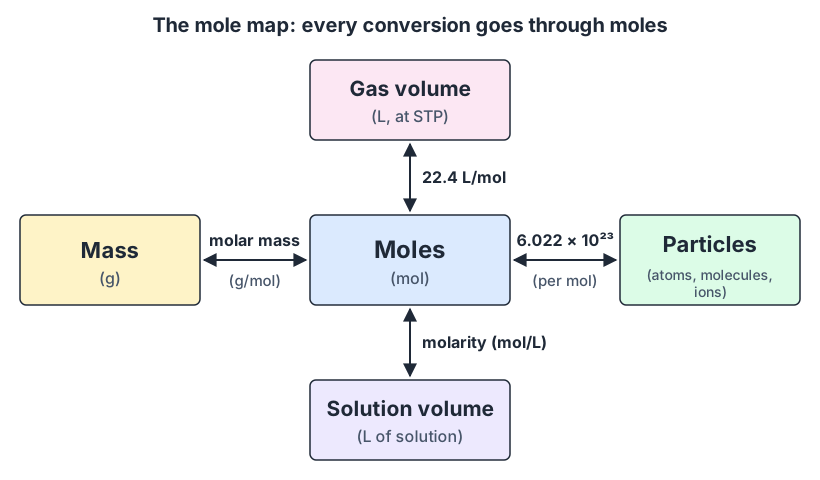
grams ÷ 22.4 × 6.022 × 10²³
grams × 22.4 ÷ molar mass
grams ÷ molar mass × 6.022 × 10²³
grams × molar mass × 6.022 × 10²³
Grams → moles divides by molar mass; moles → particles multiplies by Avogadro's number. 22.4 L/mol applies to gas volume only.
Why is the oxygen in the sample found by difference in combustion analysis?
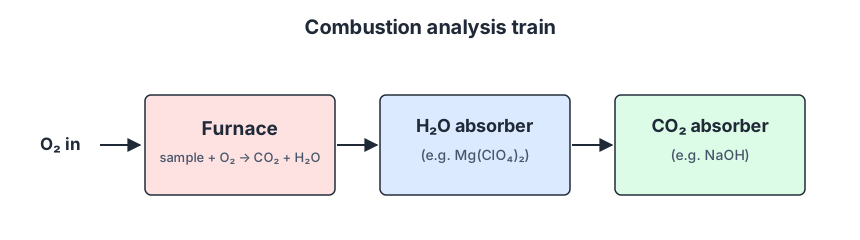
Oxygen is always 50% of the compound
Some oxygen in the CO₂ and H₂O comes from the supplied O₂
Oxygen is not absorbed by anything
Oxygen cannot be weighed
Only C (from CO₂) and H (from H₂O) can be traced back to the sample. The O atoms in the products partly come from the O₂ stream, so sample O = sample mass − mass C − mass H.
How many grams of O₂ react with 4.0 g of H₂ in 2H₂ + O₂ → 2H₂O?
32 g
16 g
64 g
8.0 g
4.0 g H₂ is about 2.0 mol; the O₂ needed is 1.0 mol = 32 g.
The volume of 0.50 mol of an ideal gas at STP (0 °C, 1 atm) is about:
22.4 L
5.6 L
44.8 L
11.2 L
0.50 × 22.4 = 11.2 L.
True or false: in a balanced equation the coefficients tell you the ratio of masses of reactants and products.
True
False
Coefficients give mole ratios (and, for gases at the same T and P, volume ratios). To get masses you must multiply by molar masses.
How many mL of 0.100 M NaOH neutralize 20.0 mL of 0.100 M H₂SO₄?
80.0 mL
40.0 mL
20.0 mL
10.0 mL
H₂SO₄ is diprotic: 20.0 mL × 0.100 M = 2.00 mmol acid needs 4.00 mmol NaOH = 40.0 mL. 20.0 mL would be right for HCl.
