Quiz · Medium
Wave speed, intensity and decibels, beats, string and pipe resonance, Doppler shift and sonic booms, with common wrong answers explained.
The frequency of a light wave changes when it passes from air into water.
True
False
False. Frequency is fixed by the source. Speed and wavelength decrease by the factor n in water.
A 440 Hz tuning fork sounds in air where the speed of sound is 343 m/s. What is the wavelength of the sound?
1.28 m
0.78 m
0.39 m
151 m
m. 1.28 m comes from inverting the ratio (f/v); 151 m multiplies instead of dividing.
A sound wave passes from air into water. Which quantity stays the same?
Its frequency
Its wavelength
Its speed
Its wavelength and speed
The source sets the frequency. Speed changes with the medium (about 343 m/s in air, 1480 m/s in water), so wavelength changes too.
The tension in a stretched string is quadrupled. What happens to the speed of waves on the string?
It quadruples
It halves
It stays the same
It doubles
, so gives .
You double your distance from a small speaker in an open field. By what factor does the sound intensity change?
It becomes 1/2
It becomes 1/8
It becomes 1/4
It stays the same
A point source spreads over area ; doubling r gives 4 times the area and 1/4 the intensity.
One sound has an intensity level of 60 dB and another 70 dB. How do their intensities compare?
The 70 dB sound is 7/6 times as intense
The 70 dB sound is 10 times as intense
The 70 dB sound is 100 times as intense
The 70 dB sound is 1.17 times as intense
dB means . Decibels are a logarithmic scale.
Two violin strings sound at 440 Hz and 446 Hz simultaneously. What do you hear?
A tone of about 443 Hz that gets louder and softer 6 times per second
A steady tone of 6 Hz
Two separate tones with no variation in loudness
A tone at 886 Hz
Beat frequency Hz; the perceived pitch is the average (443 Hz).
A 0.65 m string fixed at both ends supports waves that travel at 300 m/s. What is its fundamental frequency?
462 Hz
115 Hz
300 Hz
231 Hz
Hz. 462 Hz is the second harmonic.
A pipe 0.25 m long is closed at one end. What is its fundamental frequency in air (v = 343 m/s)?
686 Hz
172 Hz
343 Hz
1029 Hz
Hz. 686 Hz would be the open pipe of the same length; 1029 Hz is the third harmonic of the closed pipe.
Which set of frequencies can a pipe closed at one end produce (f₁ is the fundamental)?
f₁, 2f₁, 3f₁, …
f₁, 3f₁, 5f₁, …
2f₁, 4f₁, 6f₁, …
f₁, 4f₁, 9f₁, …
A closed end is a node and the open end an antinode, so only odd multiples fit. An open pipe supports all integer multiples.
A 500 Hz siren on an ambulance approaches you at 30 m/s (speed of sound 343 m/s). What frequency do you hear?
About 548 Hz
About 460 Hz
500 Hz
About 530 Hz
Hz. 460 Hz is the frequency after it passes (receding).
A jet flies at Mach 2. What is the half-angle of its shock cone?
60°
45°
26.6°
30°
, so . 60° is the complement.
A hiker hears the echo of her shout 0.40 s later. How far is the cliff (v = 343 m/s)?
137 m
34 m
69 m
0.14 m
The sound travels twice the distance: m. 137 m forgets the round trip.
Two pipes of equal length, one open at both ends and one closed at one end, are sounded in their fundamental modes. How do the frequencies compare?
The closed pipe's frequency is twice the open pipe's
The open pipe's frequency is twice the closed pipe's
They are equal
The open pipe's frequency is four times the closed pipe's
and .
A pulse travelling along a rope reaches a fixed end. What happens to the reflected pulse?
It is inverted
It is reflected upright
It is absorbed completely
It changes speed
The rope pulls the wall up, the wall pulls back down on the rope (Newton's third law), so the reflected pulse is inverted. A free end reflects the pulse upright.
Which statement about seismic waves is correct?
P-waves cannot travel through liquids
S-waves are longitudinal
S-waves arrive before P-waves
S-waves cannot travel through Earth's liquid outer core
S-waves are transverse and need a shear-resistant medium, so liquids block them. P-waves are longitudinal, travel through everything and arrive first.
A 0.10 W loudspeaker radiates sound equally in all directions. What is the intensity level 2.0 m away? (I₀ = 10⁻¹² W/m²)
120 dB
83 dB
93 dB
20 dB
W/m². dB.
A standing wave on a string fixed at both ends is vibrating in its third harmonic. How many nodes and antinodes does it have (counting the fixed ends as nodes)?
3 nodes and 4 antinodes
4 nodes and 3 antinodes
3 nodes and 3 antinodes
2 nodes and 3 antinodes
The n-th harmonic has n antinodes and n + 1 nodes (counting both ends).
On the sine wave in the diagram, if the amplitude A₀ doubles while the frequency stays the same, what happens to the energy carried by the wave?
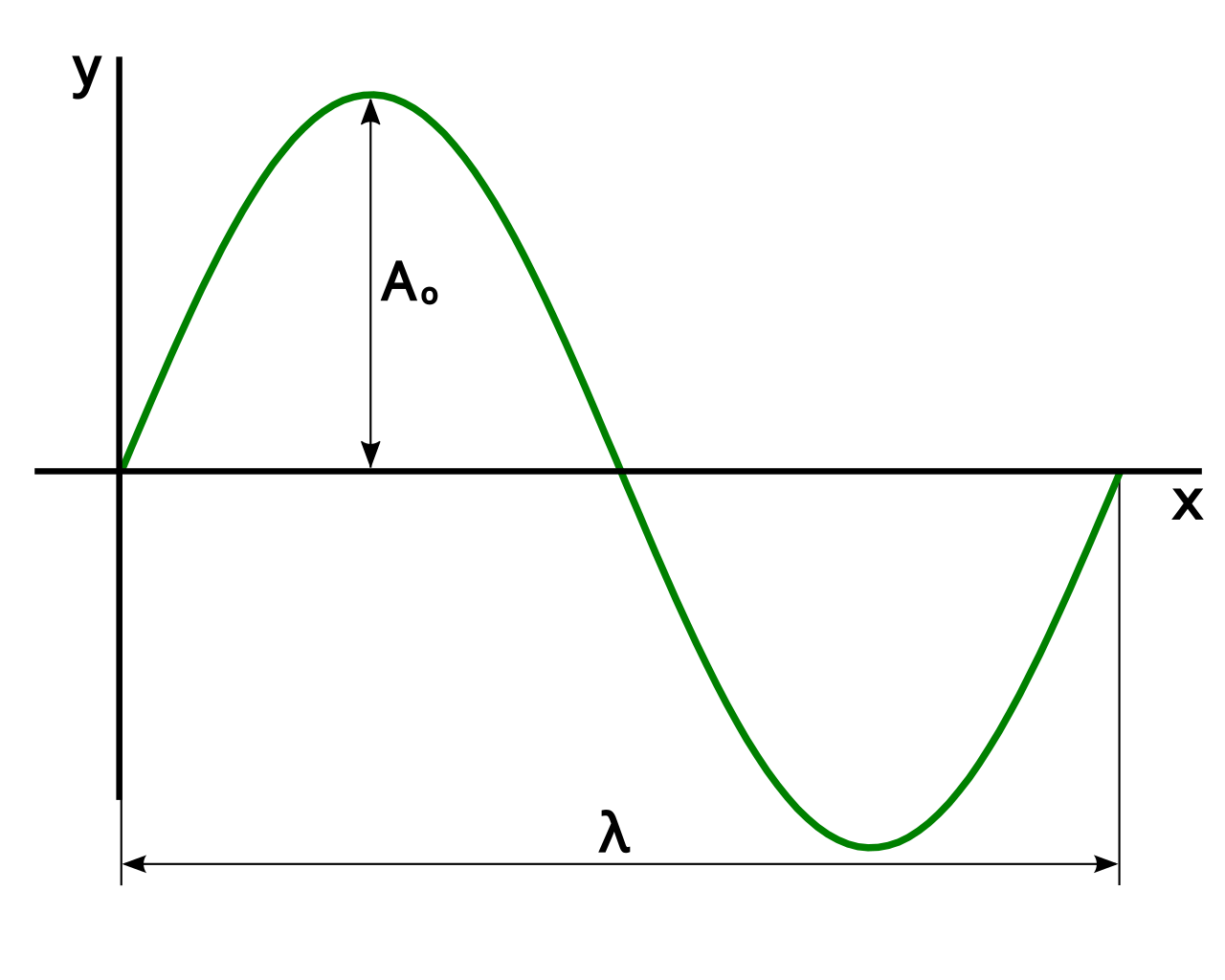
It increases by a factor of 4
It doubles
It is unchanged
It increases by a factor of 8
Wave energy and intensity are proportional to the amplitude squared. Image: Badseed and others, CC BY-SA 3.0, via Wikimedia Commons.
In the diagram the source (orange) moves to the left. What does a stationary observer to the right of the source hear?
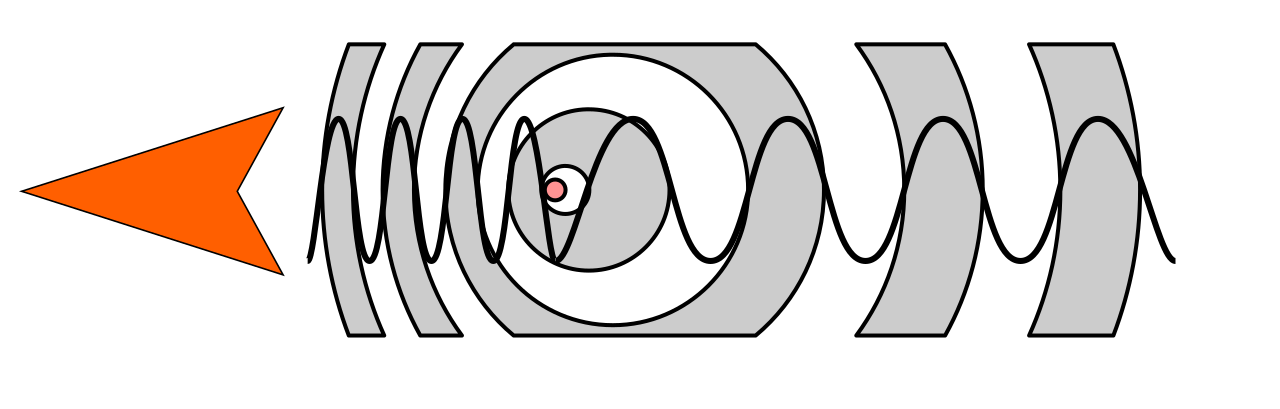
A higher frequency than the source emits
The same frequency
A louder sound with the same pitch
A lower frequency than the source emits
Behind the moving source, the wavefronts are stretched (longer wavelength), so the pitch is lower. Image: Tkarcher and Tatoute, CC BY-SA 3.0, via Wikimedia Commons.
A tuning fork with shorter prongs (same material and thickness) vibrates at a higher frequency, which is why tuning forks of different pitch differ in size.
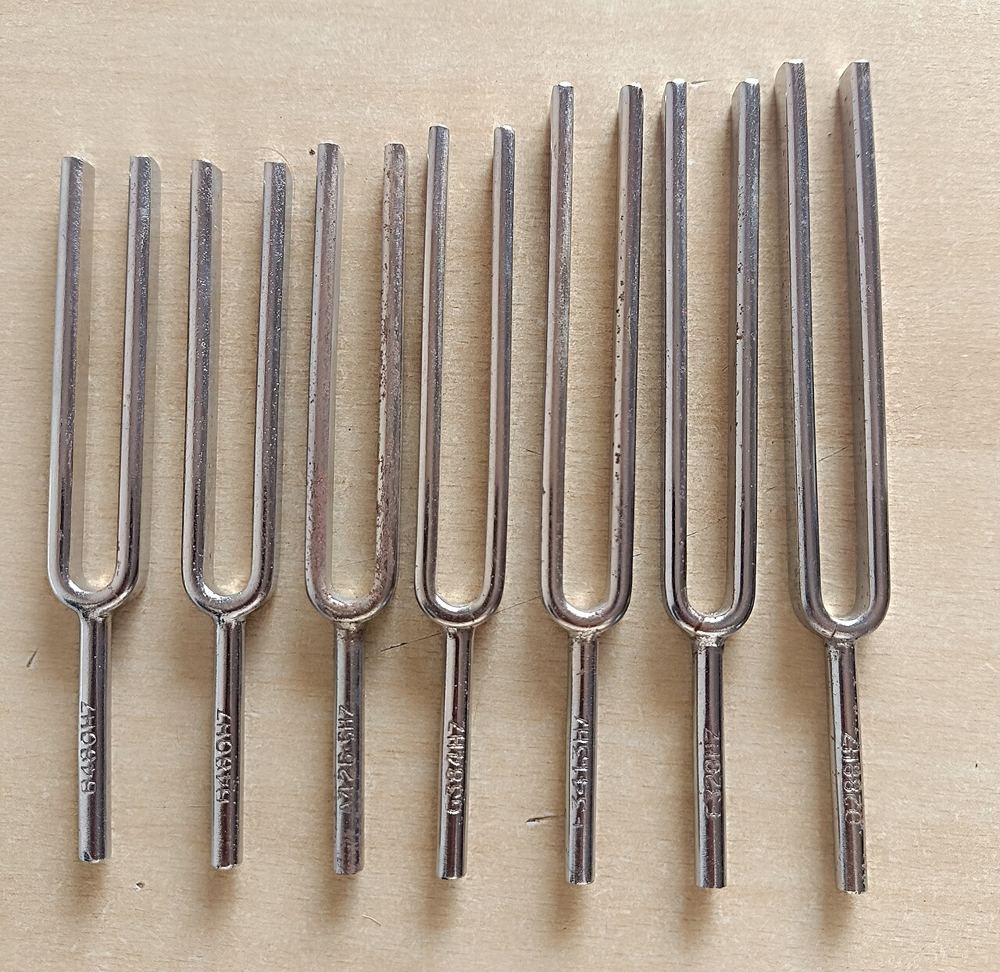
True
False
True. Shorter prongs are stiffer for their mass, so they oscillate faster. A fork produces nearly a pure tone. Image: K.Venkataramana, CC0, via Wikimedia Commons.
