Quiz · Hard
Sixteen multi-step problems: impurity and yield calculations, combustion analysis, precipitation, gas volumes, dilution and isotope averages.
A 2.00 g sample of impure CaCO₃ releases 0.410 g CO₂ when heated (CaCO₃ → CaO + CO₂). What is the mass percent of CaCO₃?
20.5%
23.3%
46.6%
93.3%
n(CO₂) = 0.410/44.01 = 9.32 × 10⁻³ mol = n(CaCO₃), a mass of 0.932 g. 0.932/2.00 = 46.6%. 93.3% comes from doubling.
5.00 g of Mg reacts with 5.00 g of O₂ (2Mg + O₂ → 2MgO). What mass of MgO forms?
8.29 g
12.6 g
10.0 g
4.15 g
Mg: 5.00/24.31 = 0.206 mol; O₂: 5.00/32.00 = 0.156 mol, which would need 0.312 mol Mg. Mg is limiting: 0.206 mol MgO × 40.30 = 8.29 g. 12.6 g is the figure if O₂ were limiting; 10.0 g adds the masses, but not all the O₂ reacts.
28.0 g of N₂ reacts with excess H₂ and 25.5 g of NH₃ is isolated. What is the percent yield?
91.1%
37.5%
150%
74.9%
28.0 g N₂ = 0.999 mol → 2.00 mol NH₃ → 34.0 g theoretical. 25.5/34.0 = 74.9%. 37.5% forgets that 1 mol N₂ gives 2 mol NH₃.
0.500 g of a hydrocarbon burns to give 1.514 g CO₂ and 0.775 g H₂O. Its molar mass is 58.1 g/mol. What is its molecular formula?
C₃H₈
C₅H₁₂
C₄H₁₀
C₂H₅
C: 1.514/44.01 = 0.0344 mol; H: 2 × 0.775/18.02 = 0.0860 mol. Ratio H : C = 2.5, so the empirical formula is C₂H₅ (29.06 g/mol). 58.1/29.06 = 2, giving C₄H₁₀.
100.0 mL of 0.200 M BaCl₂ is mixed with 100.0 mL of 0.100 M Na₂SO₄. What mass of BaSO₄ (233.39 g/mol) precipitates?
0.233 g
2.33 g
4.67 g
1.17 g
Ba²⁺: 0.0200 mol; SO₄²⁻: 0.0100 mol. SO₄²⁻ is limiting, so 0.0100 mol × 233.39 = 2.33 g. 4.67 g would use the Ba²⁺.
What volume of 0.1000 M HCl is needed to react completely with 0.500 g Na₂CO₃ (105.99 g/mol) giving CO₂?
47.2 mL
189 mL
4.72 mL
94.4 mL
Na₂CO₃ + 2HCl → 2NaCl + H₂O + CO₂. n(Na₂CO₃) = 4.72 × 10⁻³ mol; HCl = 9.44 × 10⁻³ mol; V = 94.4 mL. 47.2 mL forgets the 2.
2.00 g of Mg reacts with excess HCl at 25 °C and 1.00 atm. What volume of H₂ forms?
1.84 L
4.03 L
0.0823 L
2.01 L
n(H₂) = 2.00/24.31 = 0.0823 mol. V = nRT/P = 0.0823 × 0.08206 × 298/1.00 = 2.01 L. 1.84 L comes from wrongly using 22.4 L/mol, which holds only at 0 °C.
Boron has two isotopes: ¹⁰B (10.013 u) and ¹¹B (11.009 u). The average atomic mass is 10.81 u. What is the abundance of ¹¹B?
50.0%
10.8%
80.0%
20.0%
10.013 + x(11.009 − 10.013) = 10.81 → x = 0.797/0.996 = 0.800, so 80.0%. The average is closer to the heavier isotope.
Concentrated HCl is 36.0% by mass with density 1.18 g/mL (M = 36.46 g/mol). What is its molarity?
13.7 M
11.7 M
9.87 M
36.0 M
In 1 L: mass = 1180 g; HCl = 0.360 × 1180 = 425 g = 11.65 mol. 9.87 M ignores the density.
4FeS₂ + 11O₂ → 2Fe₂O₃ + 8SO₂. What mass of SO₂ forms from 60.0 g FeS₂ (119.98 g/mol) with excess O₂?
64.1 g
32.0 g
128 g
16.0 g
60.0/119.98 = 0.500 mol FeS₂; × 8/4 = 1.00 mol SO₂ = 64.1 g.
10.0 mL of a 0.500 M stock is diluted to 100.0 mL. Then 5.00 mL of that solution is diluted to 50.0 mL. What is the final concentration?
0.00500 M
0.0500 M
0.0250 M
0.500 M
First dilution factor 10 → 0.0500 M. Second dilution factor 10 → 0.00500 M.
50.0 mL of 0.200 M HCl is mixed with 30.0 mL of 0.100 M NaOH. What is [H⁺] after mixing?
0.100 M
0.0700 M
0.0875 M
0.140 M
H⁺: 0.0100 mol; OH⁻: 0.00300 mol. Excess H⁺ = 0.00700 mol in 0.0800 L = 0.0875 M. 0.140 M divides by the acid volume only.
True or false: doubling every coefficient in a balanced equation changes how much product you get from a given amount of reactant.
True
False
Only the ratios of coefficients matter, and doubling them keeps the ratios the same, so the predicted amounts are unchanged.
In Mixture B of the diagram (6 H₂ and 2 O₂), what is left after the reaction 2H₂ + O₂ → 2H₂O goes to completion?
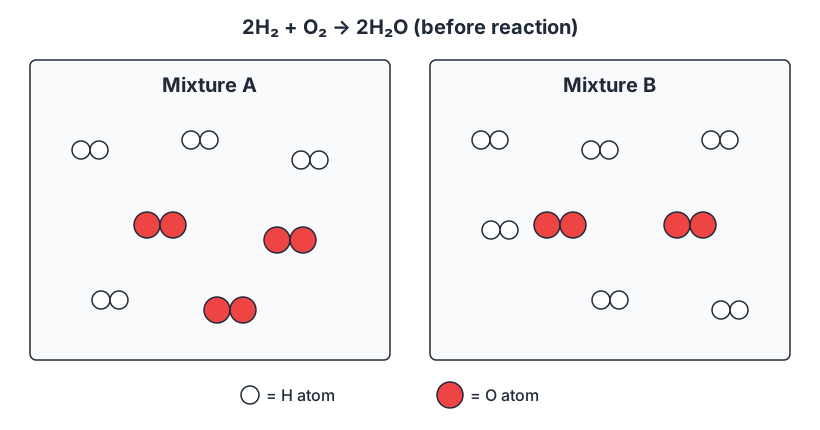
4 H₂O and 2 H₂
6 H₂O and no H₂
2 H₂O and 4 O₂
4 H₂O and 2 O₂
2 O₂ are limiting and use 4 H₂ to form 4 H₂O. Two H₂ remain.
What is the mass percent of nitrogen in NH₄NO₃ (80.05 g/mol)?
17.5%
28.0%
46.7%
35.0%
There are 2 N atoms: 28.02/80.05 = 35.0%. 17.5% counts only one N.
In the combustion train shown, why is the H₂O absorber placed before the NaOH CO₂ absorber?
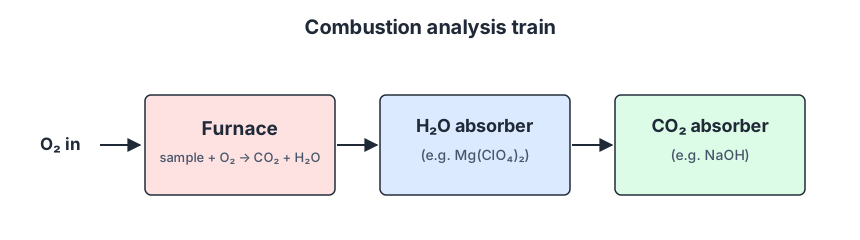
Water cannot pass through NaOH
NaOH would also absorb water, so CO₂ could not be weighed separately
CO₂ is produced after water
NaOH reacts with oxygen
Water is removed first by Mg(ClO₄)₂. Because the NaOH absorber would take up both CO₂ and H₂O, the mass gain would not separate the two products.
