Quiz · Medium
Nuclear notation, alpha, beta and gamma decay, binding energy, half-life and activity calculations, carbon dating, radiation dose, and questions on the binding curve and uranium series.
How many neutrons are in a nucleus of uranium-238 (Z = 92)?
330
92
146
238
N = A − Z = 238 − 92 = 146.
Uranium-238 undergoes alpha decay. What is the daughter nuclide?
U
Th
Np
U
Alpha emission lowers A by 4 and Z by 2: Th.
Cobalt-60 (Z = 27) decays by beta-minus emission. What is the daughter nuclide?
Ni (Z = 28)
Co (Z = 27)
Mn (Z = 25)
Fe (Z = 26)
β⁻ increases Z by 1 and leaves A unchanged, giving nickel-60 (which then emits two gamma rays).
A nuclide undergoes 3 alpha decays and 2 beta-minus decays. By how much do its mass number A and atomic number Z change?
A − 12, Z − 8
A − 6, Z − 4
A − 14, Z − 6
A − 12, Z − 4
A changes by −4 per alpha (−12 total). Z changes by −2 per alpha (−6) and +1 per beta-minus (+2), net −4.
Using u, u and a helium-4 nucleus mass of 4.00151 u, what is the binding energy per nucleon of He-4 (1 u = 931.5 MeV/c²)?
About 0.03 MeV
About 28 MeV
About 7.1 MeV
About 14 MeV
u, so MeV and MeV.
A radioactive sample's mass falls to 1/8 of its original value in 12 days. What is its half-life?
3 days
4 days
6 days
1.5 days
1/8 = (1/2)³, so 12 days is 3 half-lives, giving 4 days.
A sample contains atoms of a nuclide with half-life 6.0 h. What is its activity ()?
Bq
Bq
Bq
Bq
Bq.
A wooden artefact has only 12.5% of the carbon-14 of living wood (half-life 5730 y). About how old is it?
45,840 years
5,730 years
11,460 years
17,190 years
12.5% = 1/8 = (1/2)³, so three half-lives: 3 × 5730 = 17,190 years.
Tissue absorbs 0.05 Gy of alpha radiation (weighting factor 20). What is the equivalent dose?
20 Sv
0.0025 Sv
1.0 Sv
0.05 Sv
Sv.
Which type of radiation is most strongly ionising?
They are equal
Alpha
Beta
Gamma
Alpha particles have a large charge (+2e), mass and low speed, so they deposit energy in a very short track.
Which particle is emitted together with the electron in the beta-minus decay of carbon-14?
An antineutrino
A positron
A neutron
A neutrino
conserves lepton number: electron (+1) and antineutrino (−1).
The diagram shows alpha, beta and gamma radiation meeting paper, aluminium and lead. Which radiation is stopped by the paper?
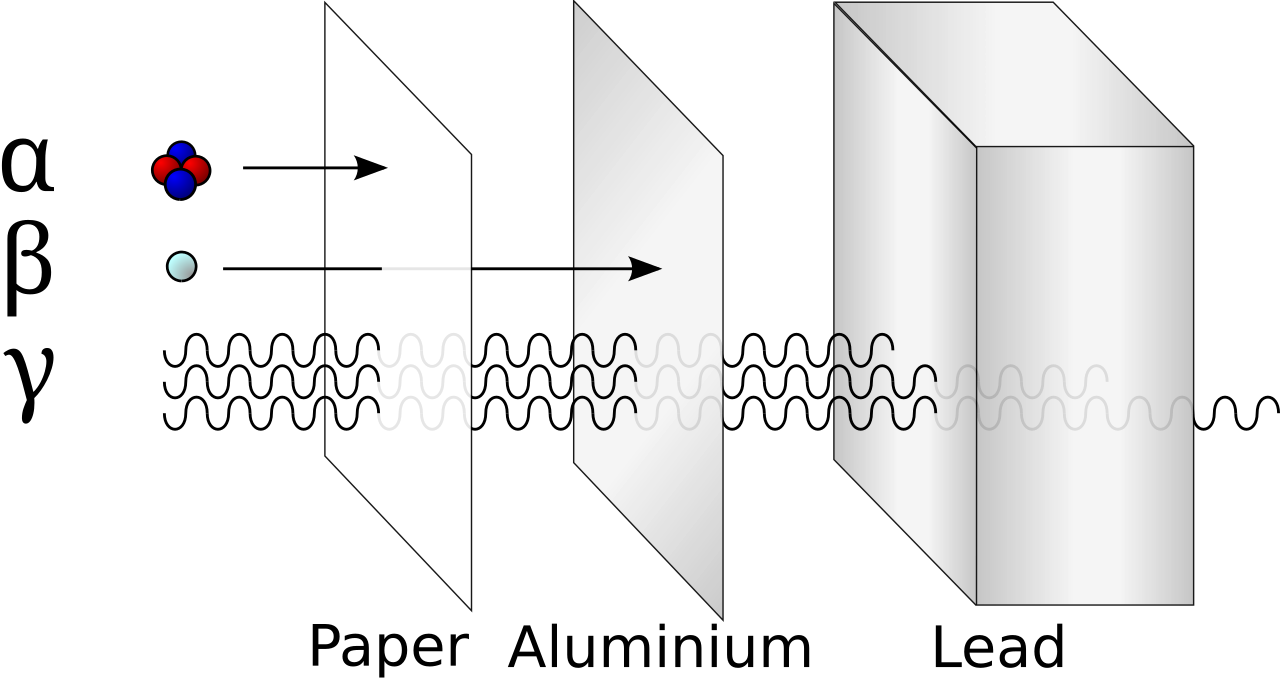
Beta
Gamma
All three
Alpha
Alpha particles are stopped by a sheet of paper or the outer layer of skin; beta needs aluminium and gamma needs lead or thick concrete. Image: Stannered and Ehamberg, CC BY 2.5, via Wikimedia Commons.
Which nucleus has about the highest binding energy per nucleon, according to this curve?
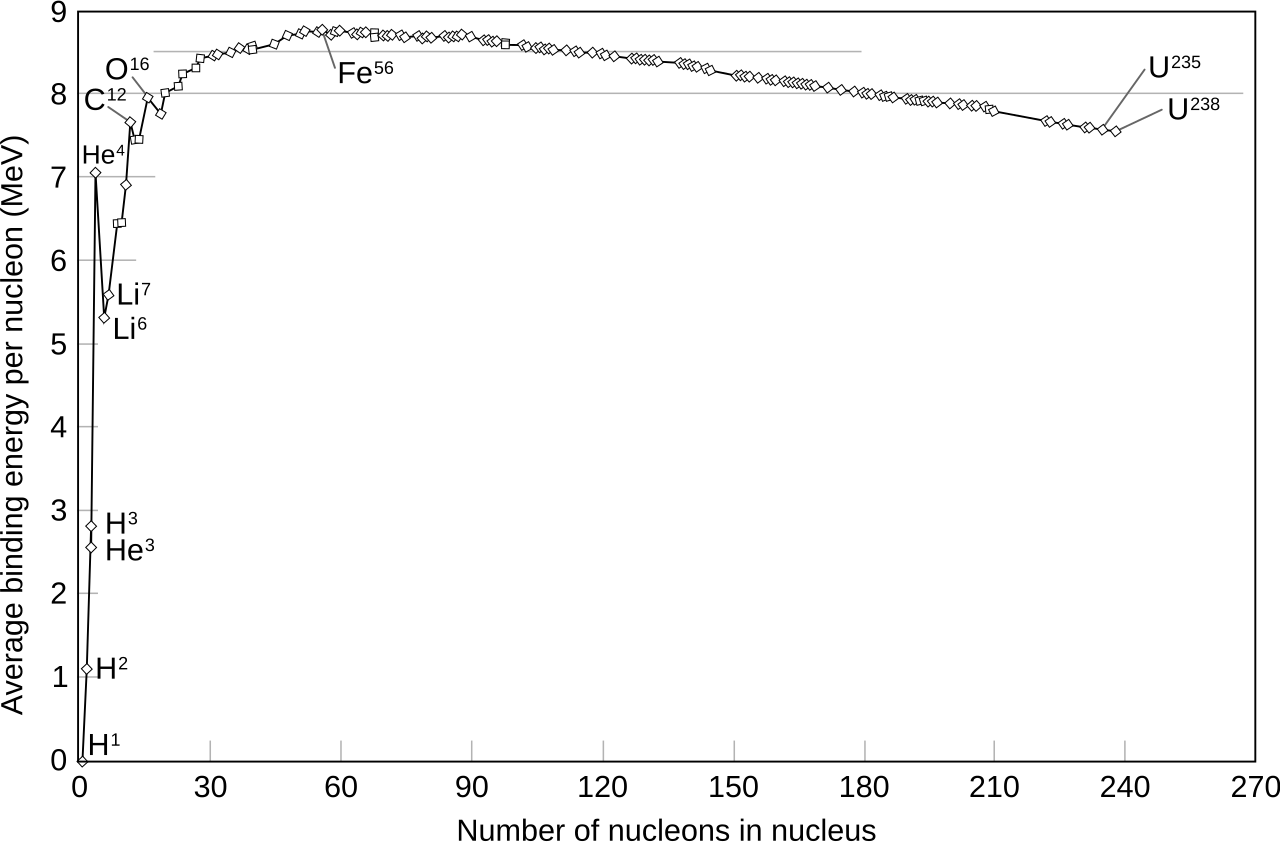
Helium-4
Uranium-235
Iron-56
Hydrogen-2
The curve peaks at the iron group, about 8.8 MeV per nucleon. Image: Fastfission, public domain, via Wikimedia Commons.
According to this decay curve, what fraction of the original nuclei remains after 4 half-lives?
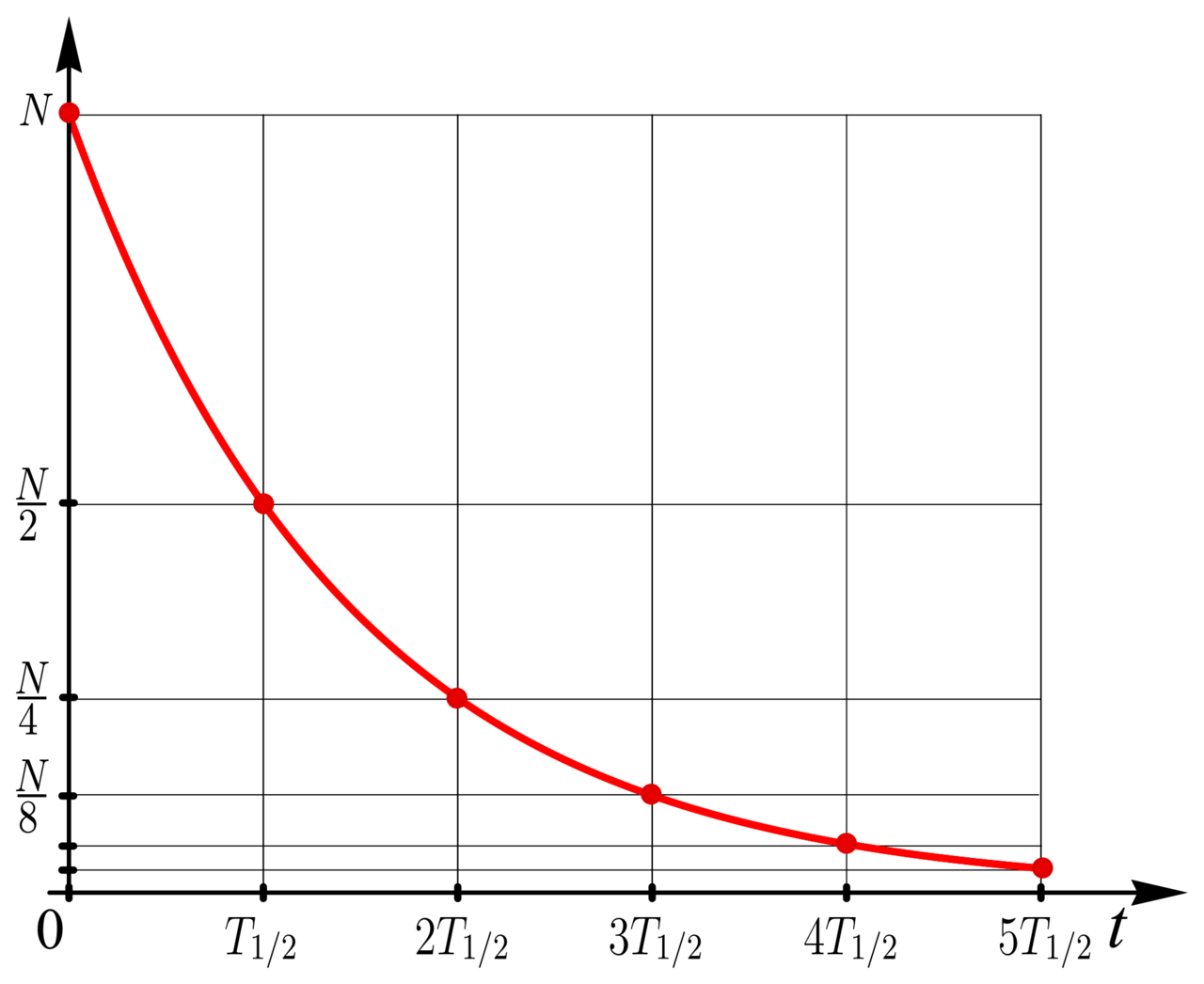
1/8
1/16
1/32
1/4
. Image: Svjo, CC BY-SA 4.0, via Wikimedia Commons.
How many alpha decays occur in the uranium-238 series shown on the way to stable lead-206?
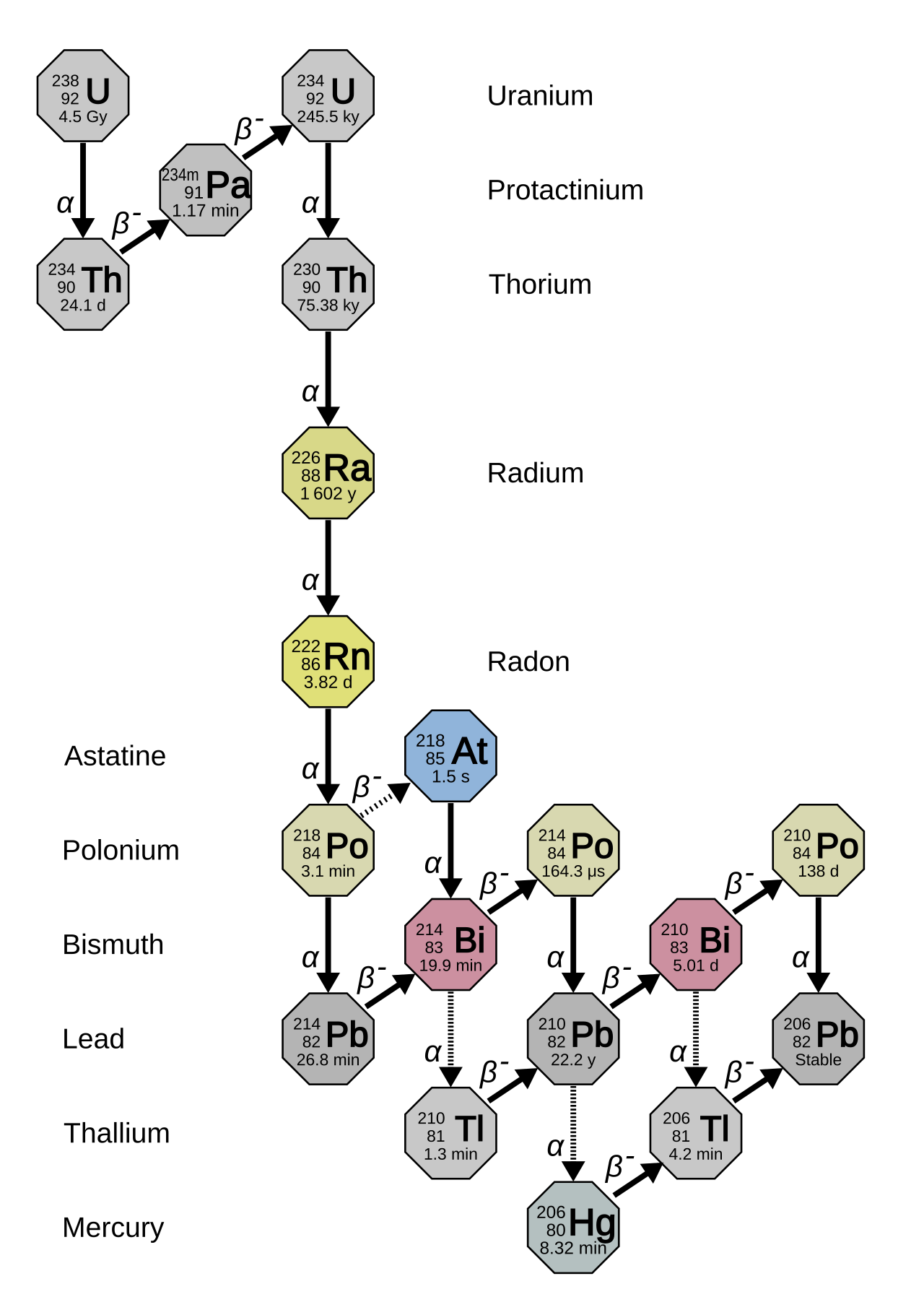
8
10
14
6
A falls by 32, so 8 alpha decays are needed (4 each); 6 beta-minus decays restore Z to 82. Image: Tosaka, CC BY 3.0, via Wikimedia Commons.
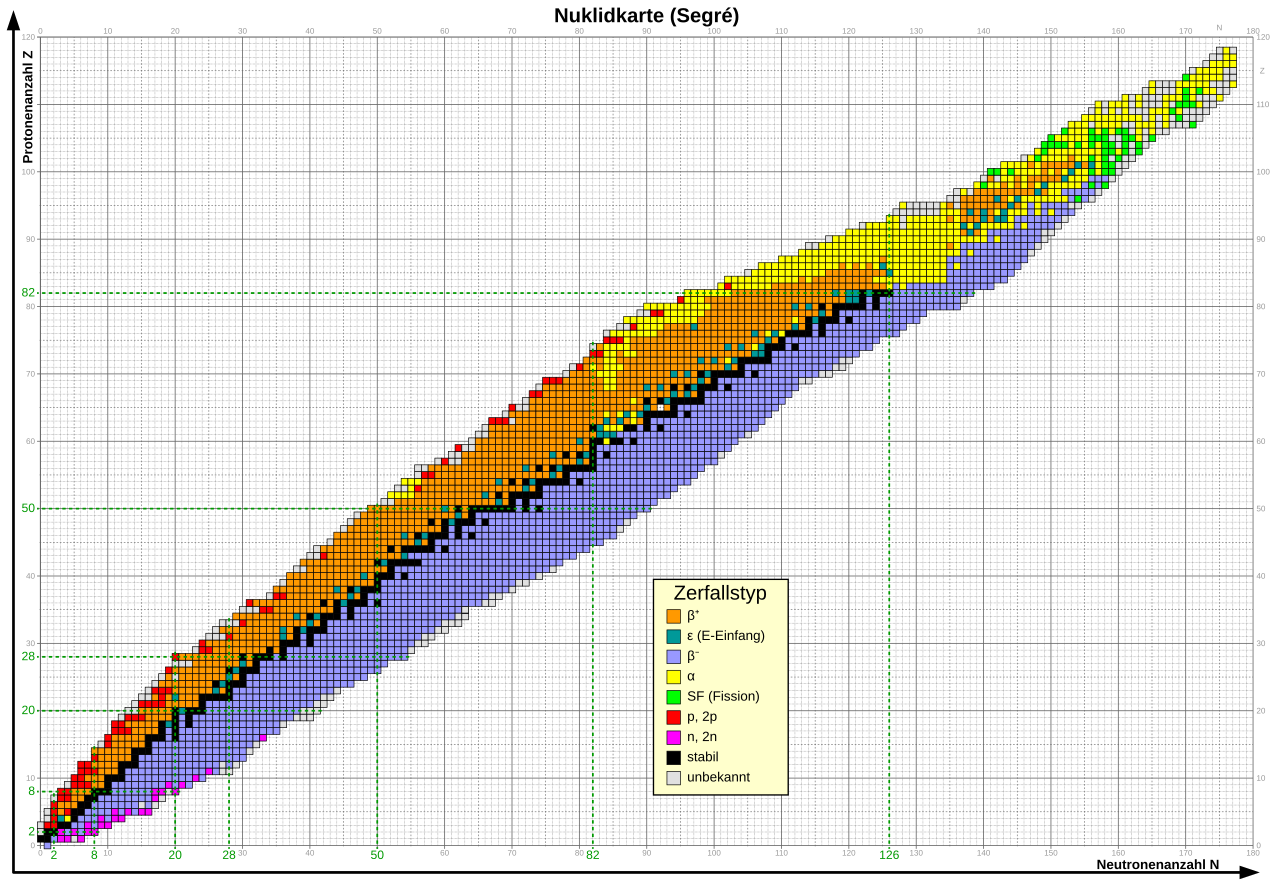
On this chart of nuclides, what do the dashed green lines at 2, 8, 20, 28, 50, 82 and 126 mark?
Half-life boundaries
Alpha-decay regions
Fission thresholds
Magic numbers of protons or neutrons
Nuclei with these numbers of protons or neutrons are exceptionally stable (closed shells). Image: Antonsusi, CC BY-SA 3.0, via Wikimedia Commons (labels in German).
The decay constant of a nuclide with half-life 5.0 s is closest to
0.35 s⁻¹
7.2 s⁻¹
0.14 s⁻¹
3.5 s⁻¹
.
Nuclear radius scales as . How does the radius of a nucleus with A = 64 compare with that of A = 8?
The same
Twice as large
Eight times as large
Four times as large
.
Count rate from a source falls from 4000 counts/min to 500 counts/min in 15 minutes (negligible background). What is the half-life?
5 min
7.5 min
15 min
2.5 min
4000 → 2000 → 1000 → 500 is 3 half-lives, so min.
Which of the following is NOT a nuclear magic number?
126
28
50
100
The magic numbers are 2, 8, 20, 28, 50, 82 and 126.
Radon-222 is formed when radium-226 undergoes which decay?
Beta-plus
Gamma
Alpha
Beta-minus
. Radon is a radioactive noble gas.
