Quiz · Medium
Questions on neuron anatomy, resting and action potentials, synaptic transmission, receptors, toxins and plasticity, including diagram-label questions.
Which structure is marked C in the diagram?
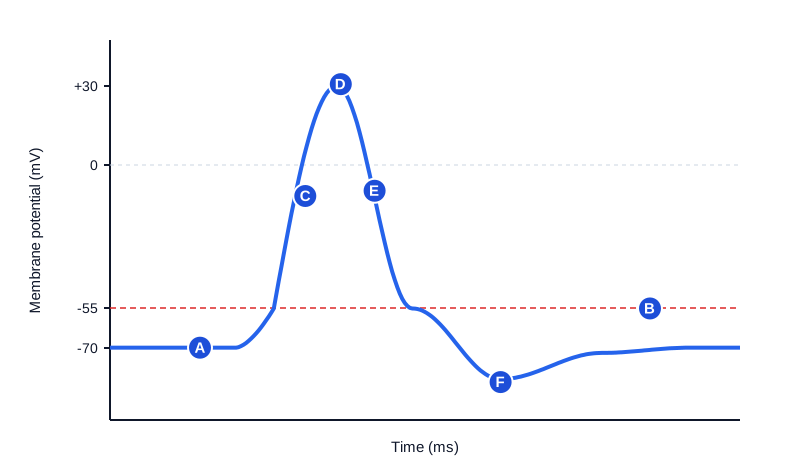
Depolarization (Na+ influx)
Repolarization (K+ efflux)
Resting potential
Hyperpolarization
The rising phase is driven by Na+ entering through voltage-gated Na+ channels. K+ efflux produces the falling phase.
Which structure is marked F in the diagram?
Threshold
Peak
Depolarization
Hyperpolarization (undershoot)
Voltage-gated K+ channels close slowly, so the membrane briefly goes below resting potential.
Which structure is marked G in the diagram?
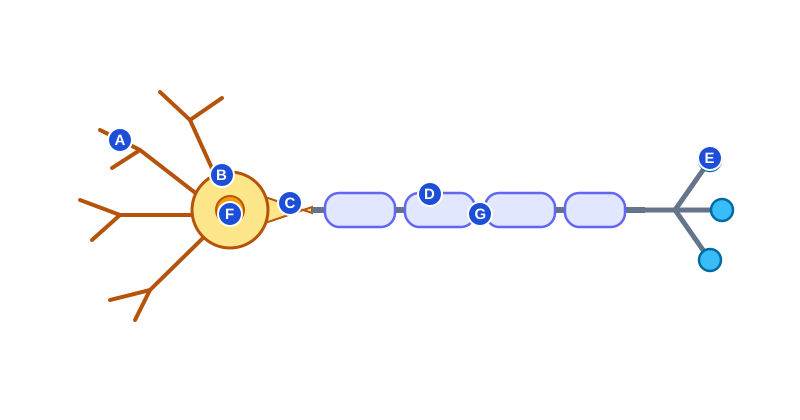
Synaptic bouton
Dendrite
Node of Ranvier
Axon hillock
Nodes are gaps in the myelin that contain clusters of voltage-gated Na+ channels.
Which structure is marked C in the diagram?
Node of Ranvier
Axon hillock
Nucleus
Axon terminal
The hillock/initial segment integrates inputs and usually initiates the spike.
Which structure is marked C in the diagram?
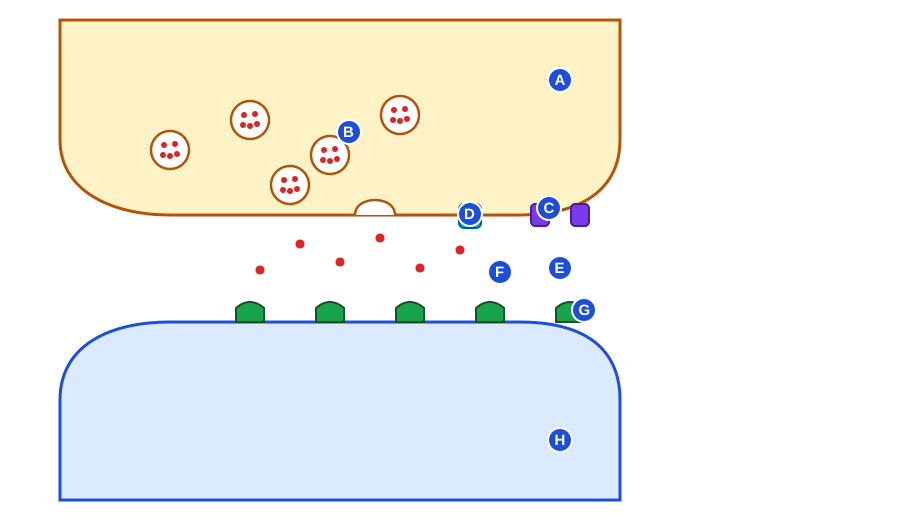
Gap junction
Voltage-gated Ca2+ channel
Reuptake transporter
Ionotropic receptor
Ca2+ entry through these channels at the active zone triggers vesicle fusion.
Which structure is marked G in the diagram?
Postsynaptic receptor
Synaptic vesicle
Presynaptic Ca2+ channel
Reuptake transporter
Postsynaptic receptors bind neurotransmitter and generate EPSPs or IPSPs.
What is the approximate resting membrane potential of a typical neuron?
0 mV
+30 mV
-55 mV
-70 mV
Rest is about -70 mV. -55 mV is a typical threshold and +30 mV is a typical spike peak.
Which ion is most responsible for setting the resting membrane potential?
Na+
Ca2+
K+
Cl-
Resting membrane is much more permeable to K+, so V(m) sits near E(K) (about -89 mV).
What happens during the absolute refractory period?
K+ channels are fully closed
The neuron is hyperpolarized only
No stimulus can trigger a second action potential because Na+ channels are inactivated
A larger stimulus can trigger another spike
The relative refractory period is when a stronger stimulus can work, due to residual K+ conductance.
An action potential is called 'all-or-none' because...
It decays with distance
Once threshold is reached, the spike has the same size regardless of stimulus strength
Larger stimuli make larger spikes
It only occurs in myelinated axons
Stimulus intensity is coded by the firing rate, not by spike size.
Which change increases conduction velocity of an axon?
Myelination and larger diameter
Smaller diameter
Removing nodes of Ranvier
Lower temperature
Myelin enables saltatory conduction; a larger diameter lowers internal resistance.
Which cells form myelin in the CNS?
Schwann cells
Microglia
Astrocytes
Oligodendrocytes
Schwann cells myelinate PNS axons. Astrocytes form the blood-brain barrier; microglia are immune cells.
Calcium entering the presynaptic terminal causes...
Reuptake of neurotransmitter
Closing of K+ channels
Hyperpolarization of the terminal
Vesicle fusion and neurotransmitter release
Ca2+ binds synaptotagmin, which triggers SNARE-mediated exocytosis.
Which statement correctly describes an EPSP?
A voltage-gated K+ conductance
An all-or-none hyperpolarization
A depolarizing graded potential that moves the membrane closer to threshold
A spike propagating along the axon
IPSPs hyperpolarize (or stabilize) the membrane, moving it away from threshold.
Which receptor is both ligand-gated and voltage-dependent (Mg2+ block)?
Nicotinic ACh receptor
NMDA receptor
AMPA receptor
GABA-A receptor
NMDA receptors need glutamate and depolarization, which allows Ca2+ in and underlies LTP.
Where in a neuron do graded potentials usually sum to decide whether a spike fires?
At the axon hillock
At the nodes of Ranvier
In the synaptic cleft
At the axon terminals
The initial segment has the highest density of Na+ channels and the lowest threshold.
The SSRI class of antidepressants works by...
Blocking serotonin reuptake so it remains in the synapse longer
Increasing serotonin degradation
Blocking serotonin receptors
Releasing serotonin from vesicles
SSRIs inhibit the serotonin transporter (SERT). MAO inhibitors block degradation instead.
Botulinum toxin causes paralysis by...
Blocking Na+ channels
Blocking nicotinic receptors
Inhibiting acetylcholinesterase
Cleaving SNARE proteins, preventing ACh release
Curare blocks nicotinic receptors; organophosphates inhibit AChE; tetrodotoxin blocks Na+ channels.
LTP in the hippocampus requires which event?
Loss of AMPA receptors
Activation of GABA-B receptors only
Ca2+ entry through NMDA receptors in the postsynaptic cell
Presynaptic K+ efflux
The Ca2+ signal triggers CaMKII and AMPA receptor insertion, strengthening the synapse.
Compared with chemical synapses, electrical synapses are...
Dependent on Ca2+ entry
Faster and usually bidirectional
Slower and unidirectional
Mediated by neurotransmitter receptors
They use gap junctions, with no synaptic delay.
Which disease involves autoimmune attack on postsynaptic nicotinic ACh receptors?
Guillain-Barre syndrome
Myasthenia gravis
Multiple sclerosis
Lambert-Eaton syndrome
Lambert-Eaton targets presynaptic Ca2+ channels, MS targets CNS myelin, and GBS targets PNS myelin.
Using the Nernst equation, what happens to E(K) if extracellular K+ increases?
It becomes less negative (depolarizes)
It reverses to +60 mV
It becomes more negative
It is unchanged
E(K) depends on log([K]o/[K]i); raising [K]o shrinks the ratio gradient and shifts E(K) toward 0.
True or false: the human brain contains about ten times more glial cells than neurons.
True
False
Modern counts show roughly 1:1 (about 86 billion neurons and a similar number of non-neuronal cells).
True or false: voltage-gated Na+ channels inactivate shortly after opening during an action potential.
True
False
Inactivation is what ends the rising phase and causes the absolute refractory period.
