Quiz · Medium
Twenty questions on lab glassware, accuracy vs precision, absorbance, calibration curves, TLC and chromatography. For intro analytical chemistry and AP/IB lab skills.
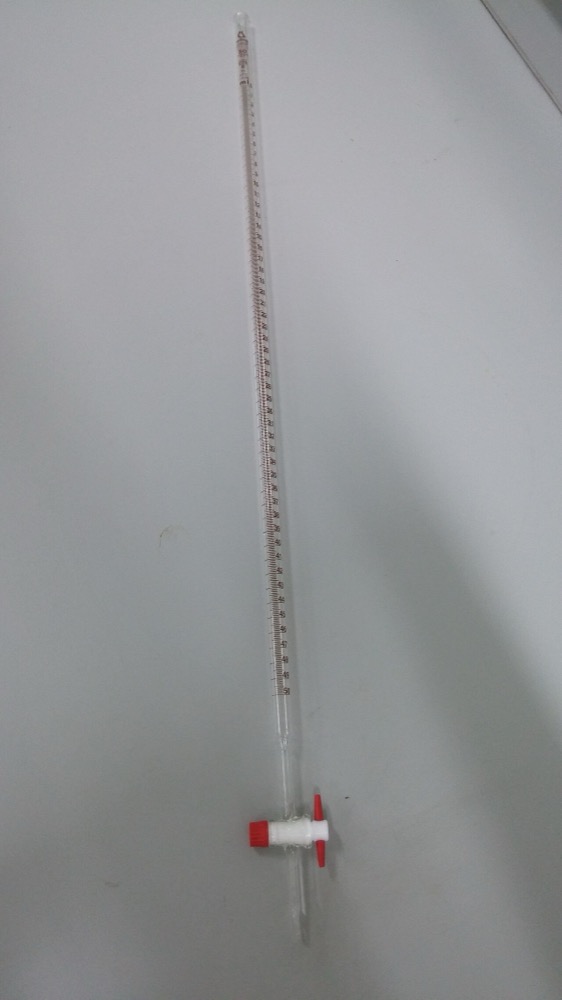
Which piece of glassware is shown?
Separatory funnel
Graduated cylinder
Burette
Volumetric flask
A burette is a long graduated tube with a stopcock at the bottom that delivers variable, measured volumes of titrant. A graduated cylinder has no stopcock and is less precise; volumetric flasks and separatory funnels are not used to deliver titrant.
Image: Gemsgy, CC BY-SA 4.0, via Wikimedia Commons.
What is a volumetric flask (shown) used for?
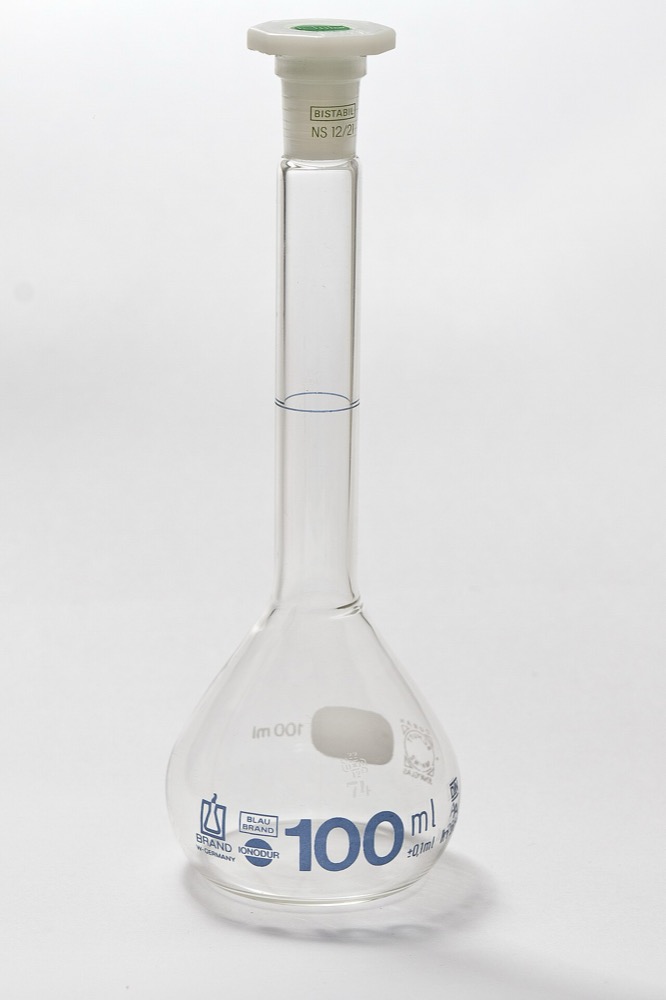
Preparing a solution of exact volume and concentration
Delivering titrant drop by drop
Heating solutions over a flame
Measuring 25.00 mL aliquots for titration
A volumetric flask contains one exact volume (up to its etched line), so it is used to dilute a weighed solid or an aliquot to a precise final volume. Delivering a fixed aliquot is the job of a volumetric pipette.
Image: Lucasbosch, CC BY-SA 3.0, via Wikimedia Commons.
In normal-phase TLC on silica, a more polar compound will generally have:
A lower Rf
The same Rf as a nonpolar compound
Rf of exactly 1
A higher Rf
Silica is polar, so polar compounds stick to it and travel less far.
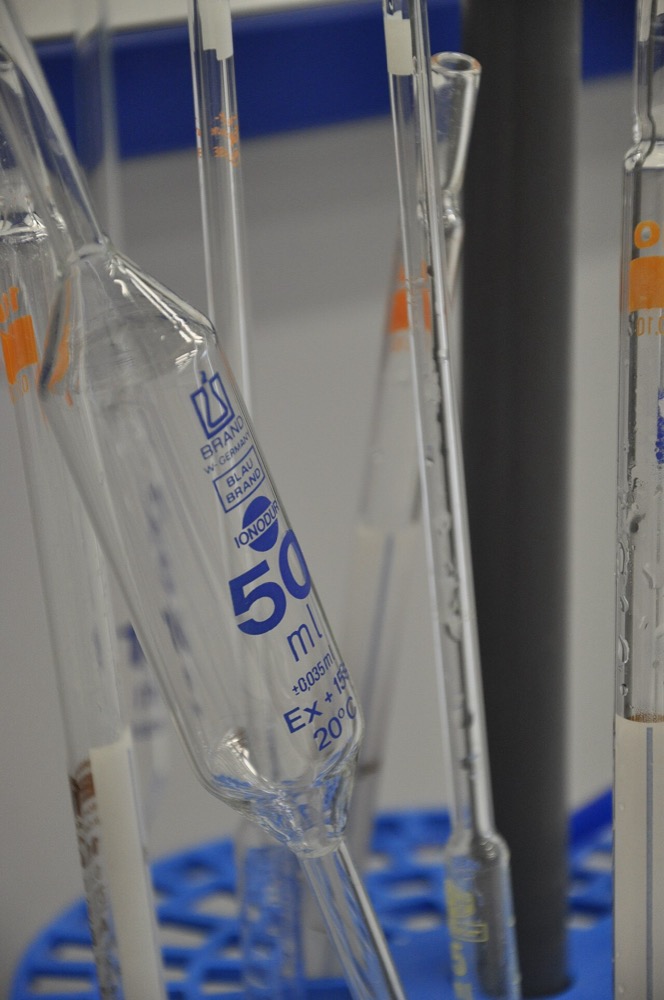
A student wants to transfer exactly 25.00 mL of unknown to a titration flask. Which tool is the best choice?
100 mL graduated cylinder
Dropper
Beaker
25 mL volumetric pipette
A volumetric (transfer) pipette is calibrated to deliver one fixed volume with very small uncertainty, typically ±0.03 mL for 25 mL. A graduated cylinder is far less precise.
Image: Zelda F. Scott, CC BY-SA 3.0, via Wikimedia Commons.
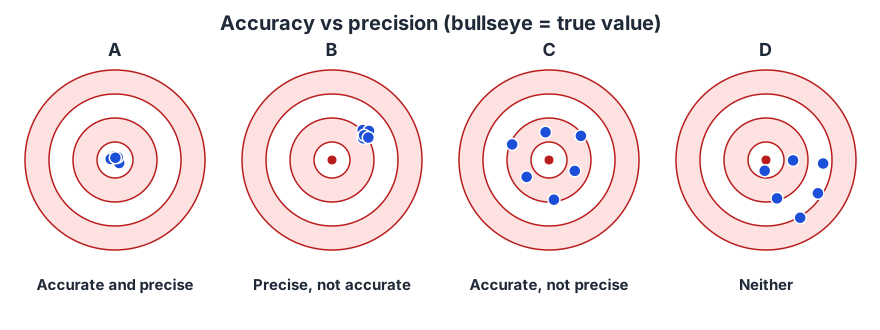
Target B in the figure shows results that are clustered tightly away from the bullseye. This is:
Neither accurate nor precise
Accurate but not precise
Precise but not accurate
Both accurate and precise
Tight clustering means high precision. The cluster being off-center means a systematic error (bias), so accuracy is poor.
Which of the following is a systematic error?
Reading the last digit of a balance by eye
A pipette that always delivers 0.05 mL too much
Random electrical noise in a detector
Small temperature fluctuations from run to run
A consistent over-delivery pushes every result the same way. The other options produce random scatter that averages out.
Replicate titrations give 24.95, 25.05 and 25.00 mL. The mean is:
25.05 mL
24.99 mL
24.95 mL
25.00 mL
(24.95 + 25.05 + 25.00) / 3 = 75.00 / 3 = 25.00 mL.
Adding more replicate measurements mainly reduces the effect of:
Both equally
Neither
Systematic error
Random error
Averaging cancels random scatter (the standard error falls as 1/√n). A bias is the same in every replicate, so averaging cannot remove it.
In the Beer–Lambert law A = εbc, what does doubling the path length b do (all else constant)?
Squares the absorbance
Halves the absorbance
Doubles the absorbance
Leaves absorbance unchanged
Absorbance is directly proportional to path length, concentration and molar absorptivity.
A solution transmits 10% of the incident light. Its absorbance is:
0.90
1.0
10
0.10
A = −log10(T) = −log10(0.10) = 1.0. The tempting 0.90 comes from 1 − T, which is not the definition.
Why is a blank used in spectrophotometry?
To zero out absorbance of the cuvette and solvent
To calibrate the wavelength
To increase sensitivity
To dilute the sample
The blank contains everything except the analyte, so setting it to A = 0 means the measured absorbance comes only from the analyte.
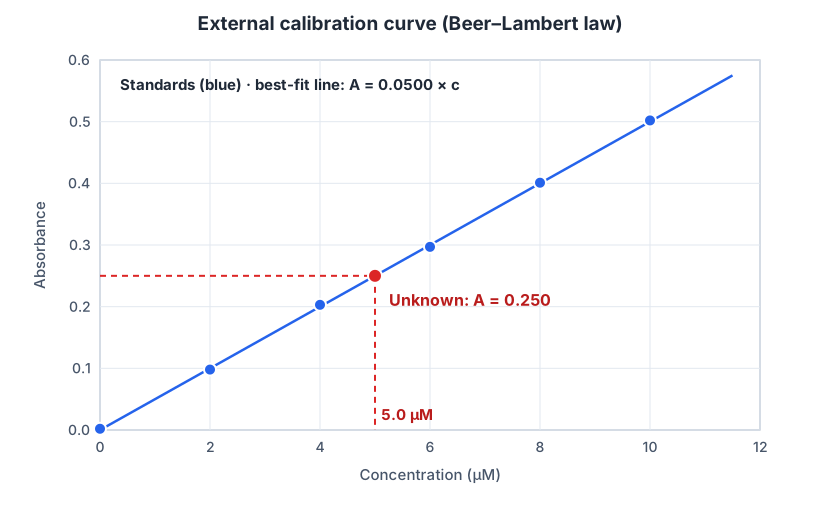
The calibration line shown is A = 0.0500c (c in µM). The unknown gives A = 0.250. What is its concentration?
5.0 µM
12.5 µM
0.0125 µM
2.5 µM
c = A/m = 0.250/0.0500 = 5.0 µM, which lies inside the range of the standards (so it is interpolation). 12.5 comes from multiplying instead of dividing.
Why should an unknown NOT be determined by extrapolating far beyond the highest standard?
Extrapolation always gives a negative value
Standards cannot be diluted
The line may curve (deviation from linearity)
The blank is too large
At high concentration, Beer's law often fails (stray light, molecular association), so the calibration is only known to be linear within the measured range.
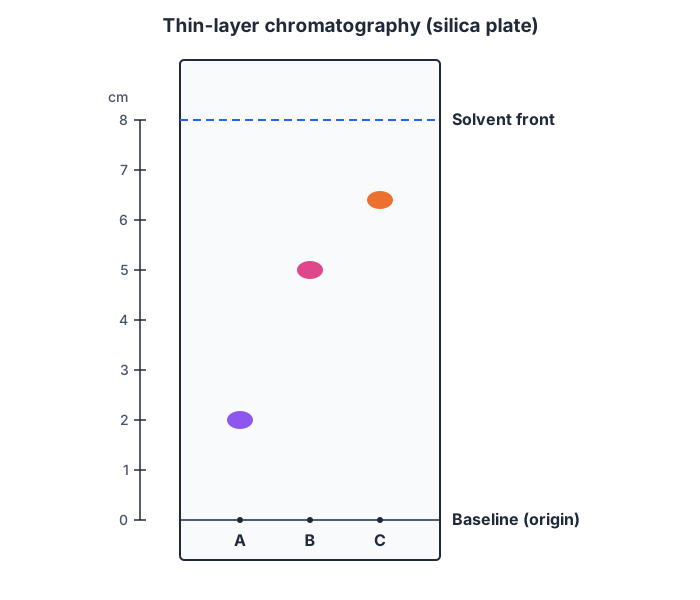
On the TLC plate shown, spot B moved 5.0 cm and the solvent front moved 8.0 cm. What is Rf?
5.0
0.63
1.6
0.38
Rf = 5.0 / 8.0 = 0.625 ≈ 0.63. Rf is a ratio and can never exceed 1 (so 1.6 is the inverted ratio).
Which technique is best for separating volatile, thermally stable organic compounds?
Size-exclusion chromatography
Ion-exchange chromatography of proteins
Paper electrophoresis
Gas chromatography
GC vaporizes the sample in a heated injector, so analytes need to be volatile and not decompose.
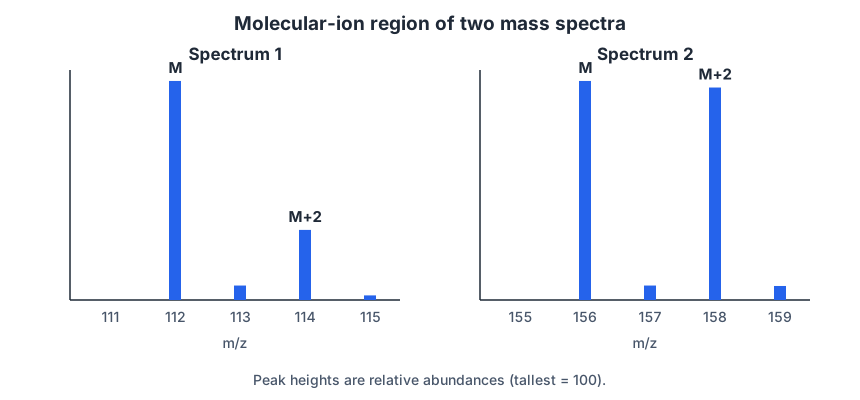
In the mass spectrum shown, the M and M+2 peaks have a 1:1 intensity ratio. The compound probably contains:
One chlorine atom
One bromine atom
One fluorine atom
One iodine atom
Bromine has two isotopes (⁷⁹Br, ⁸¹Br) in roughly 1:1 ratio. Chlorine gives about 3:1; fluorine and iodine are monoisotopic.
What is the purpose of the internal standard method?
To raise the detection limit
To compensate for variations in injection volume or instrument response
To remove all random error
To make the blank unnecessary
A known amount of a similar compound is added to every sample and standard; the analyte/standard signal ratio cancels many fluctuations.
A primary standard must be:
High purity, stable and of known formula
Hygroscopic so it dissolves quickly
A strong acid or base only
Available only as a solution
It needs to be pure, stable, non-hygroscopic and have a high molar mass (reducing weighing error). KHP and Na2CO3 are common examples.
In a titration, the point at which the indicator changes color is called the:
Buffer point
Half-equivalence point
Equivalence point
End point
The end point is what we observe; the equivalence point is the theoretical point where moles of titrant equal moles of analyte (stoichiometrically). A good indicator makes them nearly the same.
The standard deviation of a data set measures:
Systematic error
Accuracy
Spread (precision) of the data
The true value
s describes how scattered replicates are around their mean, which is precision.
A method gives a signal of 0.002 for the blank (s = 0.0005). Using the 3s criterion, the signal at the detection limit is:
0.0050
0.0005
0.0035
0.0015
Signal at LOD = blank mean + 3s = 0.002 + 3(0.0005) = 0.0035.
