Quiz · Medium
Hydrostatic pressure, gauge pressure, hydraulic lifts, barometers and manometers, Archimedes' principle, flotation, dams and balloons, with diagram questions.
What is the gauge pressure at a depth of 20 m in seawater (1025 kg/m³, g = 9.8 m/s²)?
Pa
Pa
Pa
Pa
Pa, about 2 atm; the absolute pressure is about 3 atm.
A diver is at 30 m depth in seawater (1025 kg/m³). What is the approximate absolute pressure in atmospheres?
About 2 atm
About 4 atm
About 30 atm
About 1 atm
Gauge: Pa ≈ 3 atm, plus 1 atm of the atmosphere gives about 4 atm.
A hydraulic lift has an input piston of area 10 cm² and an output piston of area 1000 cm². What input force raises a 5000 N load?
50 N
500 N
50 000 N
5 N
N. The input piston moves 100 times as far.
If water were used instead of mercury in a barometer at standard atmospheric pressure, the column would be about
103 m
76 cm
1.0 m
10.3 m
m.
A barometer tube is tilted away from vertical. What happens to the vertical height of the mercury column at constant atmospheric pressure?
It increases
It decreases
It stays the same
It becomes zero
The vertical height is fixed by the pressure; the column just gets longer along the tilted tube.
What fraction of an ice cube (917 kg/m³) is submerged when it floats in fresh water?
About 50%
About 92%
100%
About 9%
.
A metal block weighs 12 N in air and 9.0 N when fully submerged in water. What is its density?
4000 kg/m³
12 000 kg/m³
1000 kg/m³
3000 kg/m³
N, so , giving 4000 kg/m³.
A ship sails from a river into the sea. What happens to the ship?
It floats lower, because seawater is denser
It floats at the same level
It sinks
It floats higher, because seawater is denser
The ship displaces its own weight of water, and a smaller volume of denser seawater is needed. This is why Plimsoll marks differ for fresh and salt water.
An ice cube floats in a full glass of water. When it melts, the water level
Overflows
Falls
Stays the same
Rises slightly
Floating ice displaces its own weight of water. The meltwater has exactly that volume, so the level is unchanged.
A person in a floating boat throws a heavy rock overboard into a lake. What happens to the lake's water level?
It rises
It falls
It stays the same
It depends on the boat's size
In the boat the rock displaced its weight of water (a large volume); at the bottom it displaces only its own volume, so the level falls.
A dam holds back water 10 m deep across a width of 50 m. What is the horizontal force on the wall (, g = 9.8)?
N
N
N
N
N.
Which statement about a vessel of three different shapes with the same base area, all filled to the same depth with water, is correct?
The base pressure depends on total volume
The widest vessel has the greatest base pressure
The narrowest vessel has the greatest base pressure
The base pressure is the same in all three
Base pressure is : it depends only on depth. The forces on the base are equal too (the hydrostatic paradox).
In a mercury U-tube manometer (13,600 kg/m³) one limb is 5.0 cm higher than the other. What is the gauge pressure?
About 6.7 Pa
About 670 Pa
About 6.7 kPa
About 67 kPa
kPa.
In this experiment the scale on the right reads 3 N and the spring balance reads 1 N for an object that weighs 4 N in air. What is the buoyant force on the object?
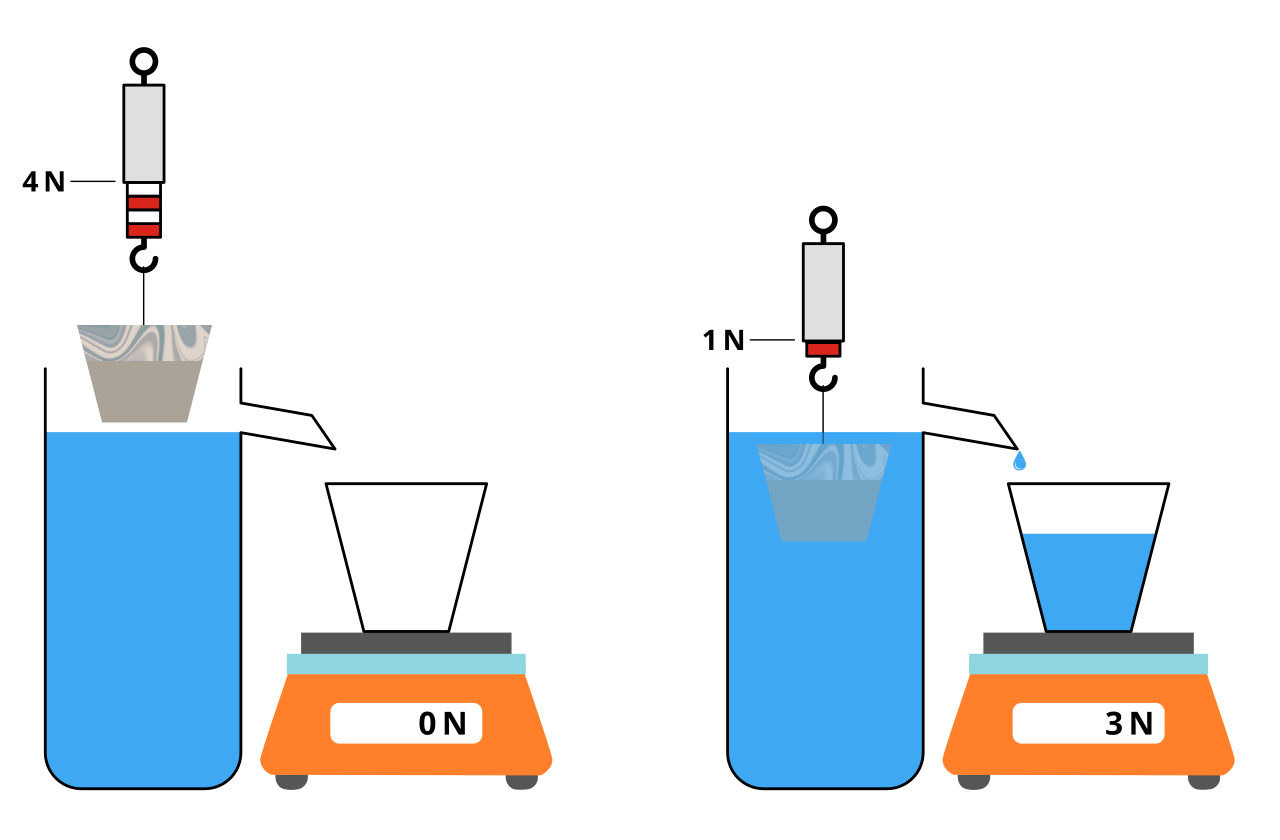
1 N
3 N
4 N
7 N
N, equal to the weight of the displaced water. Image: MikeRun, CC BY-SA 4.0, via Wikimedia Commons.
In this hydraulic press diagram, S₂ = 20 S₁ and F₁ = 30 N. What is F₂?
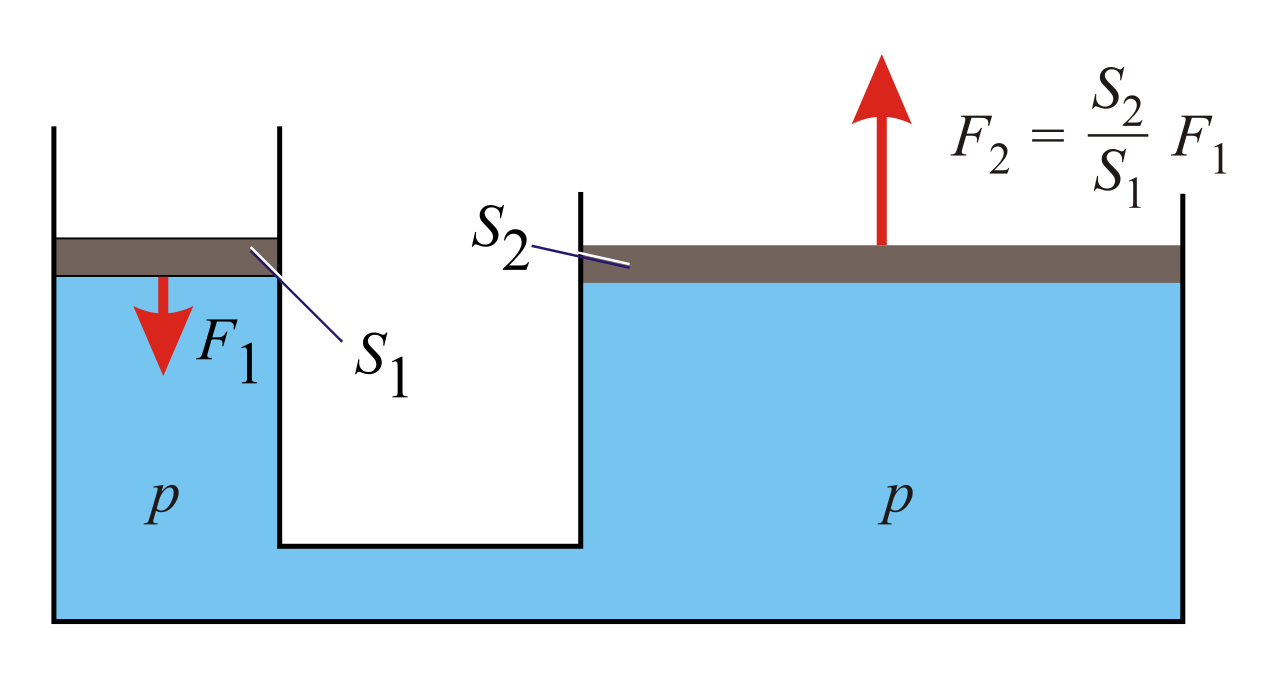
600 N
6000 N
1.5 N
30 N
N. Image: Patrol110, CC BY-SA 3.0, via Wikimedia Commons.
In this beaker the horizontal area A is 2.0 m below the water surface. What is the gauge pressure on it (g = 9.8)?
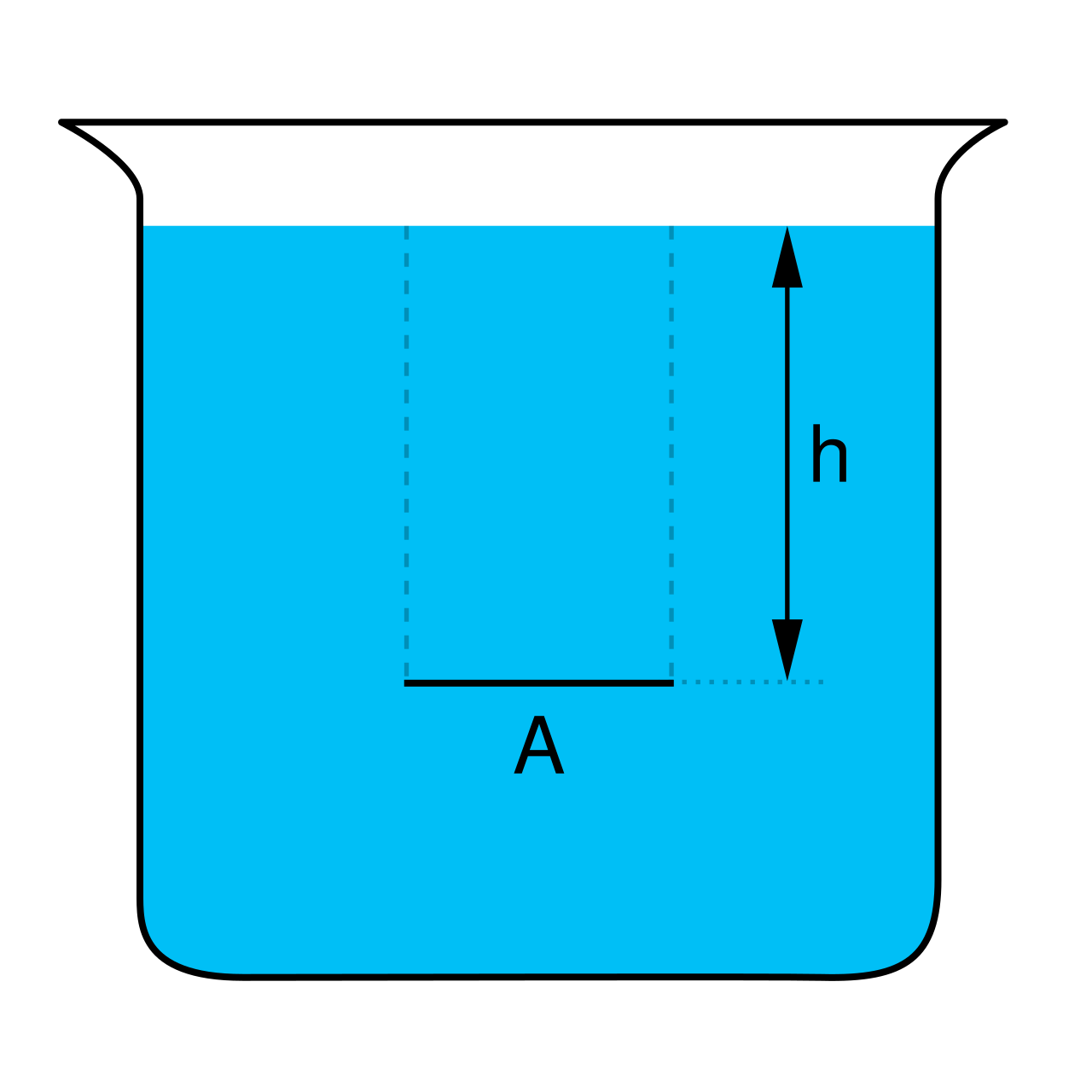
About 196 kPa
About 2.0 kPa
About 9.8 kPa
About 19.6 kPa
kPa, independent of the area A. Image: MikeRun, CC BY-SA 4.0, via Wikimedia Commons.
In this manometer the liquid stands higher on the open side. What does this tell you about the gas pressure ?
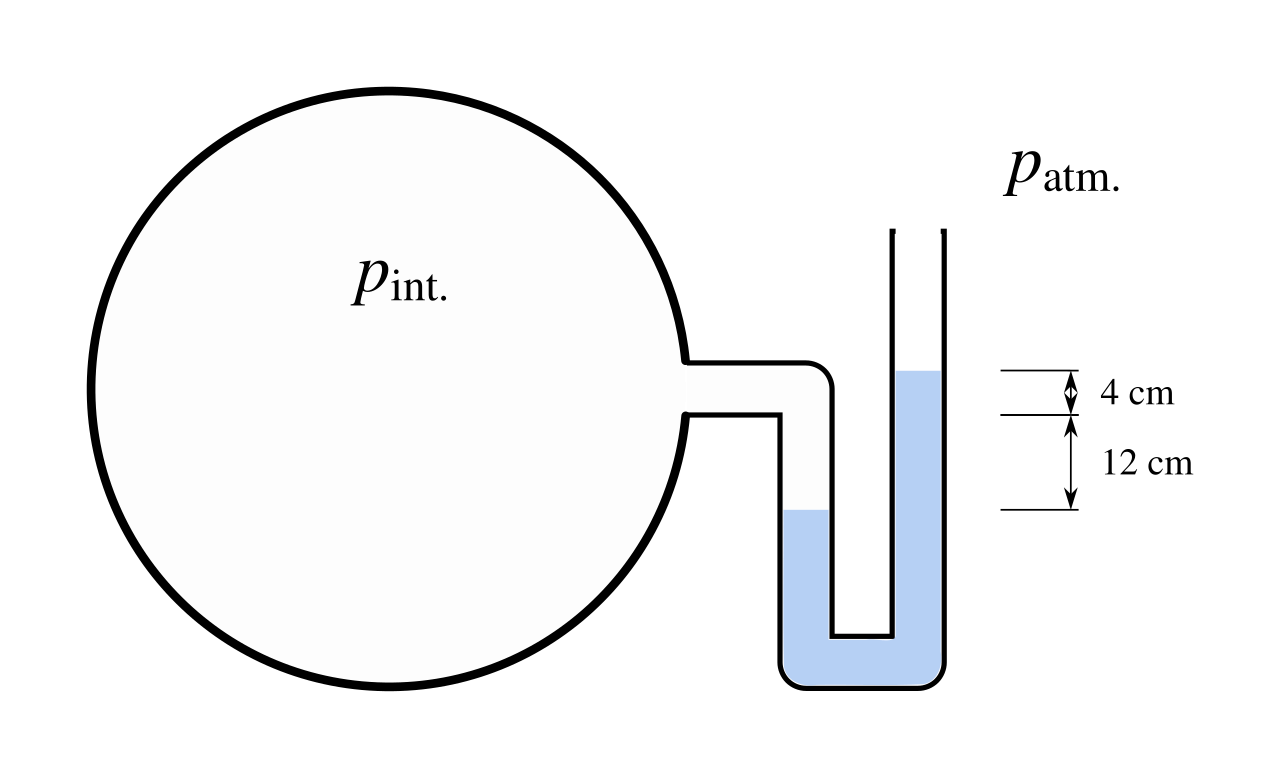
It cannot be determined
The gas pushes the liquid down on its own side, so its pressure is greater than atmospheric by . Image: Olivier Cleynen, CC0, via Wikimedia Commons.
Why is the fresh-water load line (F) higher on a ship's hull than the summer line (S)?
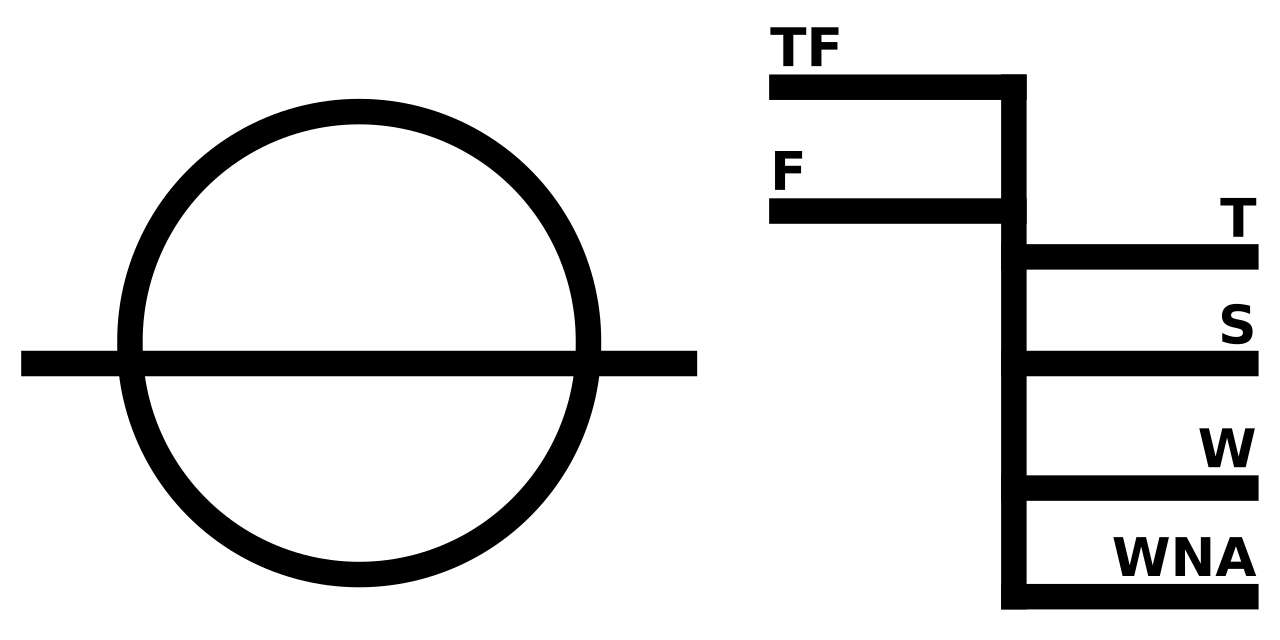
Fresh water is denser so the ship floats higher
Fresh water is less dense so the ship sinks lower for the same load
Fresh water is colder
The ship weighs more in fresh water
The ship must displace the same weight of water, which takes more volume in fresh water, so it sits deeper and is allowed a higher mark. Image: Brosen, public domain, via Wikimedia Commons.
A hot air balloon of volume 2000 m³ has outside air at 1.20 kg/m³ and inside air at 0.95 kg/m³. About what total mass can the balloon (envelope, basket and load) have to just float?
About 500 kg
About 2400 kg
About 5000 kg
About 50 kg
Net lift = kg-force; the total of envelope, fuel, basket and passengers must not exceed this.
At a pressure of 1 atm, a 10 m column of water would have pressure at the bottom (absolute) of about
10 atm
0.1 atm
1 atm
2 atm
Each 10 m of water adds about 1 atm.
