Quiz · Hard
Applied, multi-step questions on GI hormones, nutrient transport, bile and common clinical cases. Exam level for A&P and pre-health students.
A patient has had the terminal ileum removed. Which two problems are most likely over time?
Iron deficiency and lactose intolerance
Vitamin B12 deficiency and fat malabsorption
Low gastric acid and constipation
Hypoglycemia and jaundice
The terminal ileum absorbs B12 (with intrinsic factor) and reabsorbs bile salts. Losing bile salts shrinks the bile salt pool, so fat is poorly absorbed. Iron is absorbed in the duodenum.
Acidic chyme enters the duodenum. Which response helps neutralize it?
Gastrin release increases acid secretion
Secretin stimulates bicarbonate secretion from the pancreas
CCK relaxes the pyloric sphincter
Ghrelin increases hunger
Low pH in the duodenum releases secretin from S cells, which triggers bicarbonate-rich pancreatic fluid and inhibits gastric acid. CCK responds to fat and protein, not acid.
A person eats a fatty meal and develops right upper quadrant pain. Which hormone links the meal to the pain?
Secretin
Gastrin
Cholecystokinin
Somatostatin
Fat triggers CCK, which contracts the gallbladder. If a stone blocks the cystic duct, contraction against the blockage causes biliary pain.
Why does trypsinogen activation start in the duodenum and not inside the pancreas?
Trypsinogen needs acid to activate
Enteropeptidase, the activating enzyme, is located on the duodenal brush border
Bile activates it
Pancreatic cells lack trypsinogen
Enteropeptidase on the duodenal brush border converts trypsinogen to trypsin. Premature activation inside the pancreas causes pancreatitis.
A drug blocks the H+/K+ ATPase (a proton pump inhibitor). Which digestive step is most directly impaired?
Activation of pepsinogen
Emulsification of fat
Absorption of glucose
Activation of trypsinogen
Less HCl means a higher stomach pH, so pepsinogen is converted to pepsin more slowly. Trypsinogen is activated by enteropeptidase, not acid.
Glucose is absorbed into enterocytes against its concentration gradient. What directly powers this?
ATP hydrolysis by SGLT1
The Na+ gradient maintained by the basolateral Na+/K+ ATPase
GLUT5 facilitated diffusion
Osmosis
SGLT1 is secondary active transport: it uses the Na+ gradient, which the Na+/K+ pump creates by using ATP. Fructose uses GLUT5 (facilitated diffusion).
Which statement about chylomicrons is correct?
They enter blood capillaries in the villi
They are made in the liver
They enter lacteals and reach the blood via the thoracic duct
They carry mainly amino acids
Enterocytes package triglycerides into chylomicrons, which are too large for capillaries and enter lacteals. VLDL, not chylomicrons, is made by the liver.
A biopsy of the jejunum shows flattened villi in a patient who has diarrhea after eating bread. The most likely diagnosis is…
Lactose intolerance
Celiac disease
Ulcerative colitis
Peptic ulcer disease
Gluten triggers an immune reaction that causes villous atrophy in celiac disease. Lactose intolerance does not flatten the villi.
Which finding fits Crohn disease better than ulcerative colitis?
Continuous inflammation starting at the rectum
Disease limited to the mucosa
Skip lesions with full-thickness (transmural) inflammation
Involvement of the colon only
Crohn disease can affect any part of the tract, is patchy and transmural. Ulcerative colitis is continuous from the rectum and limited to the mucosa and submucosa.
Cutting the vagus nerves to the stomach would most reduce which phase of gastric secretion?
Cephalic phase
Intestinal phase
Gastric phase only
None; the stomach has no nervous control
The cephalic phase (sight, smell and thought of food) works entirely through the vagus. The gastric phase also uses local enteric reflexes and gastrin.
Which pairing of cell and secretion is correct?
Chief cell: intrinsic factor
G cell: pepsinogen
Parietal cell: HCl
Goblet cell: gastrin
Parietal cells make HCl and intrinsic factor; chief cells make pepsinogen; G cells make gastrin; goblet cells make mucus.
Bilirubin builds up in the blood and the skin turns yellow. Which of these could NOT cause this?
Excess breakdown of red blood cells
Liver failure
A gallstone blocking the common bile duct
A stone blocking only the cystic duct
Jaundice comes from too much bilirubin made (hemolysis), poor processing (liver disease) or blocked outflow (common bile duct). A cystic duct stone does not stop bile from the liver reaching the duodenum.
Why does chewing food well speed up digestion?
It activates pepsin
It increases the surface area for enzymes
It raises the pH of the stomach
It releases bile
Mechanical digestion breaks food into smaller pieces, increasing the surface area on which enzymes can act.
Which list correctly orders the structures that increase small-intestine surface area from largest to smallest?
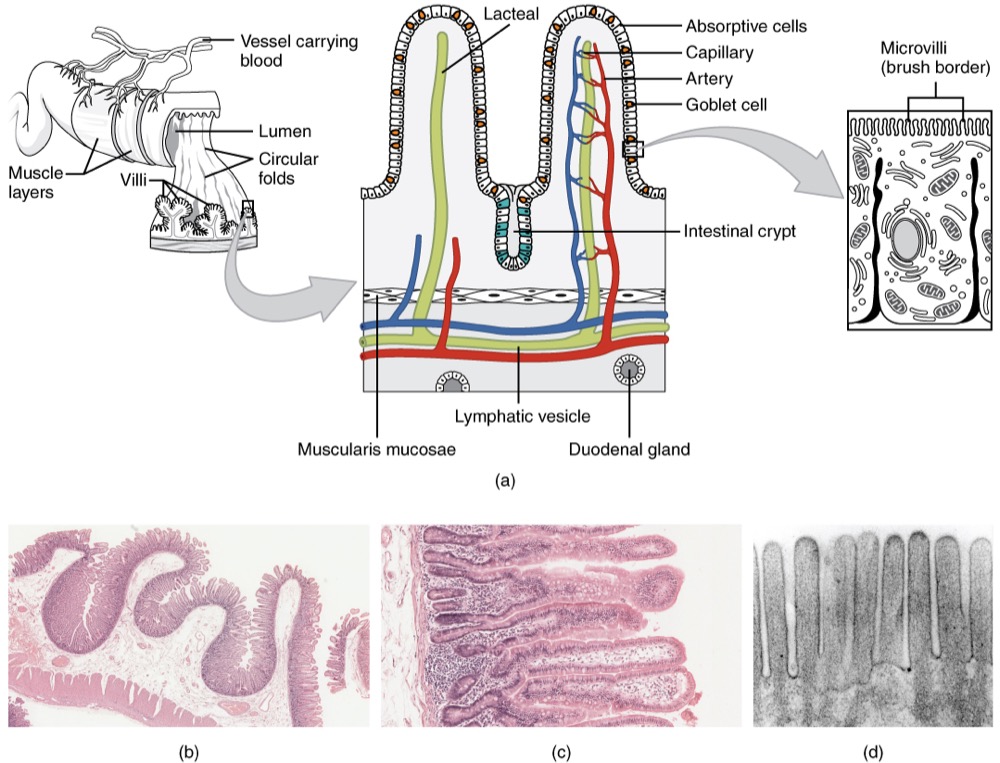
Villi, microvilli, circular folds
Circular folds, villi, microvilli
Microvilli, villi, circular folds
Rugae, villi, microvilli
Circular folds (plicae circulares) are visible to the eye, villi are about 1 mm tall and microvilli are only seen with an electron microscope. Rugae are in the stomach.
Image: OpenStax College, CC BY 3.0, via Wikimedia Commons.
A patient taking long-term broad-spectrum antibiotics develops easy bruising. What is the likely link?
Loss of gut bacteria that make vitamin K
Damage to the pancreas
Increased gastric acid
Blocked lacteals
Colon bacteria are a source of vitamin K, which the liver needs to make several clotting factors.
Distension of the duodenum by a large, fatty meal will most likely…
speed up gastric emptying
slow gastric emptying
stop bile release
increase gastrin secretion
The enterogastric reflex and CCK slow gastric emptying so the duodenum is not overloaded and fat has time to be digested.
True or false: Pancreatic lipase can digest a large fat globule as fast as the same fat emulsified by bile.
True
False
False. Lipase works only at the fat-water surface; emulsification greatly increases that surface, so digestion is much faster.
