Quiz · Medium
Identify the parts of the kidney and nephron and check the basics of filtration, reabsorption and hormones.
Normally, which of these is NOT found in the urine?
Urea
Creatinine
Glucose
Sodium
Glucose is fully reabsorbed in the PCT unless blood glucose exceeds the renal threshold.
What is the approximate normal GFR?
12.5 mL/min
125 mL/min
1250 mL/min
12 L/min
About 125 mL/min (about 180 L/day).
The functional unit of the kidney is the…
Nephron
Neuron
Calyx
Pyramid
Each kidney has about a million nephrons.
Which structure carries urine from the kidney to the bladder?
Urethra
Ureter
Renal vein
Collecting duct
Ureters carry urine to the bladder. The urethra carries urine out of the bladder.
Which blood vessel brings blood to the glomerulus?
Efferent arteriole
Afferent arteriole
Peritubular capillary
Renal vein
Afferent arterioles bring blood in. Efferent arterioles take it out.
Which structure is labeled 3 in the diagram?
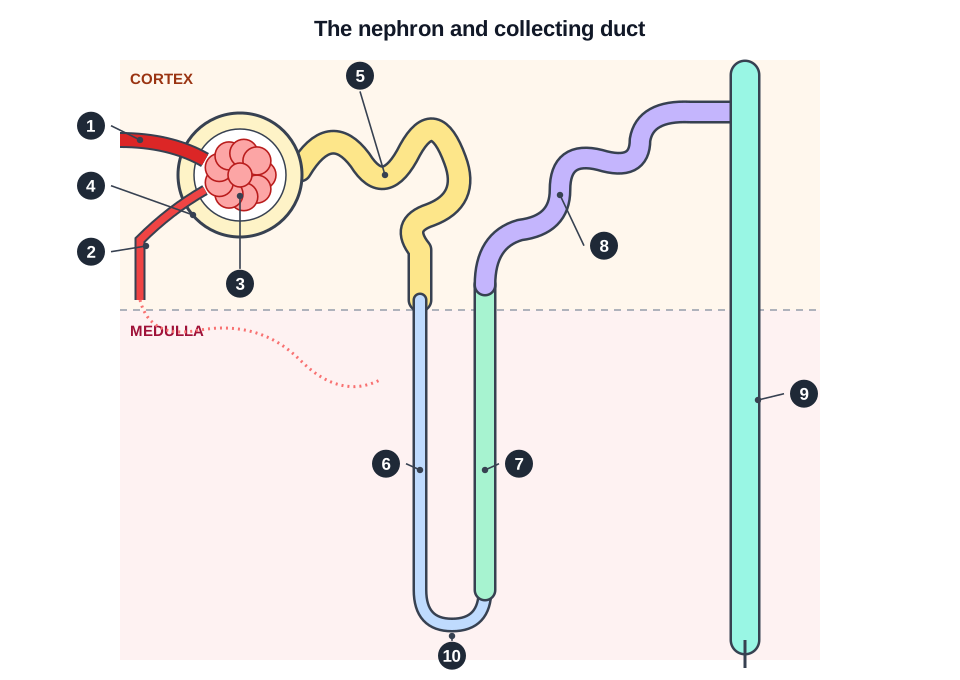
Glomerulus
Proximal convoluted tubule
Collecting duct
Loop of Henle
The glomerulus is the capillary tuft where blood is filtered; it sits inside Bowman's capsule.
Which structure is labeled 5 in the diagram?
Distal convoluted tubule
Collecting duct
Proximal convoluted tubule
Descending limb
The PCT leaves Bowman's capsule and does most reabsorption.
Which structure is labeled 2 in the diagram?
Afferent arteriole
Efferent arteriole
Vasa recta
Renal artery
The efferent arteriole carries blood away from the glomerulus.
Which structure is labeled 3 in the diagram?
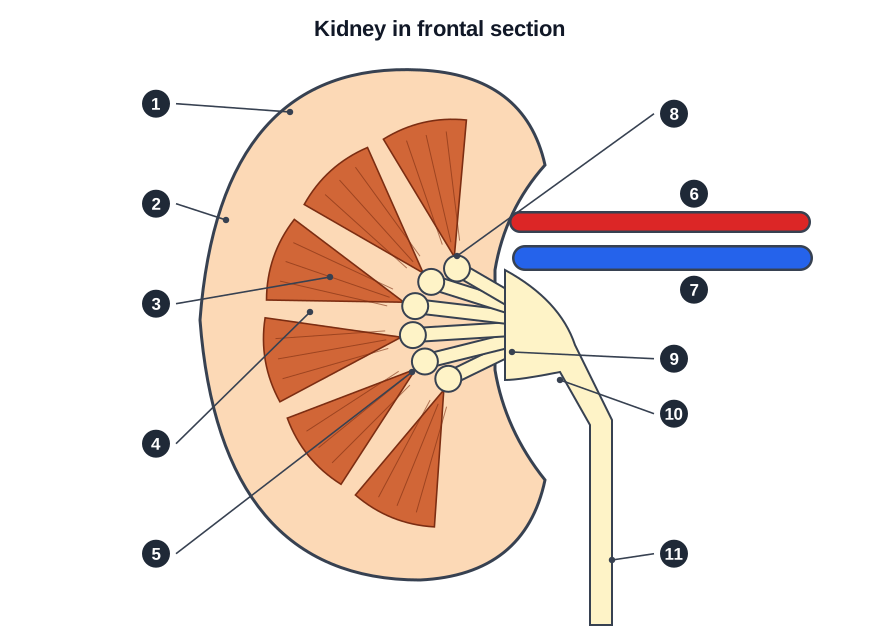
Renal pyramid
Renal column
Renal capsule
Renal pelvis
Renal pyramids make up the medulla; columns are the cortical tissue between them.
Which structure is labeled 10 in the diagram?
Minor calyx
Renal pelvis
Ureter
Renal papilla
The renal pelvis is the funnel that collects urine from the calyces and continues as the ureter.
Where does most reabsorption of water and solutes occur?
Proximal convoluted tubule
Distal tubule
Collecting duct
Bowman's capsule
About 65% of filtered Na+ and water is reabsorbed here.
Which hormone makes the collecting duct permeable to water?
Aldosterone
ADH
ANP
Renin
ADH inserts aquaporin-2 channels. Aldosterone acts on Na+ and K+.
Which cells of the juxtaglomerular apparatus release renin?
Macula densa cells
Granular (juxtaglomerular) cells
Podocytes
Intercalated cells
Granular cells in the afferent arteriole make renin. The macula densa senses NaCl.
True or false: The kidneys receive about 20 to 25% of cardiac output.
True
False
True, despite being a small proportion of body weight.
Which part of the nephron is impermeable to water but pumps out NaCl?
Descending limb
Thick ascending limb
PCT
Collecting duct (with ADH)
The thick ascending limb dilutes filtrate. The descending limb is the opposite: water-permeable.
Which hormone does the kidney make that stimulates red cell production?
Renin
Erythropoietin
Aldosterone
Calcitonin
Erythropoietin from the peritubular interstitial cells responds to hypoxia.
The thin outer fibrous covering of the kidney is called the…
Renal fascia
Renal capsule
Renal cortex
Perirenal fat
The renal capsule directly encloses the kidney. The fascia and fat are outside it.
