Quiz · Medium
Coulomb forces, electric fields and potential, equipotentials, capacitor energy and combinations, shielding and induction, with diagrams.
The distance between two point charges is tripled. By what factor does the electrostatic force between them change?
It becomes 1/3 as large
It becomes 1/9 as large
It becomes 3 times as large
It becomes 9 times as large
Coulomb's law is inverse-square: , so gives . A factor of 1/3 would hold for an inverse (not inverse-square) law.
Charges +q and +4q repel each other. How do the forces on the two charges compare?
They are equal in magnitude and opposite in direction
The force on +4q is four times larger
The force on +q is four times larger
They are equal in magnitude and in the same direction
Newton's third law: the pair of forces always have equal magnitude, whatever the size of the charges. The larger charge just produces a larger field.
What is the approximate electric field 0.30 m from a point charge of 2.0 nC? (k = 8.99×10⁹ N·m²/C²)
60 N/C
600 N/C
20 N/C
200 N/C
N/C. 600 N/C comes from using r instead of r².
An electron is released from rest in a uniform electric field pointing east. In which direction does it start to move?
East
North
West
It stays at rest
For a negative charge points opposite to the field. A proton would go east.
At the midpoint between a +q and a −q charge (an electric dipole), which statement is correct?
The electric field is zero, but the potential is not zero
The electric potential is zero, but the electric field is not zero
Both field and potential are zero
Neither is zero
Potentials add as scalars: +kq/r and −kq/r cancel. Field vectors from the two charges point in the same direction at the midpoint (away from + and toward −), so they add.
At the midpoint between two equal positive charges, which statement is correct?
The electric field is zero, but the potential is not zero
The electric potential is zero, but the electric field is not zero
Both field and potential are zero
Both are nonzero
The field vectors point in opposite directions and cancel. The potentials are both positive and add.
How much energy is stored in a 10 μF capacitor charged to 12 V?
0.12 mJ
1.4 mJ
120 μJ
0.72 mJ
J. The formula is , not (which would be the charge).
A parallel-plate capacitor stays connected to a battery while a dielectric slab is inserted between its plates. What happens?
The capacitance increases and the charge stays the same
The voltage across the capacitor increases
The capacitance and the charge on the plates both increase
The capacitance decreases
With the battery attached, V is fixed. rises by κ, so increases. If the battery were disconnected, Q would stay fixed and V would drop.
A 6 μF capacitor and a 3 μF capacitor are connected in series. What is their equivalent capacitance?
9 μF
2 μF
4.5 μF
18 μF
, so F. Series capacitors combine like parallel resistors; 9 μF is the parallel value.
The plates of a parallel-plate capacitor are pulled apart to twice the original separation (no dielectric). What happens to the capacitance?
It is halved
It is doubled
It is quartered
It is unchanged
.
What is the electric field inside the cavity of a hollow, closed metal shell placed in an external electric field?
Equal to the external field
Half the external field
Reversed in direction
Zero
Free charges in the conductor rearrange until the net field inside the conductor and the empty cavity is zero (electrostatic shielding; Faraday cage).
A charge of 2.0 μC is moved through a potential difference of 50 V. How much work is done on it?
J
J
J
100 J
J. Watch the micro prefix: 10⁻⁶.
An electron is accelerated from rest through a potential difference of 250 V. What kinetic energy does it gain?
250 J
250 eV
125 eV
0.5 eV
The energy gained by a charge e through V volts is eV, by definition of the electronvolt. In joules it is 250 × 1.6×10⁻¹⁹ = 4.0×10⁻¹⁷ J.
12 V is applied across two parallel plates that are 3.0 mm apart. What is the electric field between them (assume it is uniform)?
4000 V/m
36 V/m
4.0 V/m
0.25 V/m
V/m. Remember to convert mm to m.
A negatively charged rod is brought near, but does not touch, a neutral metal sphere on an insulating stand. The sphere is briefly grounded and then the ground connection is removed, and finally the rod is taken away. What is the sphere's charge?
Negative
Neutral
Positive on one side and negative on the other
Positive
Electrons are repelled to ground while the rod is nearby, leaving the sphere with a net positive charge. Charging by induction always gives the opposite sign to the inducing charge.
In this field-line diagram of two opposite charges, which statement is correct?
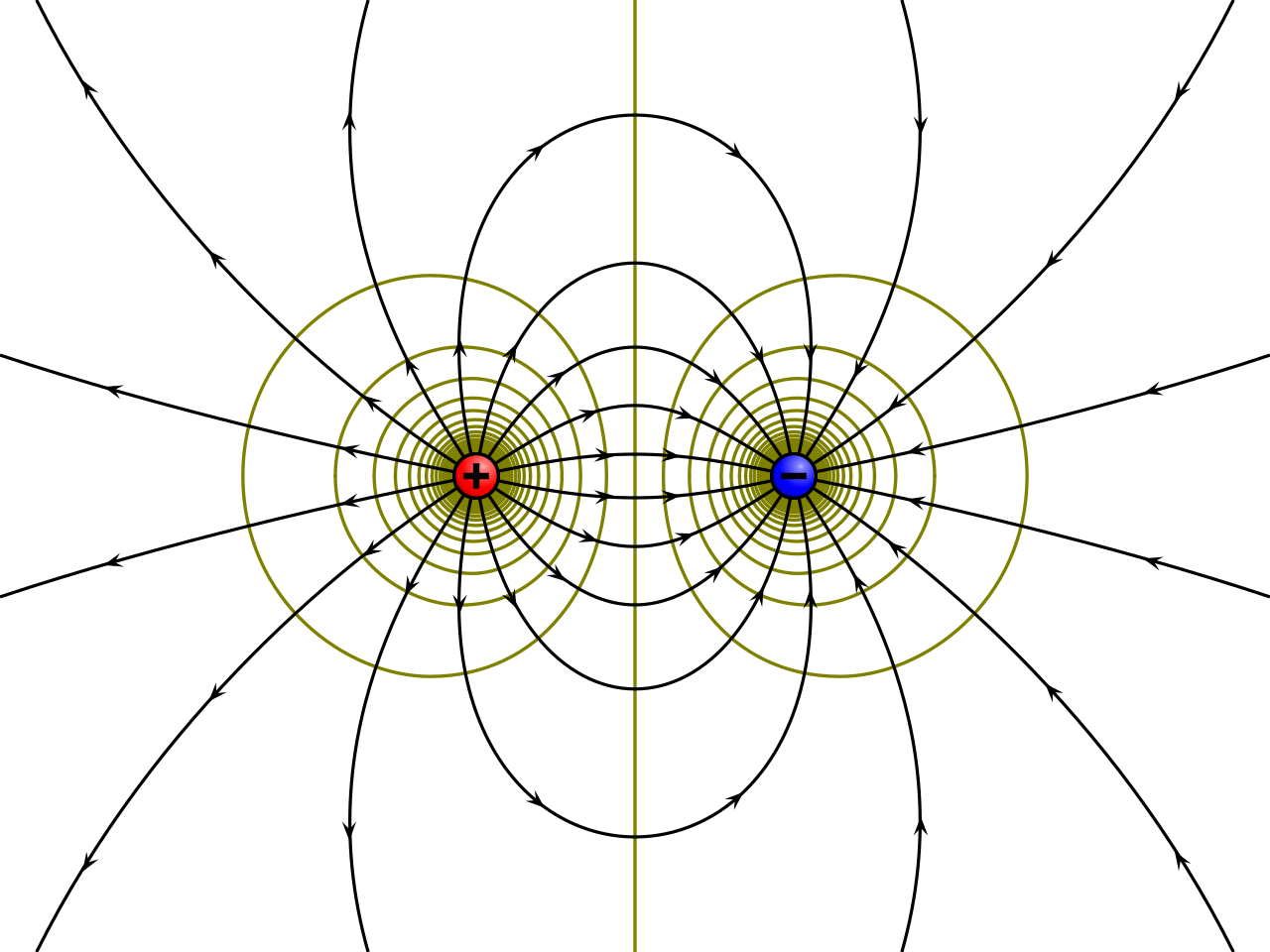
Field lines begin on the negative charge and end on the positive charge
Field lines cross at the midpoint between the charges
Field lines begin on the positive (red) charge and end on the negative (blue) charge
Equipotential lines are parallel to the field lines
Field lines are drawn from + to −, never cross, and meet the equipotentials at right angles. Image: Geek3, derivative by MikeRun, CC BY-SA 3.0, via Wikimedia Commons.
A proton is released from rest between the two plates shown (top plate positive). How does it move?
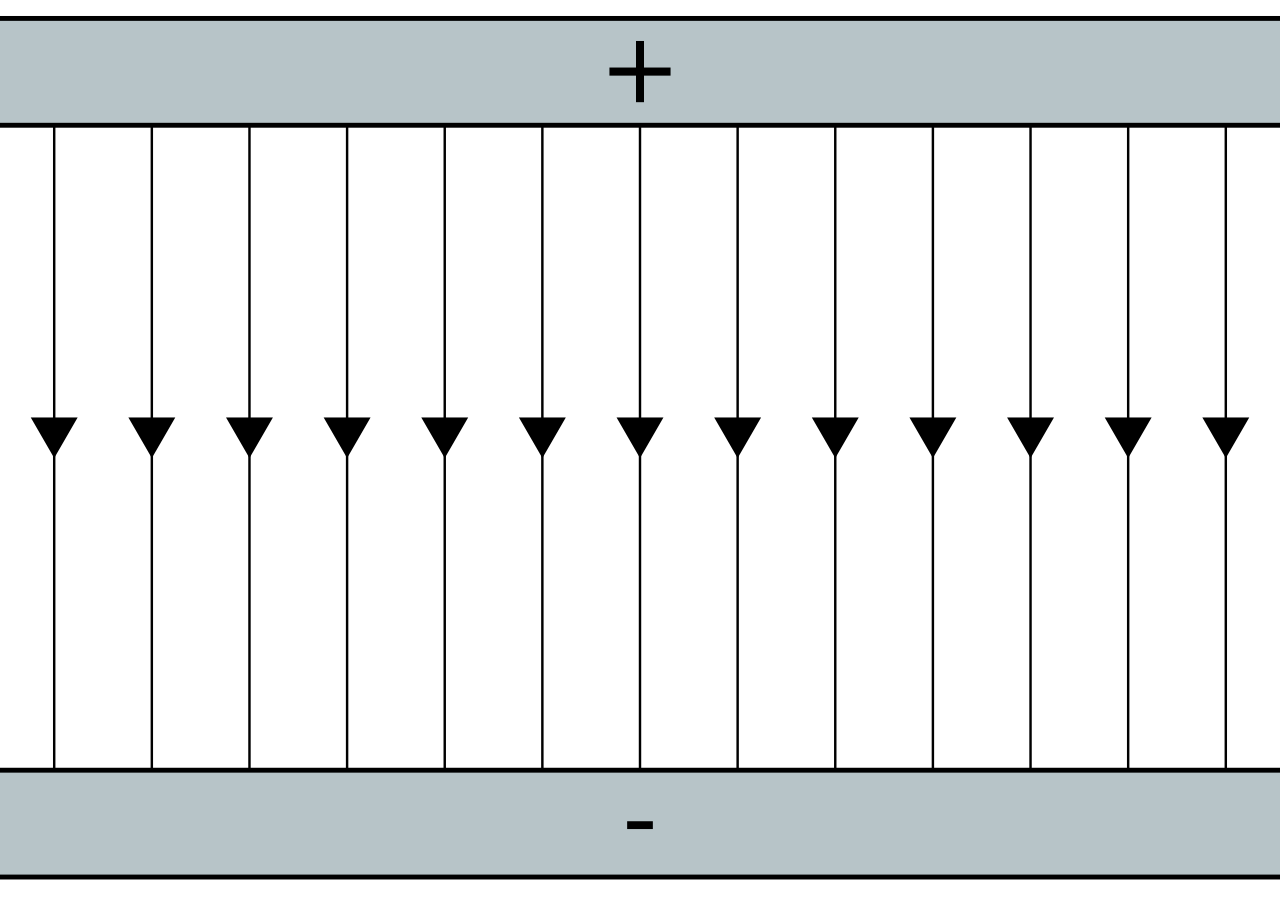
Upward, with constant acceleration
Downward, with constant acceleration
Downward, at constant speed
It stays at rest
Positive charges move along the field, from + to −, here downward. The field is uniform, so is constant. Image: Sjlegg, public domain, via Wikimedia Commons.
Electric field lines can cross each other at a point where the field is zero.
True
False
False. A field line shows the direction of the net field at each point; if lines crossed, the field would have two directions at that point. At a null point, lines simply do not pass through.
Electrons in a copper wire drift at only about a tenth of a millimetre per second, yet a lamp lights almost instantly when the switch is closed. Why?
The electric field is established through the wire at nearly the speed of light, moving all the free electrons at once
Electrons inside the wire travel at nearly the speed of light
Electrons are pushed from the battery to the lamp as a single clump
The lamp has its own stored electrons that start moving
The drift velocity is tiny, but the field that pushes every electron appears along the whole wire almost instantly (it propagates at a substantial fraction of c).
What does the lightning photograph illustrate about the electric field in air?
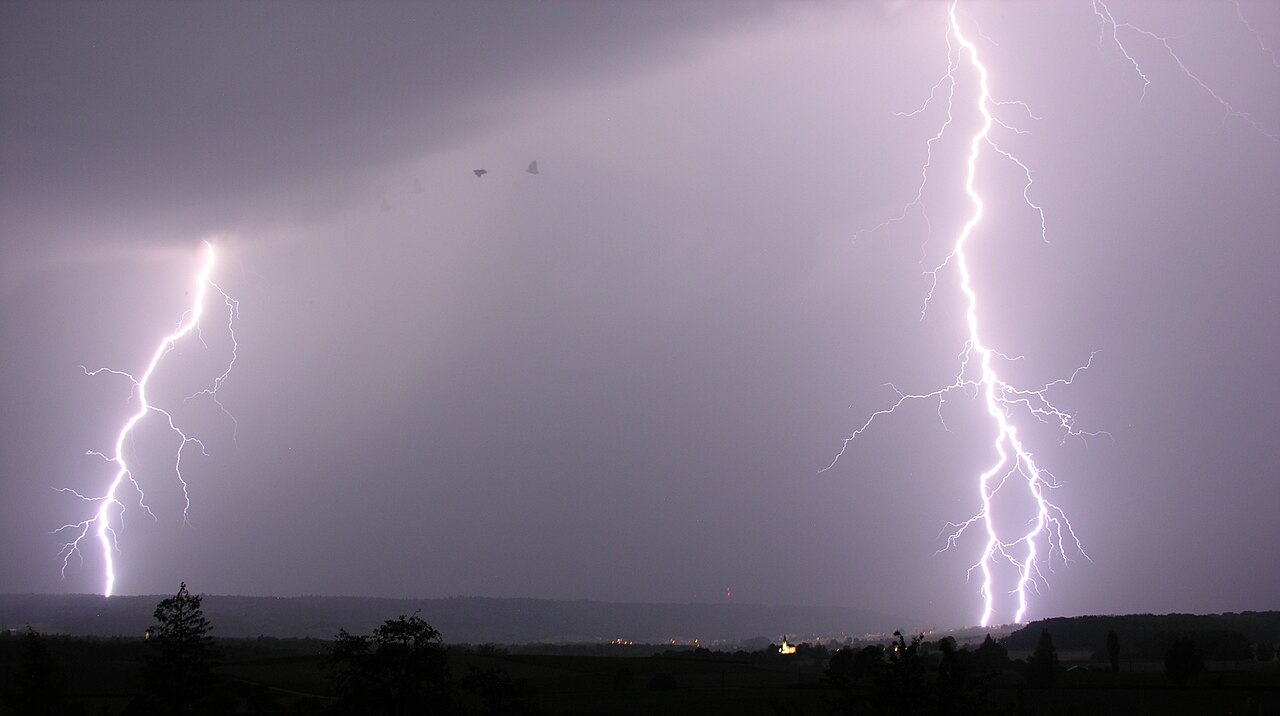
The cloud and ground were at the same potential
The air became a perfect insulator
The field in the air was zero
The field exceeded the breakdown value of dry air (about 3×10⁶ V/m)
A lightning strike occurs when charge separation in the storm cloud creates a field strong enough to ionize air and form a conducting channel. Image: Hansueli Krapf, CC BY-SA 3.0, via Wikimedia Commons.
