Quiz · Medium
Core concepts from a first physical chemistry course: the laws of thermodynamics, free energy, rate laws, the Arrhenius equation, galvanic cells and a little quantum mechanics.
Which equation represents the first law of thermodynamics?
PV = nRT
ΔU = q + w
ΔG = ΔH - TΔS
ΔS = q/T for all processes
The internal energy change equals heat added plus work done on the system. ΔG = ΔH - TΔS is a definition of Gibbs energy, and PV = nRT is the ideal gas law.
A reaction has ΔH < 0 and ΔS < 0. When is it spontaneous?
Only at high temperatures
Only at low temperatures
At no temperature
At all temperatures
ΔG = ΔH - TΔS. The negative ΔH helps at low T, but the -TΔS term becomes positive at high T and eventually dominates.
What does ΔG° < 0 tell you about K?
K > 1
K = 1
Nothing: K depends only on ΔH
K < 1
ΔG° = -RT ln K, so a negative ΔG° gives ln K > 0 and K > 1.
What are the units of k for a first-order reaction?
M-2 s-1
s-1
M s-1
M-1 s-1
Rate (M/s) = k[A], so k = rate/[A] has units of 1/s.
Which plot is a straight line for a first-order reaction?
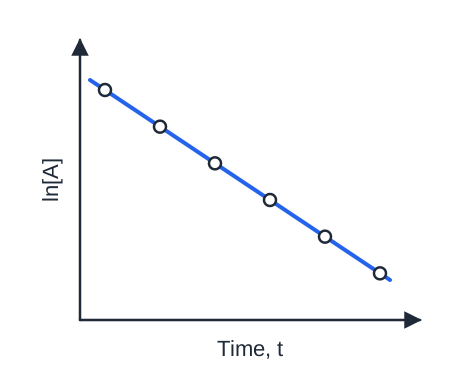
ln[A] vs t
1/[A] vs t
[A]2 vs t
[A] vs t
The integrated law is ln[A] = ln[A]0 - kt. [A] vs t is linear for zero order and 1/[A] vs t for second order.
The half-life of a first-order reaction is 20 minutes. How much of the original remains after 60 minutes?
1/2
1/8
1/3
1/6
60 min is 3 half-lives, and (1/2)^3 = 1/8. A common slip is to divide by 3 instead.
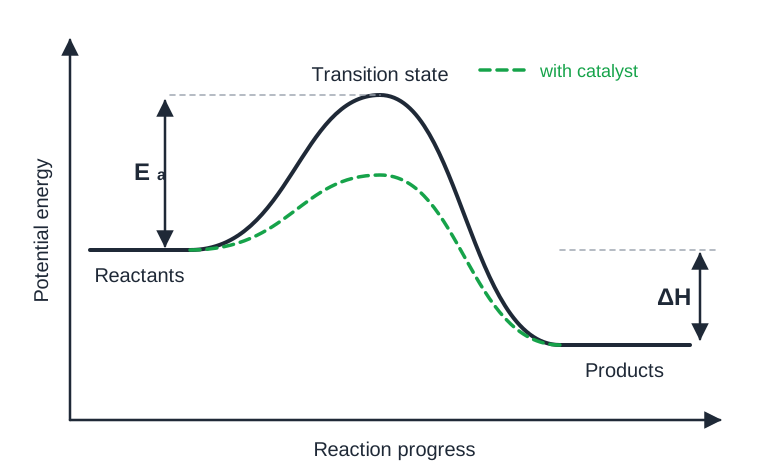
What does a catalyst change?
The products formed at equilibrium
The activation energy
ΔH of the reaction
The equilibrium constant
A catalyst provides a lower-energy pathway. It has no effect on K, ΔH or the equilibrium composition.
According to the Arrhenius equation, what happens to k when T rises?
k decreases
k is unchanged
k increases exponentially
k increases linearly
k = A exp(-Ea/RT), so a higher temperature makes the exponent less negative and k increases rapidly.
In a galvanic cell, oxidation occurs at the
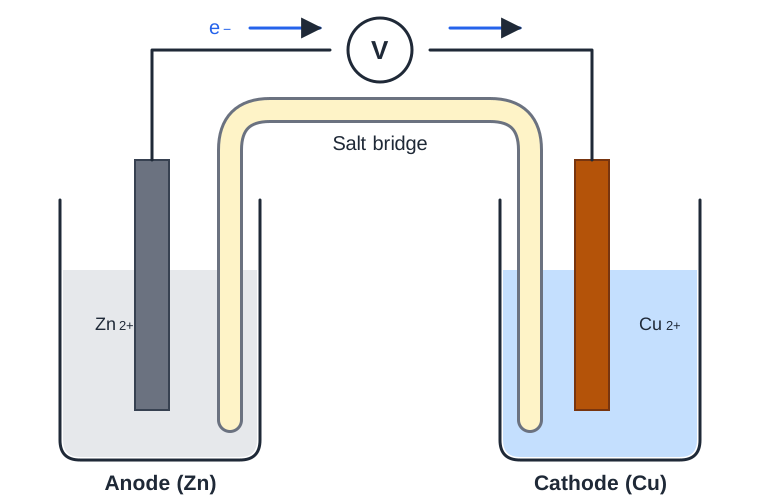
Anode
Cathode
Salt bridge
Voltmeter
An ox, red cat: oxidation at the anode, reduction at the cathode.
What is the role of the salt bridge?
It carries electrons between the electrodes
It supplies the reactants
It maintains charge balance by letting ions migrate
It increases the cell voltage
Electrons flow through the wire. The bridge lets ions move so that the half-cells do not build up charge.
What is E°cell for Zn | Zn2+ || Cu2+ | Cu, if E°(Cu2+/Cu) = +0.34 V and E°(Zn2+/Zn) = -0.76 V?
-0.42 V
+0.42 V
+1.10 V
-1.10 V
E°cell = E°cathode - E°anode = 0.34 - (-0.76) = +1.10 V. Adding the signs without the subtraction gives the wrong answer.
Which species is the strongest oxidizing agent?
Zn2+ (E° = -0.76 V)
Cu2+ (E° = +0.34 V)
Na+ (E° = -2.71 V)
Li+ (E° = -3.04 V)
The most positive reduction potential means the species is reduced most easily, so it is the best oxidizing agent.
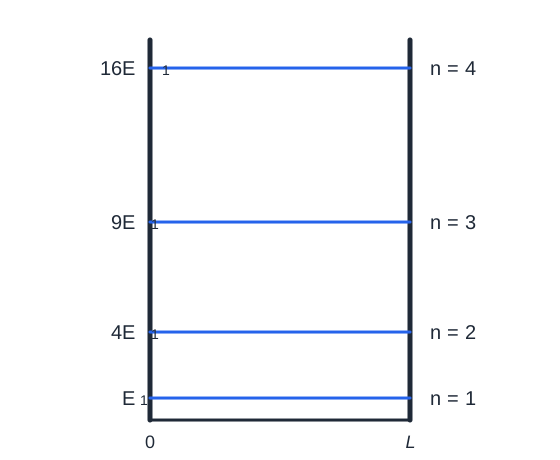
The energy levels of a particle in a box vary with quantum number n as
1/n2
n2
n
1/n
E_n = n2 h2 / 8mL2. The hydrogen atom, by contrast, goes as -1/n2.
What is the speed ordering of gases at the same temperature?
Heavier molecules move faster
It depends on pressure only
Lighter molecules move faster
All gases move at the same speed
The average kinetic energy is the same, so v_rms = sqrt(3RT/M) is higher for smaller M.
The photoelectric effect shows that
Electrons are emitted only if the light frequency exceeds a threshold
Light behaves as a wave only
Light has no energy
Brighter light always gives faster electrons
Below the threshold frequency no electrons are emitted regardless of intensity. Higher intensity gives more electrons, not faster ones.
Which molecule is NOT IR active in its stretching vibration?
CO
N2
HCl
NO
IR absorption needs a change in the dipole moment. N2 is homonuclear and nonpolar, so its stretch does not change the dipole.
For an ideal gas undergoing an isothermal expansion, which is true?
q = 0
ΔH > 0
ΔU = 0
w = 0
U depends only on T for an ideal gas, so ΔU = 0 and q = -w (the gas absorbs heat to do work).
