Quiz · Medium
Identify the glands, match hormones to their sources and basic actions.
Which structure is labeled 3 in the diagram?
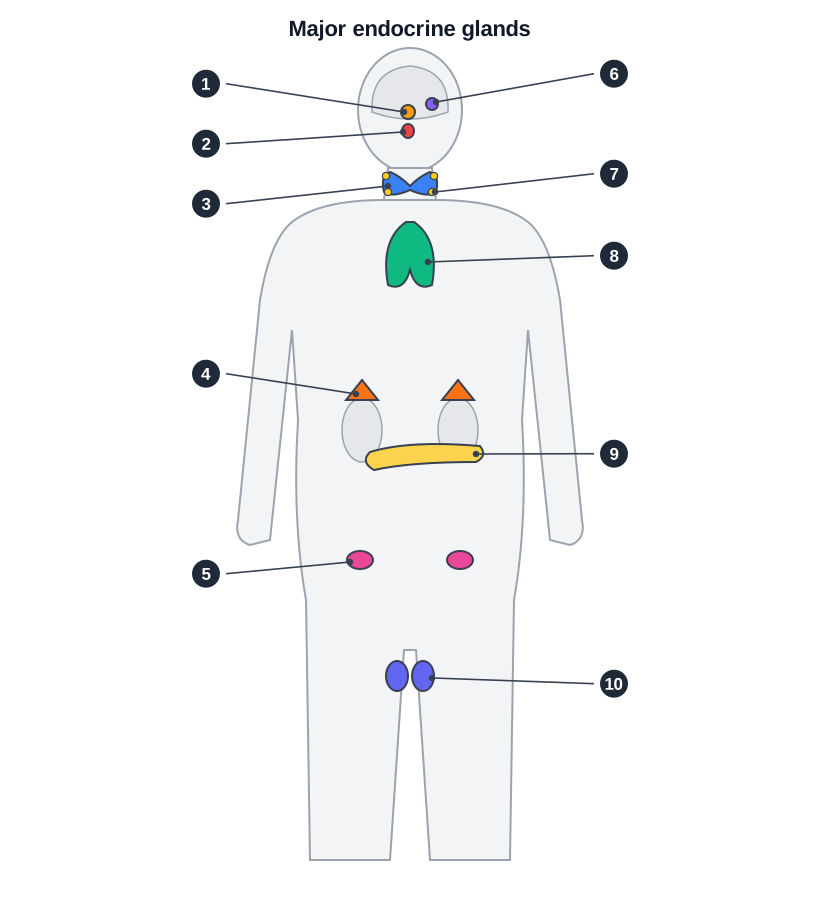
Parathyroid glands
Thyroid gland
Thymus
Pineal gland
The thyroid is the butterfly-shaped gland on the front of the neck. The parathyroids are small and sit on its back surface.
Which structure is labeled 6 in the diagram?
Pituitary gland
Pineal gland
Hypothalamus
Adrenal gland
The pineal gland, deep in the brain, secretes melatonin.
Which structure is labeled 4 in the diagram?
Adrenal gland
Ovary
Pancreas
Thymus
The adrenal glands sit on top of the kidneys. The cortex makes steroids; the medulla makes catecholamines.
Which structure is labeled 6 in the diagram?
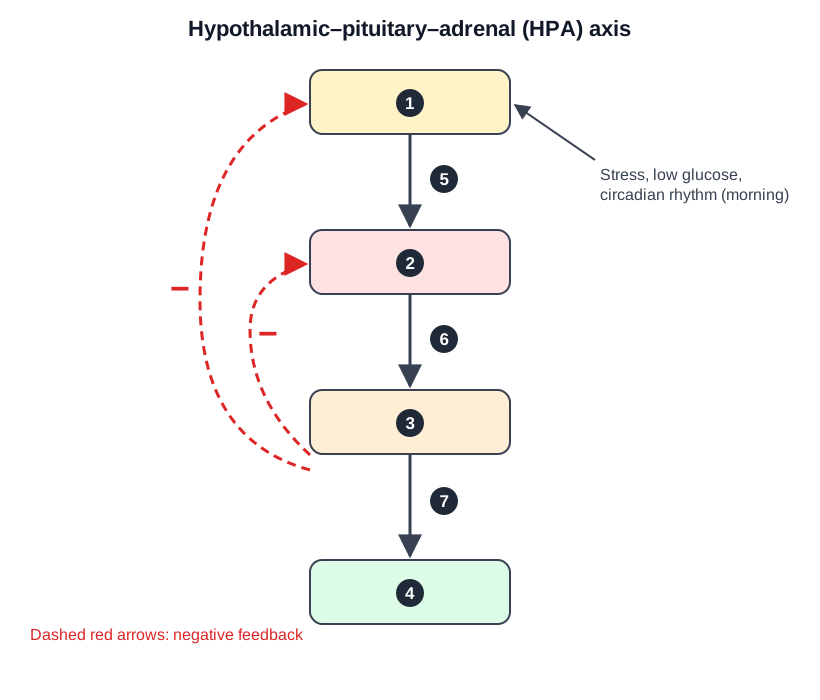
CRH
ACTH
TSH
Cortisol
ACTH comes from the anterior pituitary and stimulates the adrenal cortex. CRH is the hypothalamic hormone that comes first.
Which hormone lowers blood glucose?
Glucagon
Cortisol
Insulin
Epinephrine
Insulin is the only major hormone that lowers blood glucose. The others all raise it.
Which gland is called the 'master gland'?
Thyroid
Pituitary
Adrenal
Pineal
The anterior pituitary secretes tropic hormones that control the thyroid, adrenals and gonads. It is itself controlled by the hypothalamus.
Which hormones are released by the posterior pituitary?
TSH and ACTH
ADH and oxytocin
GH and prolactin
FSH and LH
ADH and oxytocin are made in the hypothalamus and released from the posterior pituitary. The others are anterior pituitary hormones.
Which hormone raises blood calcium?
Calcitonin
Insulin
Parathyroid hormone
Aldosterone
PTH raises Ca2+ by acting on bone, kidney and (via vitamin D) the gut. Calcitonin lowers calcium but is of minor importance in adults.
Which cells of the pancreas secrete glucagon?
Beta cells
Alpha cells
Delta cells
Acinar cells
Alpha cells make glucagon, beta cells insulin, delta cells somatostatin. Acinar cells make digestive enzymes.
Steroid hormones typically act by…
binding surface receptors and raising cAMP
binding intracellular receptors and altering gene expression
opening ion channels directly
being broken down in the blood
Being lipid-soluble, steroid hormones enter cells and act on transcription. Peptide hormones use surface receptors and second messengers.
An excess of cortisol causes which condition?
Addison disease
Cushing syndrome
Graves disease
Conn syndrome
Cushing syndrome. Addison disease is cortisol deficiency, Graves is thyroid excess and Conn syndrome is aldosterone excess.
Which hormone stimulates milk ejection?
Prolactin
Oxytocin
Estrogen
Progesterone
Oxytocin causes let-down. Prolactin makes the milk but does not eject it, a frequent mix-up.
Which gland makes thyroid-stimulating hormone (TSH)?
Thyroid
Hypothalamus
Anterior pituitary
Posterior pituitary
TSH comes from the anterior pituitary; the hypothalamus releases TRH and the thyroid responds by making T3 and T4.
Which is a classic sign of hypothyroidism?
Heat intolerance
Weight loss
Tachycardia
Cold intolerance and fatigue
Low thyroid hormone slows metabolism. Heat intolerance, weight loss and tachycardia belong to hyperthyroidism.
Which symptoms suggest uncontrolled diabetes mellitus?
Polyuria and polydipsia
Bradycardia and cold intolerance
Tremor and weight loss with low glucose
Hypotension and hyperpigmentation
High glucose spills into urine and drags water with it, so the person urinates and drinks more.
True or false: The adrenal medulla secretes cortisol.
True
False
False. Cortisol comes from the cortex (zona fasciculata). The medulla secretes epinephrine and norepinephrine.
Which hormone is made by the kidney in response to low oxygen?
Erythropoietin
Renin
ANP
Aldosterone
Erythropoietin stimulates red blood cell production. Renin is also made in the kidney, but it is an enzyme released in response to low blood pressure.
Which structure is labeled 9 in the diagram?
Thymus
Adrenal gland
Pancreas
Pituitary gland
The pancreas lies behind the stomach and contains the islets of Langerhans, which release insulin and glucagon.
How do hypothalamic releasing hormones reach the anterior pituitary?
Through axons running down the stalk
Through the hypophyseal portal blood vessels
Through the cerebrospinal fluid
Through the optic chiasm
A portal capillary system carries them directly. Axons in the stalk serve the posterior pituitary, whose hormones are made in the hypothalamus.
