Quiz · Hard
Exam-level, multi-step problems: quantum numbers, ion configurations, combined gas law, partial pressures, effusion, heating energy and colligative properties.
Which ion has the configuration [Ar] 3d¹⁰?
Cu⁺
Cu²⁺
Zn
Ni²⁺
Cu is [Ar] 3d¹⁰ 4s¹; removing the 4s electron gives Cu⁺ = [Ar] 3d¹⁰. Cu²⁺ is 3d⁹, neutral Zn still has 4s², and Ni²⁺ is 3d⁸.
Which set of quantum numbers (n, ℓ, mℓ, ms) is NOT allowed?
(3, 2, −2, +½)
(2, 1, 0, −½)
(4, 0, 1, +½)
(3, 1, −1, −½)
For ℓ = 0, mℓ can only be 0, so (4, 0, 1, +½) is impossible. The others obey ℓ ≤ n − 1 and −ℓ ≤ mℓ ≤ +ℓ.
How many unpaired electrons does Mn²⁺ (Mn: Z = 25) have in its ground state?
1
3
5
7
Mn is [Ar] 4s² 3d⁵; Mn²⁺ loses the two 4s electrons to give [Ar] 3d⁵, five unpaired d electrons (Hund's rule).
What is the maximum number of electrons that can have n = 4 and ℓ = 2?
2
6
10
14
n = 4, ℓ = 2 is the 4d subshell: 5 orbitals × 2 electrons = 10. 14 would be the 4f subshell (ℓ = 3).
A 500. mL sample of gas at 27 °C and 1.00 atm is heated to 127 °C and compressed to 2.00 atm. What is its new volume?
333 mL
375 mL
588 mL
1.18 L
Use kelvin: V₂ = V₁(P₁/P₂)(T₂/T₁) = 500.(1.00/2.00)(400./300.) = 333 mL. Using °C (127/27) gives a nonsense answer of about 1.18 L.
Hydrogen is collected over water at 25 °C. The total pressure is 760. torr and the vapor pressure of water at 25 °C is 23.8 torr. What is the partial pressure of H₂?
23.8 torr
736 torr
760. torr
784 torr
Dalton's law: P(H₂) = P(total) − P(H₂O) = 760. − 23.8 = 736 torr. Forgetting to subtract the water vapor gives 760 torr.
An unknown gas effuses at half the rate of O₂ under the same conditions. What is its molar mass?
16 g/mol
64 g/mol
128 g/mol
256 g/mol
Graham's law: r(unknown)/r(O₂) = √(32/M) = 0.5 → 32/M = 0.25 → M = 128 g/mol. 64 g/mol comes from forgetting to square.
What is the density of CO₂ gas at STP (0 °C, 1 atm, 22.4 L/mol)?
0.509 g/L
1.25 g/L
1.96 g/L
44.0 g/L
d = M / Vm = 44.01 g/mol ÷ 22.4 L/mol = 1.96 g/L. 44.0 g/L confuses molar mass with density.
2 KClO₃(s) → 2 KCl(s) + 3 O₂(g). What volume of O₂ at STP (22.4 L/mol) forms from 2.00 mol KClO₃?
22.4 L
44.8 L
67.2 L
89.6 L
2.00 mol KClO₃ gives 3.00 mol O₂ (mole ratio 3:2), and 3.00 × 22.4 = 67.2 L. 44.8 L ignores the mole ratio.
How much heat is needed to turn 18.0 g of ice at 0 °C into liquid water at 25.0 °C? (ΔHfus = 6.01 kJ/mol, c = 4.184 J g⁻¹ °C⁻¹)
1.88 kJ
6.01 kJ
7.89 kJ
47.0 kJ
Two steps: melting 1.00 mol = 6.01 kJ, then warming q = (18.0)(4.184)(25.0) = 1.88 kJ. Total 7.89 kJ. Choosing 6.01 or 1.88 kJ counts only one step.
0.50 mol of CaCl₂ is dissolved in 1.0 kg of water (Kf = 1.86 °C/m). Assuming complete dissociation, what is the freezing point?
−0.93 °C
−1.86 °C
−2.79 °C
−5.58 °C
ΔTf = iKf m = 3 × 1.86 × 0.50 = 2.79 °C, so the solution freezes at −2.79 °C. −0.93 °C forgets the van 't Hoff factor.
What is the osmotic pressure of 0.10 M glucose at 298 K? (R = 0.08206 L atm mol⁻¹ K⁻¹)
0.24 atm
2.4 atm
4.9 atm
24 atm
Π = iMRT = (1)(0.10)(0.08206)(298) = 2.4 atm. Glucose does not ionize, so i = 1; using i = 2 gives 4.9 atm.
A solution contains 1.0 mol glucose and 9.0 mol water. Pure water's vapor pressure is 23.8 torr. What is the solution's vapor pressure?
2.4 torr
21.4 torr
23.8 torr
26.2 torr
Raoult's law: P = x(water) P° = (9.0/10.0)(23.8) = 21.4 torr. A nonvolatile solute always lowers vapor pressure, so 26.2 torr is impossible.
A radioactive isotope has a half-life of 5.0 days. How much of an 80. g sample remains after 15 days?
5.0 g
10. g
20. g
27 g
15 days is 3 half-lives: 80 → 40 → 20 → 10. g. 27 g comes from dividing by 3 instead of halving three times.
Using this phase diagram, what happens if the substance at its triple-point temperature is held at a pressure well below the triple point?
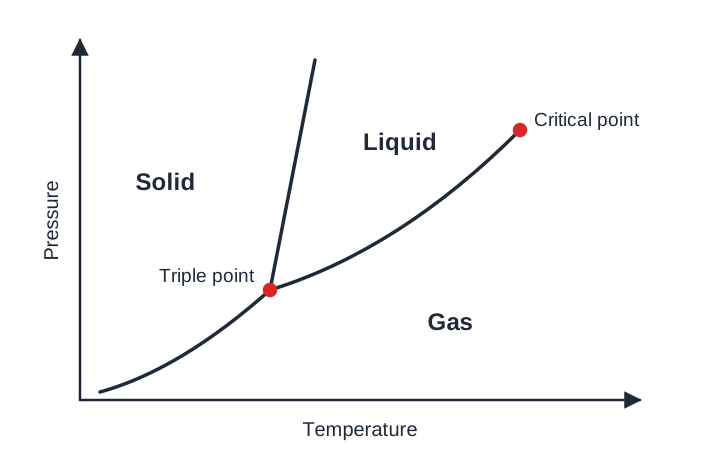
It is a liquid
It is a gas
It is a solid
It is a supercritical fluid
Below the triple-point pressure only solid and gas phases exist, and at the triple-point temperature with lower pressure you are in the gas region. Liquid can only exist above the triple-point pressure.
Which statement about a gas sample is correct when its kelvin temperature doubles at constant volume?
The average kinetic energy of the molecules doubles
The average speed of the molecules doubles
The pressure is halved
The number of moles doubles
Average kinetic energy is proportional to T, so it doubles. Speed goes up by √2, not 2, and pressure doubles (Gay-Lussac's law).
