Quiz · Medium
Eighteen questions on Brønsted–Lowry theory, strong vs weak acids, pH, buffers, titration endpoints, indicators and salt solutions.
According to Brønsted–Lowry theory, an acid is a:
Electron-pair donor
Producer of OH⁻ in water
Proton donor
Proton acceptor
Brønsted–Lowry acids donate H⁺. Acceptors are bases; electron-pair donors are Lewis bases; OH⁻ producers are Arrhenius bases.
In NH₃ + H₂O ⇌ NH₄⁺ + OH⁻, the conjugate acid of NH₃ is:
NH₄⁺
OH⁻
H₂O
NH₂⁻
NH₃ accepts a proton to become NH₄⁺, its conjugate acid. OH⁻ is the conjugate base of water.
What is the pH of 0.0010 M HNO₃?
1.00
11.00
2.30
3.00
HNO₃ is a strong acid: [H⁺] = 1.0 × 10⁻³ M, pH = 3.00.
What is the pH of 0.050 M Ca(OH)₂?
1.00
1.30
13.00
12.70
[OH⁻] = 2 × 0.050 = 0.10 M, pOH = 1.00, pH = 13.00. 12.70 forgets the factor of 2.
A solution has pH 4. Compared with a solution of pH 6 its [H⁺] is:
10 times larger
100 times larger
2 times larger
100 times smaller
Two pH units is a factor of 10² = 100; lower pH means higher [H⁺].
Which of these is a strong acid?
HF
CH₃COOH
H₂CO₃
HBr
HBr ionizes completely in water. HF, acetic acid and carbonic acid are weak.
The pH of pure water at 25 °C is 7.00. As water is heated to 60 °C, its pH:
Rises above 7 and it becomes basic
Stays exactly 7
Falls and it becomes acidic
Falls below 7 but it stays neutral
Autoionization is endothermic so Kw increases. [H⁺] and [OH⁻] rise equally, so the pH drops (about 6.5 at 60 °C), yet [H⁺] = [OH⁻] so the water is still neutral.
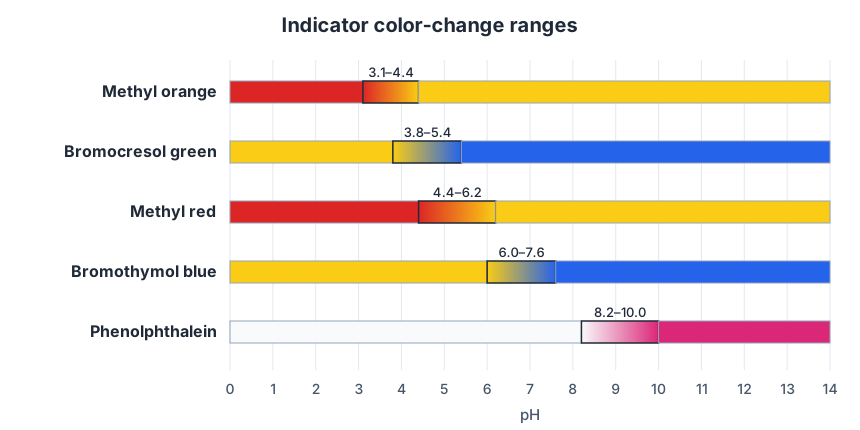
Which indicator in the chart changes color in the most basic range?
Methyl red
Bromocresol green
Phenolphthalein
Methyl orange
Phenolphthalein changes at pH 8.2–10.0, well above the others.
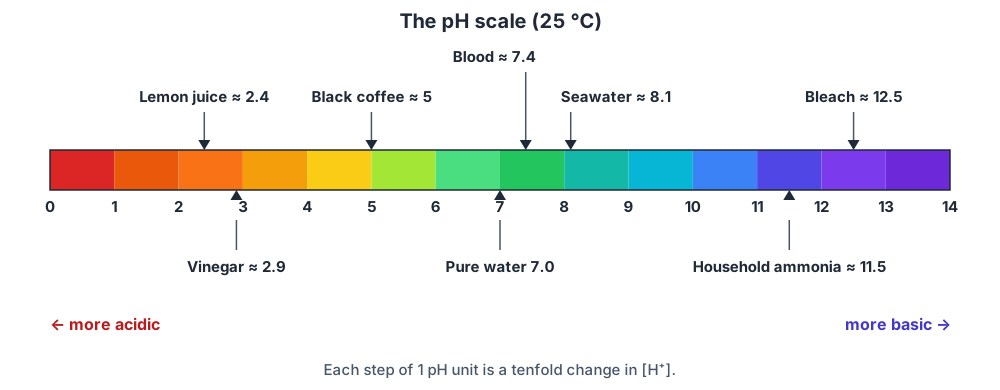
A pH reading of about 7.4 on the scale matches which item?
Vinegar
Blood
Lemon juice
Bleach
Blood is slightly basic, about pH 7.4.
Which statement about a weak acid is correct?
It is only partly ionized in solution
It always has a pH above 7
It has a weak conjugate base
It cannot be titrated
A weak acid ionizes partially. Its conjugate base is relatively strong (not weak), and it can of course be titrated.
For the weak acid HA, Ka = 1.0 × 10⁻⁵. Its pKa is:
5.0
9.0
−5.0
1.0
pKa = −log(1.0 × 10⁻⁵) = 5.0.
In a buffer with [A⁻]/[HA] = 10, the pH equals:
pKa
pKa + 10
pKa + 1
pKa − 1
Henderson–Hasselbalch: pH = pKa + log 10 = pKa + 1.
Which mixture makes a buffer?
0.10 mol NaOH + 0.10 mol NaCl
0.10 mol CH₃COOH + 0.05 mol NaOH
0.10 mol HCl + 0.10 mol NaOH
0.10 mol HCl + 0.10 mol NaCl
Adding half the equivalent of NaOH to acetic acid leaves 0.05 mol CH₃COOH and 0.05 mol CH₃COO⁻, a conjugate pair. Strong-acid/strong-base mixtures contain no weak pair.
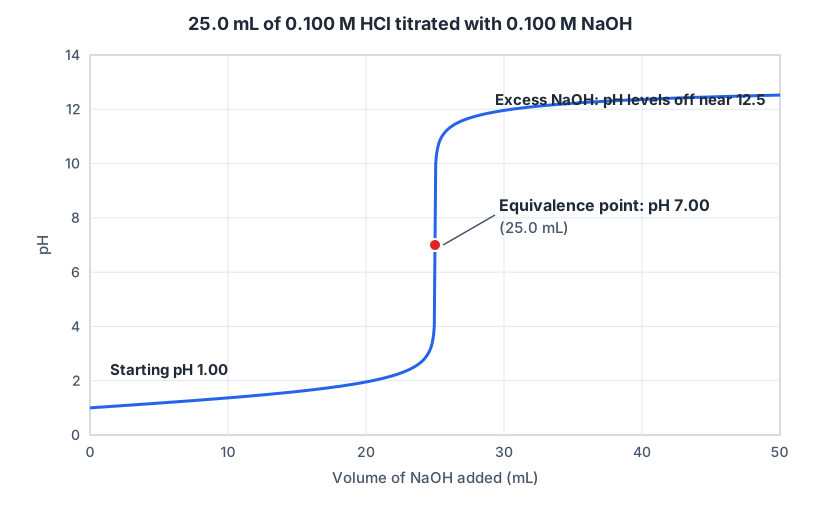
A strong acid is titrated with a strong base. At the equivalence point the pH is:
7.00
Less than 7
Greater than 7
Equal to 14
The salt formed does not hydrolyze, so the solution is neutral at 25 °C.
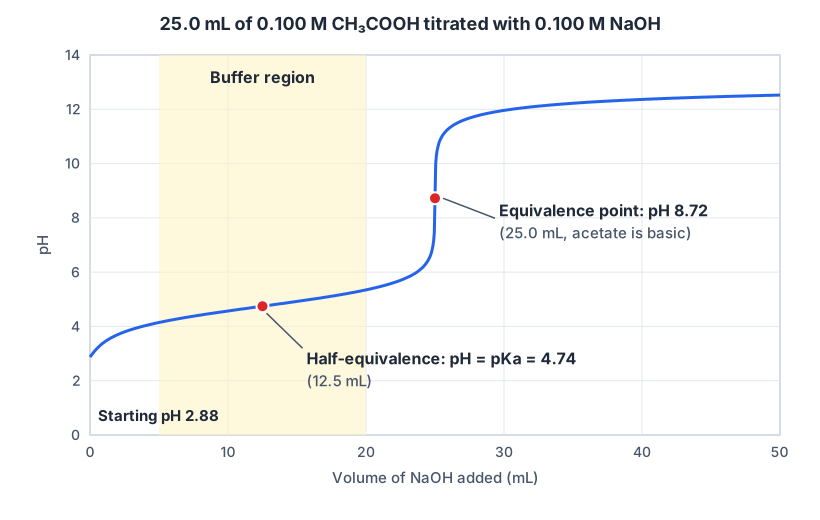
In the weak acid titration shown, the pH at the equivalence point is above 7 because:
Excess NaOH has been added
The acid is strong
The indicator is basic
The conjugate base of the acid is present
At equivalence all HA has become A⁻ (acetate), a weak base that raises the pH to about 8.7.
What is the name of the instrument shown?
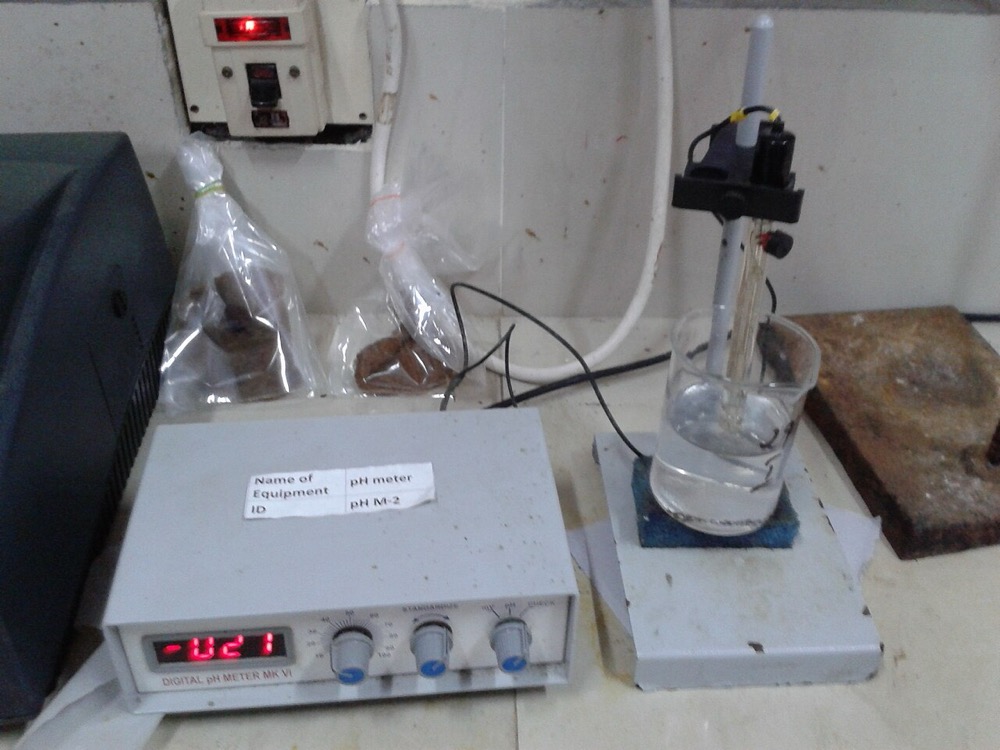
Calorimeter
pH meter
Spectrophotometer
Conductivity bridge
The glass electrode in the beaker is connected to a digital pH meter that reads [H⁺] directly.
Image: Vis M, CC BY-SA 4.0, via Wikimedia Commons.
Which salt makes an acidic aqueous solution?
KNO₃
NH₄Cl
NaCl
CH₃COONa
NH₄⁺ is the conjugate acid of a weak base, so it donates protons. NaCl and KNO₃ are neutral; sodium acetate is basic.
Which is the best indicator for titrating CH₃COOH with NaOH?
Phenolphthalein
Methyl orange
Bromocresol green
Methyl red
The equivalence point is near pH 8.7, in phenolphthalein's range (8.2–10.0). The others change color too early.
