Quiz · Medium
Identify male and female reproductive structures, sperm anatomy and the basic hormonal control of reproduction.
Which structure is labeled 3 in the diagram?
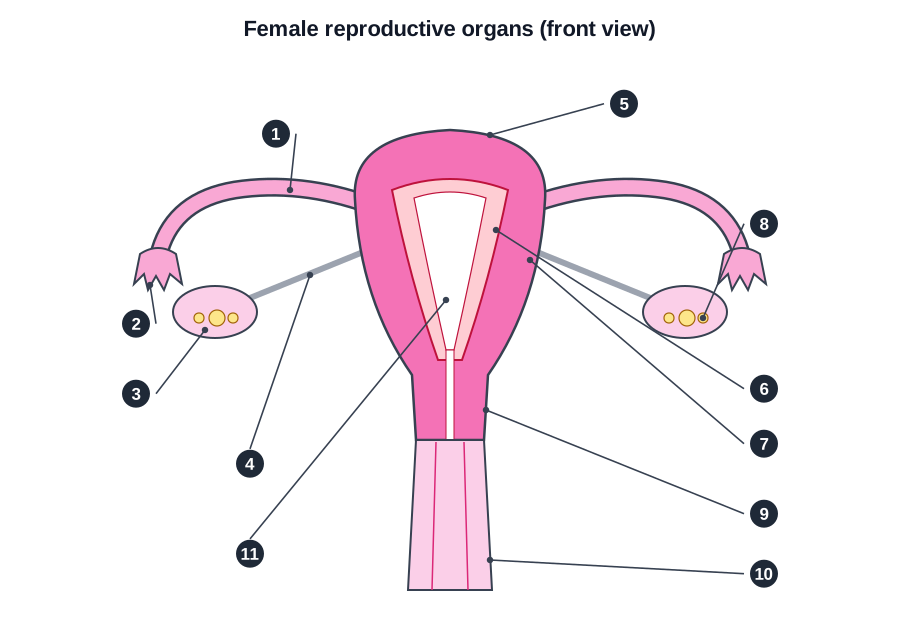
Uterine tube
Ovary
Cervix
Fundus
The ovaries are the paired gonads that sit near the ends of the uterine tubes.
Which structure is labeled 9 in the diagram?
Vagina
Cervix
Myometrium
Fundus
The cervix is the narrow neck between the uterus and vagina.
Which structure is labeled 6 in the diagram?
Myometrium
Endometrium
Perimetrium
Ovarian ligament
The endometrium is the inner lining, shed during menstruation. The myometrium is the muscle.
Which structure is labeled 7 in the diagram?
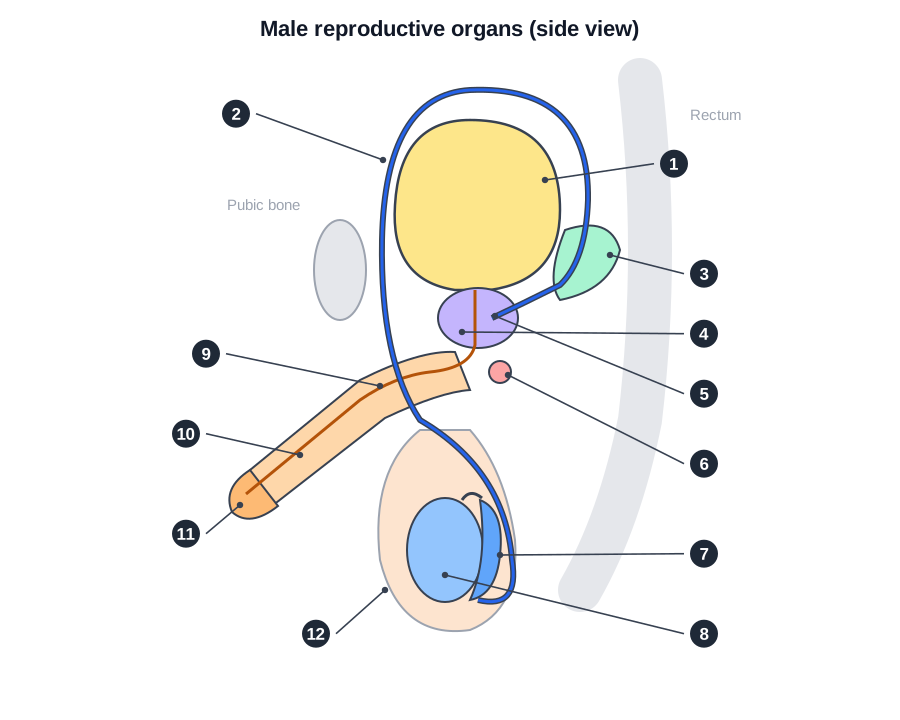
Epididymis
Vas deferens
Seminal vesicle
Prostate
The epididymis is the coiled tube on the back of the testis where sperm mature.
Which structure is labeled 4 in the diagram?
Seminal vesicle
Bulbourethral gland
Prostate gland
Epididymis
The prostate surrounds the urethra just below the bladder.
Which structure is labeled 1 in the diagram?
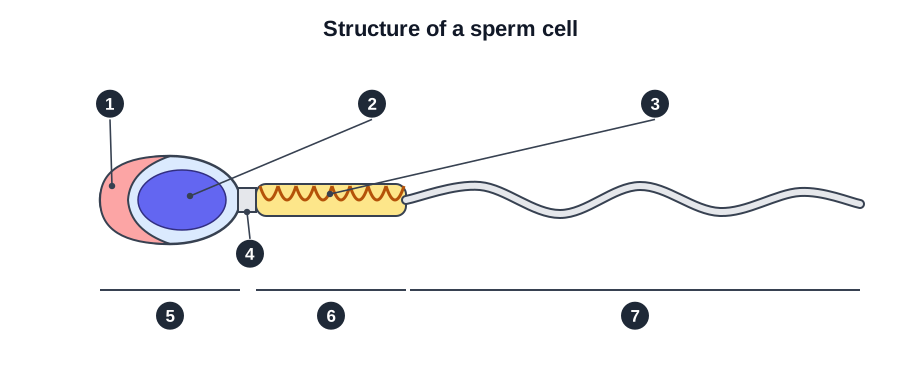
Mitochondria
Acrosome
Centriole
Tail
The acrosome at the tip of the head holds enzymes for penetrating the oocyte.
Where does fertilization usually occur?
Uterus
Ampulla of the uterine tube
Vagina
Ovary
The ampulla is the widest part of the tube. The fertilized egg then travels to the uterus to implant.
Which hormone surge triggers ovulation?
FSH
LH
Progesterone
hCG
The LH surge triggers ovulation about 24 to 36 hours later.
Which structure secretes progesterone after ovulation?
Corpus luteum
Graafian follicle
Corpus albicans
Placenta only
The corpus luteum forms from the ruptured follicle. The corpus albicans is scar tissue that makes no hormone.
Where are sperm produced?
Epididymis
Seminiferous tubules
Prostate
Vas deferens
Spermatogenesis takes place in seminiferous tubules; the epididymis only matures and stores sperm.
Which cells in the testis produce testosterone?
Sertoli cells
Leydig cells
Spermatogonia
Granulosa cells
Leydig cells (interstitial cells) respond to LH. Sertoli cells support sperm development.
Which phase of the uterine cycle follows menstruation?
Secretory
Proliferative
Luteal
Ovulatory
Estrogen drives the proliferative phase. The secretory phase follows ovulation (progesterone). The luteal phase refers to the ovarian cycle.
What does hCG do in early pregnancy?
Triggers ovulation
Maintains the corpus luteum
Stimulates labor
Stops lactation
hCG keeps the corpus luteum making progesterone until the placenta takes over.
Which hormone makes the uterus contract during labor and causes milk ejection?
Oxytocin
Prolactin
Estrogen
Relaxin only
Oxytocin from the posterior pituitary. Prolactin makes milk but does not eject it.
True or false: Meiosis II of the oocyte is completed at ovulation.
True
False
False. The oocyte arrests in metaphase II at ovulation and completes meiosis II only if fertilized.
Which gland contributes the largest volume of semen?
Prostate
Seminal vesicles
Bulbourethral glands
Epididymis
Seminal vesicles produce about 60% of semen volume.
Which cells provide nutrients to developing sperm and form the blood-testis barrier?
Leydig cells
Sertoli cells
Theca cells
Granulosa cells
Sertoli cells (sustentacular cells) line the tubules.
The primary function of the scrotum is to…
Store sperm for a long time
Keep testes cooler than body temperature
Make testosterone
Produce semen
Sperm production works best at slightly below core temperature.
