Quiz · Hard
Applied questions on dose-response graphs, potency versus efficacy, therapeutic index, drug interactions and pharmacogenomics.
Drug A and Drug B produce the same maximal effect, but Drug A reaches half of it at a much lower dose. Which statement is correct?
Drug A is more efficacious
Drug A is more potent; efficacy is the same
Drug B is more potent
Drug A has a higher Emax
Potency compares the dose for a given effect; efficacy is the maximum. Same plateau means equal efficacy.
A drug has an ED50 of 5 mg and a TD50 of 100 mg. What is its therapeutic index?
20
0.05
95
500
TI = TD50 / ED50 = 100 / 5 = 20. Inverting gives the wrong 0.05.
In the graph, the red curve plateaus far below the blue curve. What does the lower plateau indicate?
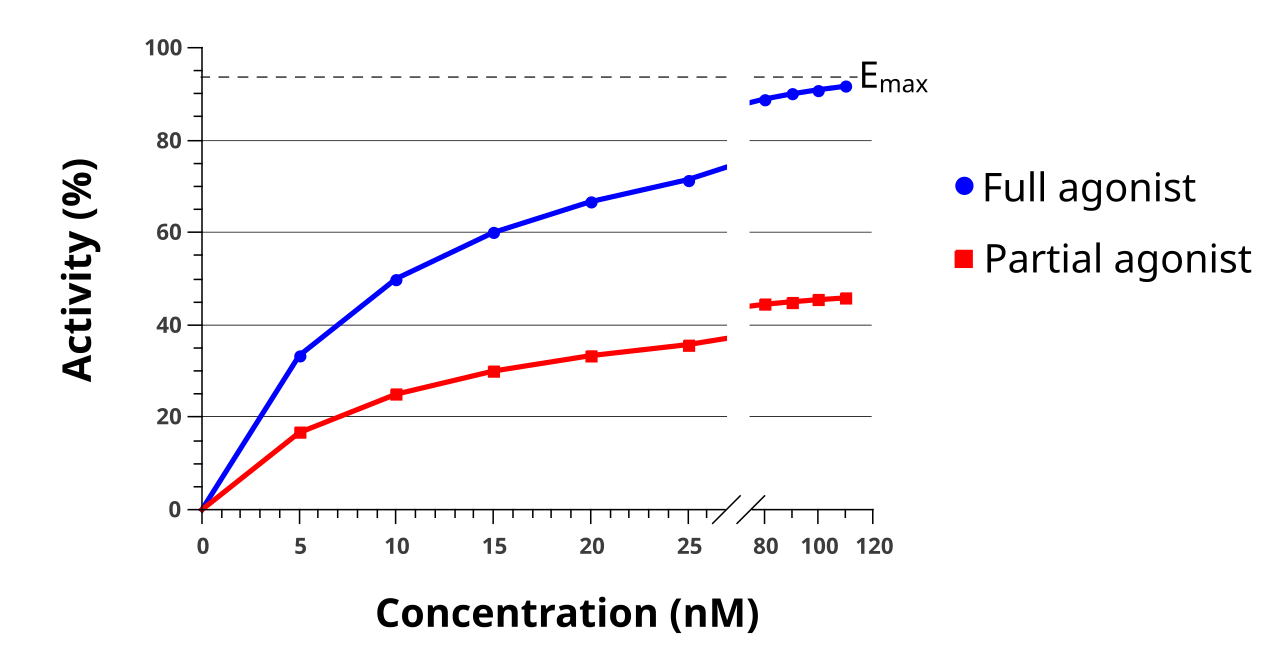
Lower potency
Higher affinity
Irreversible antagonism
Lower efficacy (partial agonist)
The plateau is Emax (efficacy). Potency would be seen as a horizontal shift. Image: Radio89, CC BY-SA 3.0, via Wikimedia Commons.
Which change to a dose-response curve corresponds to adding an irreversible antagonist after the spare receptors are used?
The curve shifts right in parallel with the same maximum
The curve shifts left
Nothing changes
The maximum response decreases
Irreversible binding permanently removes receptors. Once reserve is exhausted, Emax falls and the block cannot be overcome.
Furosemide produces more diuresis at its maximum than hydrochlorothiazide. This difference reflects which property?
Higher potency
Higher efficacy
Higher affinity
Lower Kd
Furosemide is a high-ceiling diuretic. Potency would be measured by the dose needed for a given effect.
What fraction of receptors is occupied when the drug concentration equals 3 times Kd?
33%
50%
75%
90%
Occupancy = [D]/([D] + Kd) = 3/(3 + 1) = 0.75.
An agonist has EC50 = 2 nM. After adding a competitive antagonist, the EC50 becomes 20 nM and Emax is unchanged. What does this show?
Irreversible antagonism
Partial agonism
Reversible competitive antagonism
Tachyphylaxis
A parallel right shift with unchanged maximum indicates competitive, surmountable antagonism.
A patient on buprenorphine for opioid use disorder takes a full opioid agonist. What is a likely result?
Increased respiratory depression through synergism
No interaction because they bind different receptors
Faster elimination of buprenorphine
Reduced effect of the full agonist because buprenorphine occupies receptors
Buprenorphine has high affinity and lower intrinsic activity, so it blunts the full agonist. In a dependent patient it can also precipitate withdrawal.
Which finding best describes a drug with a narrow therapeutic index?
Effective dose is far below the toxic dose
The drug has high potency
Toxic dose is close to the effective dose
The drug has no side effects
A low TD50/ED50 ratio means little room for error, so monitoring is required (warfarin, digoxin, lithium).
Carbidopa given with levodopa illustrates which interaction?
Additive effect
Chemical antagonism
Potentiation (carbidopa has no antiparkinson effect alone but boosts levodopa)
Physiological antagonism
Carbidopa blocks peripheral DOPA decarboxylase; it has no effect of its own on parkinsonism but increases brain levodopa.
A patient of Southeast Asian ancestry will start carbamazepine. Which test is recommended first?
HLA-B*5701
TPMT activity
G6PD
HLA-B*1502
HLA-B*1502 predicts carbamazepine-induced SJS/TEN. HLA-B*5701 is for abacavir; TPMT for azathioprine; G6PD for oxidant drugs.
Which drug and genotype pair is correct?
Azathioprine: TPMT deficiency increases myelosuppression
Abacavir: HLA-B*1502
Primaquine: TPMT
Carbamazepine: HLA-B*5701
Low TPMT leaves too much active thiopurine nucleotide. The other pairs mix up the markers.
A patient develops hemolytic anemia after primaquine. Which underlying condition is most likely?
TPMT deficiency
HLA-B*5701 carriage
G6PD deficiency
Pseudocholinesterase deficiency
Oxidant drugs (primaquine, dapsone, rasburicase) cause hemolysis when G6PD is deficient.
Which sequence best matches Gq signaling?
PLC activation, IP3 and DAG production, increased intracellular calcium
Adenylyl cyclase activation, cAMP rise, PKA
Adenylyl cyclase inhibition, cAMP fall
Guanylyl cyclase activation, cGMP rise
Gq uses phospholipase C. Gs raises cAMP; Gi lowers it; NO raises cGMP.
An ion channel receptor with a ligand bound shows which feature?
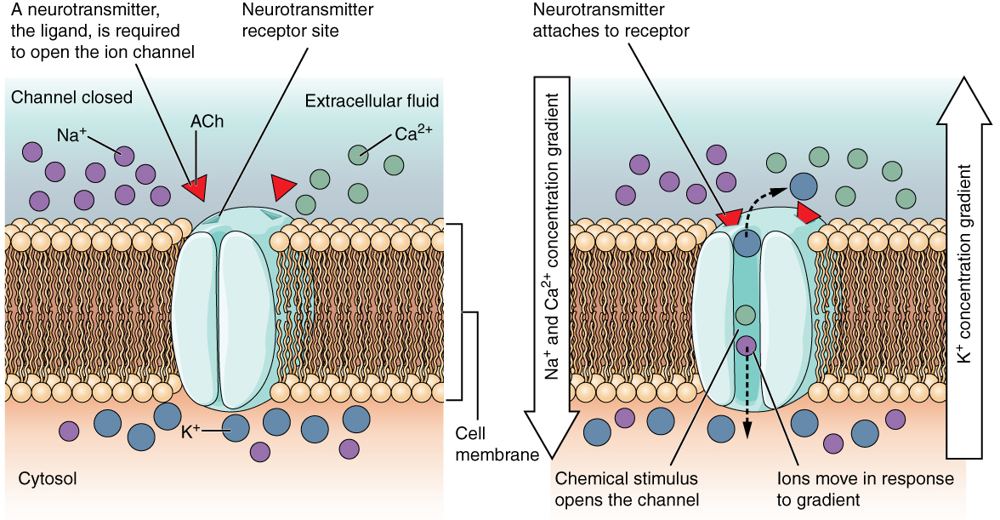
Immediate pore opening for ion flow
Gene transcription changes over hours
Dimerization and autophosphorylation
Second-messenger amplification through cAMP
Ligand-gated channels open directly. Nuclear receptors alter transcription; RTKs dimerize. Image: OpenStax, CC BY 4.0, via Wikimedia Commons.
In the nuclear receptor diagram, what happens after the hormone-receptor complex binds DNA?
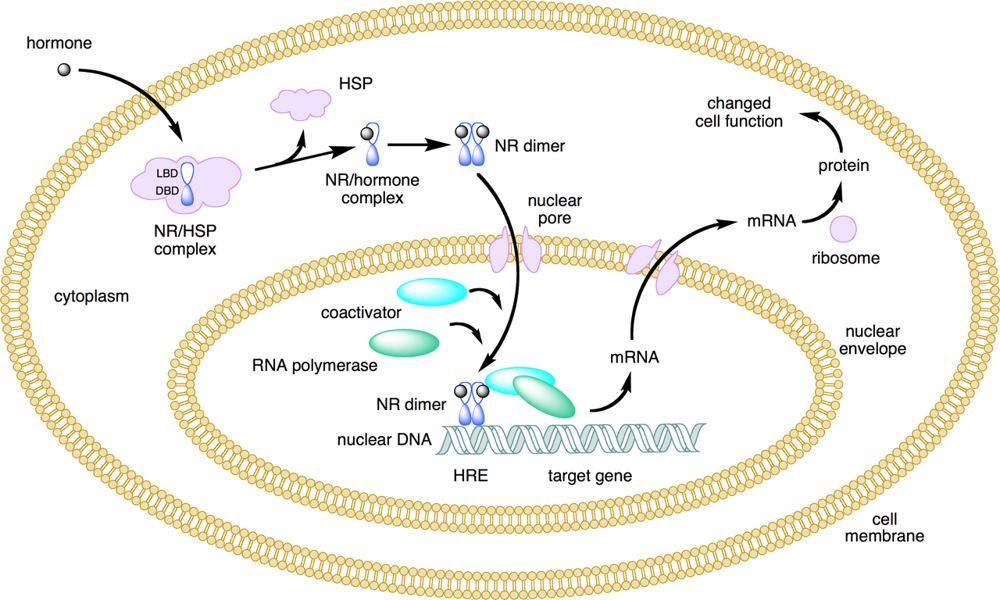
Transcription of target genes changes and new proteins alter cell function
The receptor is exported to the membrane
Ion channels open within milliseconds
cAMP rises
Intracellular receptors are transcription factors. The effect is slow (hours to days). Image: Boghog2, public domain, via Wikimedia Commons.
