Quiz · Medium
Twenty foundational questions on bacterial structure and shapes, gene transfer, the Gram stain, growth curves, phages and common pathogens.
Which structure of a bacterial cell holds the circular chromosome?
Capsule
Nucleus
Nucleoid
Plasmid
The nucleoid is a region of cytoplasm with no membrane around it. A plasmid is a small extra loop of DNA, so it is a tempting but incorrect choice.
What do bacterial cells have in place of mitochondria for the electron transport chain?
The plasma membrane
The nucleoid
The capsule
The ribosome
Prokaryotes have no membrane-bound organelles, so the electron transport chain is in the plasma membrane.
Which of the following is TRUE about bacterial ribosomes?
They are 70S and inside a nucleus
They are absent
They are 80S and bound to the ER
They are 70S and float in the cytoplasm
Bacterial ribosomes are 70S. 80S ribosomes are eukaryotic. There is no nucleus or ER.
A bacterium that grows in chains of spherical cells is called:
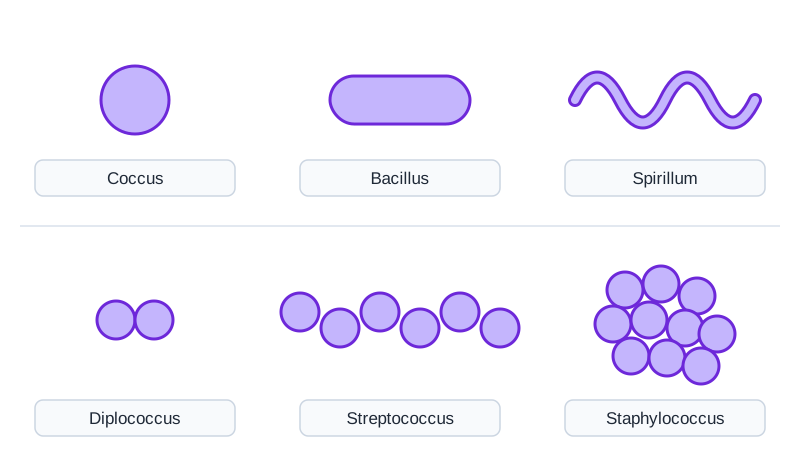
Staphylococcus
Streptococcus
Diplobacillus
Spirillum
Strepto- means chain; Staphylo- means grape-like cluster.
Which shape is shown by the bacteria labelled 'spirillum'?
Rod
Rigid spiral
Comma-shaped
Spherical
A spirillum is a rigid spiral. Cocci are spheres and bacilli are rods.
In a Gram stain, which step comes right after the iodine mordant?
Methylene blue
Crystal violet
Safranin
Alcohol decolorizer
Order: crystal violet, iodine, alcohol, safranin.
A bacterium stains pink after a Gram stain. Which of the following is most likely true?
It has a thin peptidoglycan layer and an outer membrane
It has no cell wall at all
It is an archaeon
It has a thick peptidoglycan layer and no outer membrane
Gram-negative cells have thin peptidoglycan plus an outer membrane with LPS. A thick layer is Gram-positive. A cell with no wall would not retain the stain well, but it is not the standard explanation for pink.
Which of the following is the main target of penicillin?
The outer membrane LPS
The 30S ribosomal subunit
Peptidoglycan cross-linking
DNA gyrase
Penicillin inhibits transpeptidase, so growing cells burst. Tetracycline targets the 30S subunit and fluoroquinolones target DNA gyrase.
Bacteria transfer a plasmid directly through a pilus. This is called:
Transformation
Transduction
Conjugation
Binary fission
Conjugation is direct contact. Transformation takes up free DNA, and transduction uses a phage.
Which process uses a virus to move DNA between bacteria?
Transduction
Translation
Conjugation
Transformation
Transduction. Do not confuse with transcription or translation, which are about gene expression.
Why does boiling not sterilize a solution?
Boiling makes mutations
Viruses repair themselves
Water cannot reach 100 °C
Endospores survive boiling
Endospores survive 100 °C. Autoclaves use 121 °C steam under pressure.
In a lab, a plate of rich medium inoculated with E. coli shows a flat, nearly horizontal line for the first hour. What phase is this?
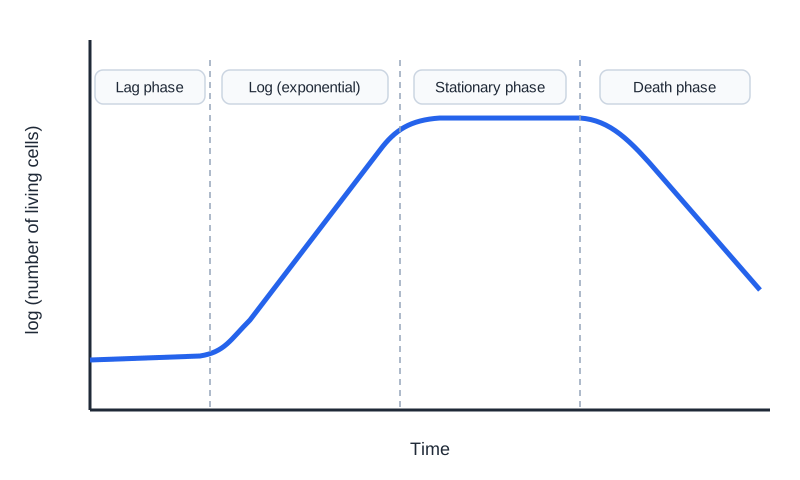
Log phase
Lag phase
Stationary phase
Death phase
In lag phase, cells adjust and make enzymes but do not divide yet.
Starting with 50 cells and a generation time of 30 min, how many cells after 3 hours?
1,500
3,200
9,000
300
3 h = 6 generations, so 50 x 2^6 = 50 x 64 = 3,200. A common mistake is to multiply 50 x 6 (300).
Which of these is the best example of a Gram-negative gut bacterium that can grow with or without oxygen?
Staphylococcus aureus
Bacillus anthracis
Clostridium tetani
Escherichia coli
E. coli is a Gram-negative facultative anaerobe. The other three are Gram-positive.
Which bacteria fix nitrogen in the root nodules of legumes?
Rhizobium
Pseudomonas
Lactobacillus
Nitrosomonas
Rhizobium. Nitrosomonas oxidizes ammonia to nitrite (nitrification) and is free-living in soil.
The main reason bacteriophages are so host-specific is:
They cannot make proteins
They only infect bacteria in a particular color
Their tail fibers recognize specific receptors on the host
They only live in the gut
Tail fibers bind receptor molecules found only on certain strains.
Which of the following describes the lysogenic cycle?
The phage digests the cell wall from outside
The cell bursts immediately
Phage DNA integrates into the host chromosome and is copied with it
The phage makes new DNA from RNA
In the lysogenic cycle the prophage can remain dormant for generations before induction.
HIV uses reverse transcriptase. What does this enzyme do?
Makes DNA from RNA
Makes proteins from RNA
Cuts DNA at specific sites
Makes RNA from DNA
Reverse transcriptase copies RNA into DNA. The reverse of that is what RNA polymerase does in transcription.
Which organism is the cause of malaria?
A fungus
A virus
A bacterium
A protist (Plasmodium)
Plasmodium is a protist spread by Anopheles mosquitoes.
True or False: Antibiotics are effective against the influenza virus.
True
False
Viruses lack cell walls and ribosomes, so antibiotics have no target. Antivirals such as oseltamivir are used instead.
What are the clear rings around the disks in a Kirby-Bauer plate?
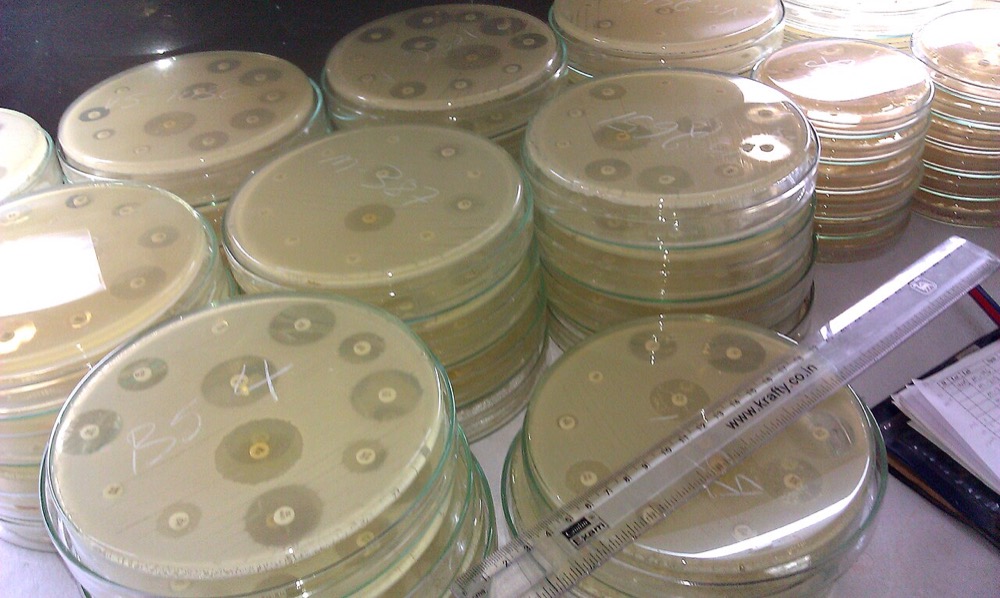
Colonies of resistant cells
Zones of inhibition
Zones of hemolysis
Biofilms
A clear ring means growth was stopped by the antibiotic that diffused outward.
Image: Microrao, CC BY-SA 4.0, via Wikimedia Commons.
