Quiz · Medium
Twenty-one questions on antidotes, digoxin and potassium safety, insulin, isolation precautions, PPE removal, injections, chest tubes, pressure injuries and transfusion reactions.
A client taking warfarin has an INR of 5.2 and no bleeding. Which medication does the nurse anticipate?
Protamine sulfate
Naloxone
Acetylcysteine
Vitamin K (phytonadione)
Vitamin K reverses warfarin. Protamine sulfate reverses heparin; naloxone reverses opioids; acetylcysteine treats acetaminophen overdose.
Which finding in a client receiving digoxin requires the nurse to withhold the dose and call the provider?
Apical pulse of 72 bpm
Potassium of 4.2 mEq/L
Apical pulse of 52 bpm
Digoxin level of 1.0 ng/mL
An adult apical pulse below 60 suggests toxicity or heart block. The level of 1.0 ng/mL and potassium of 4.2 are in range.
A nurse prepares to give potassium chloride 20 mEq IV to an adult. Which action is correct?
Give it by slow IV push over 5 minutes
Administer undiluted through a peripheral line
Dilute it and infuse it using a pump at no more than 10 mEq/hour
Give it quickly to correct hypokalemia fast
IV push or undiluted potassium can cause fatal arrhythmias. It must be diluted and infused slowly via a pump (usual peripheral maximum 10 mEq/hour), with urine output confirmed.
A client with COPD is receiving oxygen. Which flow rate does the nurse expect?
10 to 15 L/min by non-rebreather
6 L/min by simple mask
100 percent by Venturi mask
1 to 2 L/min by nasal cannula
Low-flow oxygen with a target saturation of 88 to 92 percent avoids suppressing the hypoxic drive and CO2 retention.
The nurse needs to mix regular insulin and NPH insulin in one syringe. What is the correct procedure?
Draw up the NPH first, then the regular
Draw up the regular (clear) insulin first, then the NPH (cloudy)
Draw up the regular first only if the NPH is warm
Mix the two vials together before drawing up
'Clear before cloudy' prevents contaminating the regular insulin vial with NPH. Inject air into both vials first.
A client with a new prescription for nitroglycerin sublingual tablets asks how to use it. Which statement shows understanding?
'I will swallow the tablet with water.'
'I will keep the tablets in a pill organizer.'
'I will take up to 6 tablets before calling for help.'
'If my chest pain is not relieved 5 minutes after one tablet, I will call 911.'
Sublingual tablets are placed under the tongue; call 911 if pain is not relieved 5 minutes after the first dose, and keep tablets in the dark glass bottle.
Which client should be placed in a private room with negative pressure?
A client with suspected pulmonary tuberculosis
A client with influenza
A client with MRSA wound infection
A client with Clostridioides difficile
TB requires airborne precautions with a negative-pressure room and N95 respirator. Influenza needs droplet precautions; MRSA and C. diff need contact precautions.
A nurse is removing personal protective equipment after caring for a client on contact precautions. Which item is removed first?
Gown
Mask
Gloves
Goggles
The order of removal is gloves, goggles or face shield, gown, then mask or respirator, with hand hygiene afterward. The most contaminated items come off first.
A client with C. difficile has diarrhea. Which hand hygiene is correct after leaving the room?
Use alcohol-based hand rub only
Rinse with water only
No hand hygiene is needed if gloves were worn
Wash with soap and water
Alcohol hand rub does not kill C. difficile spores; mechanical washing with soap and water is required.
A nurse is giving an IM injection to an adult. Which site is preferred?
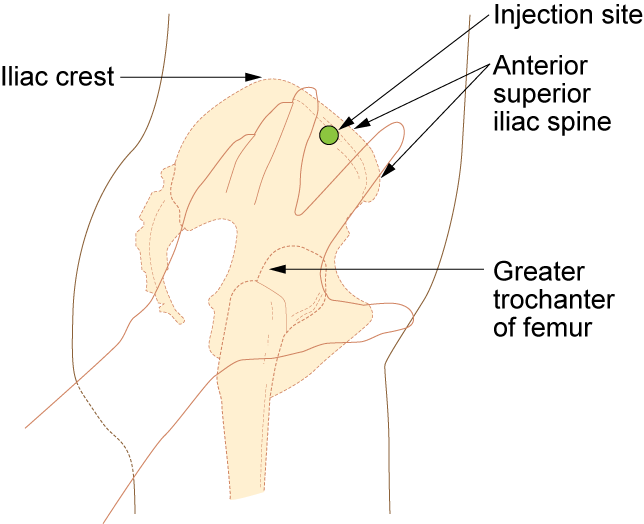
Dorsogluteal
Rectus femoris
Ventrogluteal
Anterior thigh at the groin
The ventrogluteal site is away from major nerves and vessels and has thick muscle. The dorsogluteal is avoided because of the sciatic nerve. Image: British Columbia Institute of Technology (BCIT), CC BY 4.0, via Wikimedia Commons.
A client with a chest tube has continuous bubbling in the water seal chamber. What does the nurse suspect?
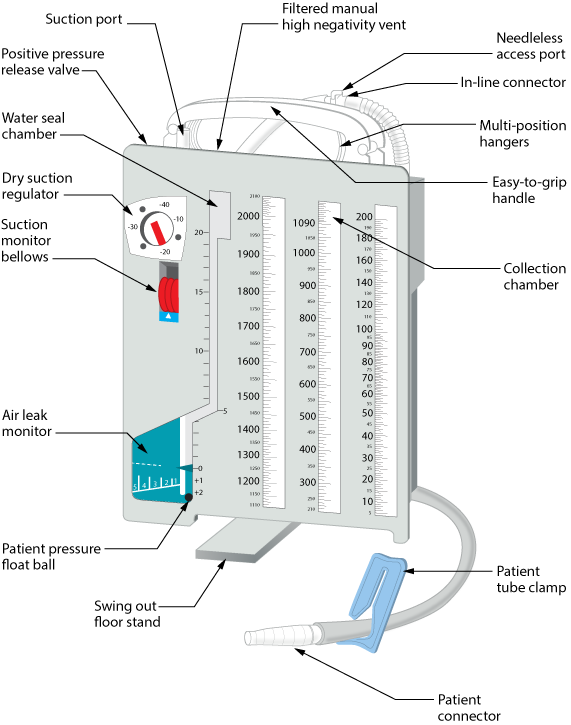
Normal tidaling
Lung re-expansion
Excess suction
An air leak in the system
Intermittent bubbling in the water seal with coughing may be expected, but continuous bubbling indicates an air leak. Check connections and notify the provider. Tidaling is a normal rise and fall with breathing. Image: British Columbia Institute of Technology (BCIT), CC BY-SA 4.0, via Wikimedia Commons.
A chest tube becomes disconnected from the drainage system. What should the nurse do first?
Clamp the tube near the drainage unit and leave it
Quickly reconnect the system or place the tube end in sterile water, and assess the client
Remove the chest tube
Apply an occlusive dressing to the insertion site
Re-establish a water seal immediately (reconnect after cleaning the end or submerge in sterile water about 2 cm) and assess respiratory status. Prolonged clamping risks tension pneumothorax.
A client is 24 hours post-op and the nurse finds a stage 2 pressure injury on the sacrum. Which finding characterizes this stage?
Partial-thickness skin loss with exposed pink dermis or an intact blister
Intact skin with non-blanchable redness
Full-thickness loss with visible fat
Exposed bone, tendon or muscle
Stage 1 is non-blanchable redness; stage 2 is partial thickness; stage 3 shows fat; stage 4 shows muscle, tendon or bone.
Which client has the HIGHEST risk for pressure injury based on a Braden scale score?
Score of 15
Score of 9
Score of 18
Score of 22
A lower Braden score means a higher risk: 9 or below is very high risk, 10 to 12 high, 13 to 14 moderate, 15 to 18 mild.
A client receiving a blood transfusion develops chills, flank pain and a temperature of 38.9 C within 10 minutes. What is the nurse's first action?
Slow the transfusion rate and recheck vital signs in 15 minutes
Administer acetaminophen and continue
Stop the transfusion and infuse normal saline through new tubing
Notify the blood bank and continue the infusion
These signs suggest an acute hemolytic reaction. Stop the transfusion, keep the vein open with normal saline via new tubing, then notify the provider and blood bank.
A nurse finds an adult unresponsive and not breathing. After calling for help and getting an AED, what is the correct compression technique?
60 compressions per minute at a depth of 1 inch
100 to 120 compressions per minute at a depth of at least 2 inches
Compressions at 80 per minute, with a pulse check after each cycle
Compressions at 150 per minute at a depth of 3 inches
Rate 100 to 120/min and depth at least 2 inches (5 cm) with full recoil and minimal interruptions, with a 30:2 ratio for a single rescuer.
A client taking ibuprofen for arthritis also takes warfarin. What should the nurse monitor for?
Signs of hypoglycemia
Signs of hyperkalemia
Signs of bleeding
Signs of dehydration
NSAIDs impair platelet function and irritate the stomach lining, raising bleeding risk with warfarin.
A client taking an ACE inhibitor reports swelling of the lips and tongue. What is the priority?
Administer an antihistamine and recheck in an hour
Maintain the airway and notify the provider
Take the client's blood pressure
Apply a cold pack to the face
Angioedema is an airway emergency. Stop the ACE inhibitor and prepare for epinephrine or intubation.
A client prescribed levothyroxine asks when to take it. What is the best instruction?
'Take it in the morning on an empty stomach, 30 to 60 minutes before breakfast.'
'Take it with your evening meal.'
'Take it with a calcium supplement.'
'Take it only when you feel tired.'
Levothyroxine is best absorbed on an empty stomach; calcium and iron reduce absorption, and therapy is lifelong.
The nurse prepares a client for the first dose of vancomycin. Which action will help prevent red man syndrome?
Infuse it by rapid IV push
Infuse the dose over at least 60 minutes
Give it with a heparin flush
Mix it with an aminoglycoside
Rapid infusion causes histamine release with flushing and hypotension. Slow the infusion; antihistamines may help.
A client reports a sudden rash and wheezing during an IV antibiotic infusion. What is the nurse's first action?
Stop the infusion
Give diphenhydramine
Call the pharmacist
Take the client's temperature
Stopping the drug prevents further exposure. Then assess airway, call for help, and give epinephrine IM if anaphylaxis is suspected.
