Quiz · Medium
Cell cycle phases, checkpoints, stages of mitosis and meiosis, and variation.
An organism has 2n = 8. How many different gametes can form from independent assortment alone?
4
64
8
16
2^n where n = 4 pairs of chromosomes gives 16.
Which diagram shows anaphase of mitosis?
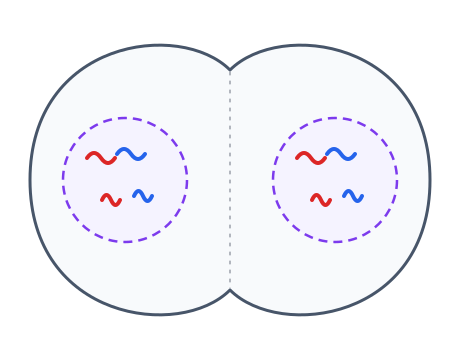
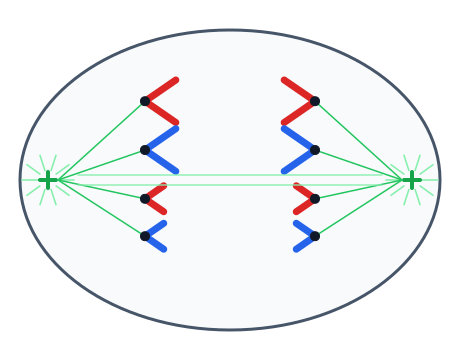
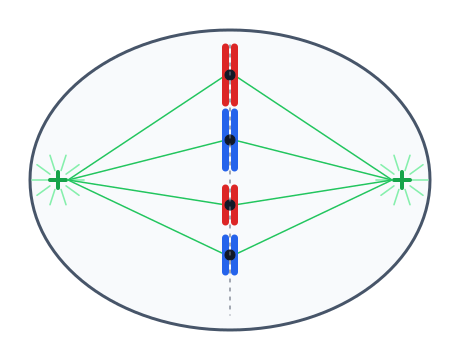
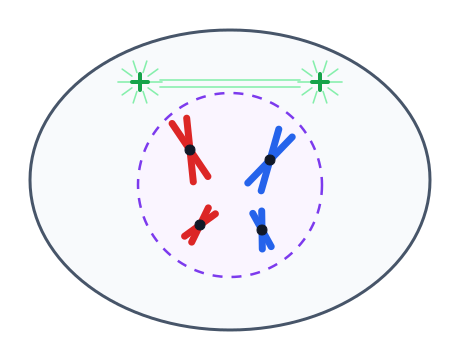
In anaphase the sister chromatids have separated and move toward opposite poles. In metaphase they line up at the middle.
Down syndrome usually results from
A deletion in chromosome 21
Crossing over between X and Y
Nondisjunction giving three copies of chromosome 21
An extra X chromosome
A gamete with an extra chromosome 21 fertilizes a normal gamete, giving trisomy 21.
Which diagram shows metaphase of mitosis?
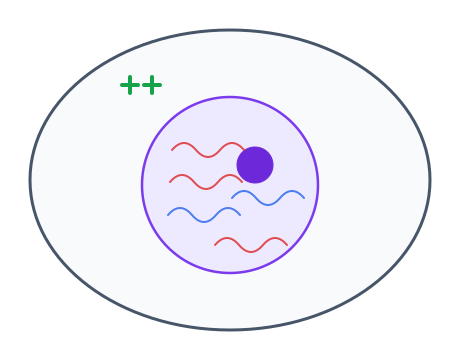
Chromosomes align on the metaphase plate, attached to spindle fibers from both poles.
Which diagram shows prophase?
In prophase chromosomes condense and the nuclear envelope starts to break down.
In which phase of the cell cycle is DNA replicated?
Metaphase
G1
S phase
G2
G1 and G2 are gap phases for growth. DNA synthesis occurs in S phase.
A human cell in G2 has how many chromosomes and chromatids?
46 chromosomes, 92 chromatids
46 chromosomes, 46 chromatids
23 chromosomes, 46 chromatids
92 chromosomes, 92 chromatids
Replication doubles the chromatids but the number of centromeres, and hence chromosomes, is still 46.
At which checkpoint is the cell mostly checking that all chromosomes are attached to the spindle?
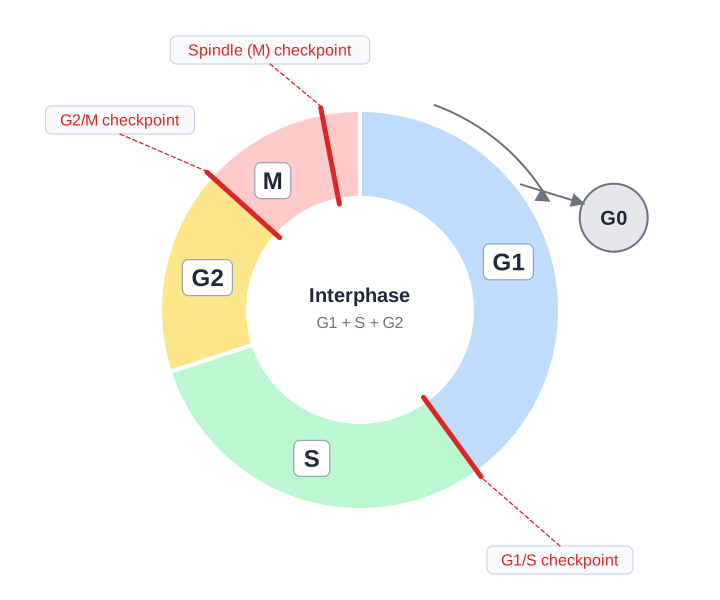
G0 checkpoint
G1/S checkpoint
Spindle (M) checkpoint
G2/M checkpoint
This prevents separation of chromatids until each is properly attached.
A mutation inactivates p53 in a cell with damaged DNA. What is the likely result?
The cell arrests permanently in G0
The cell skips S phase
The cell passes the G1/S checkpoint and replicates damaged DNA
The cell undergoes apoptosis
p53 normally halts the cycle for repair or triggers apoptosis; without it, damaged cells keep dividing.
Which event occurs only in meiosis?
Spindle formation
Crossing over between homologs
Chromosome condensation
DNA replication
Mitosis does not involve pairing of homologs or crossing over.
During which phase of meiosis do homologous chromosomes separate?
Metaphase II
Prophase II
Anaphase II
Anaphase I
Anaphase I separates homologs; anaphase II separates sister chromatids.
After meiosis I, each daughter cell is
Haploid, with chromosomes made of two chromatids
Diploid, with single-chromatid chromosomes
Haploid, with single-chromatid chromosomes
Diploid, genetically identical
Meiosis I reduces the chromosome number; chromatids separate only in meiosis II.
Which gives the most genetic variation in the gametes of one person?
Spindle formation
Crossing over together with independent assortment
Cytokinesis
DNA replication
Both shuffle alleles: crossing over within chromosomes and independent assortment among chromosomes.
Plant cell cytokinesis differs from animal cytokinesis because plants
Form a cell plate
Divide only by meiosis
Form a cleavage furrow
Use no cytoplasm division
The rigid cell wall prevents pinching, so vesicles build a new wall between daughter cells.
Most cells in a photograph of an onion root tip are in interphase because
Only interphase cells stain
Mitosis never occurs in roots
Prophase is shorter than cytokinesis
Interphase is the longest phase of the cell cycle
Proportion of cells in a stage reflects the time spent in it.
Which cells normally divide by meiosis in humans?
Neurons
Skin cells
Germ cells in testes and ovaries
Red blood cells
Somatic cells divide by mitosis.
Which is true of cyclin-dependent kinases (CDKs)?
They are active only when bound to a cyclin
They are made only in G0
Their concentration oscillates
They are inhibitors of the cell cycle
The cyclin concentration oscillates; the CDK concentration is relatively stable.
True or false: Sister chromatids are genetically identical (barring mutation) and are separated in meiosis II.
True
False
They are copies from replication. Homologs are separated in meiosis I.
True or false: Mitosis produces haploid cells.
True
False
Mitosis produces two cells with the same chromosome number as the parent.
Which of these cells is most likely to be in G0?
A mature neuron
A cell in S phase
A cell in metaphase
A cell with two nuclei forming
Mature neurons leave the cycle and do not divide.
A cell's DNA content is measured in G1 as 2C. What is it at the end of meiosis II in each gamete?
0.5C
1C (half of the G1 value)
4C
2C
G1 = 2C, S phase doubles to 4C, meiosis I halves to 2C, meiosis II halves to 1C.
