Quiz · Medium
Twenty questions with diagrams on gene regulation, PCR, gel electrophoresis, plasmid cloning, blots and mutation types.
Which pair is correctly matched?
Chargaff: A = T
Sanger: PCR
Southern blot: RNA
Hershey-Chase: protein is genetic material
Chargaff's rules say A = T and G = C. Hershey and Chase showed DNA is the genetic material; Sanger developed chain-termination sequencing.
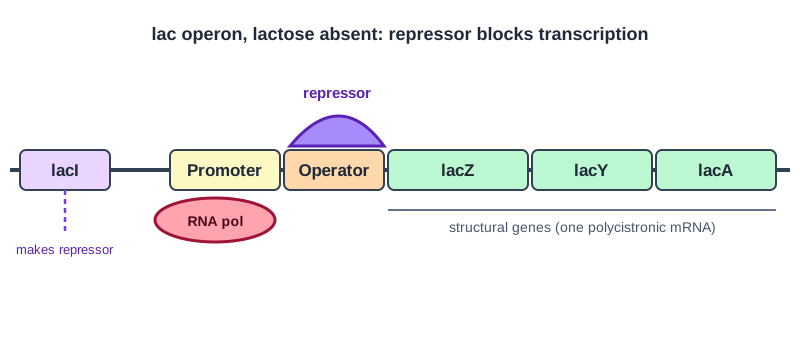
In the lac operon with lactose absent, what prevents transcription?
Allolactose binds the promoter
CAP binds the operator
The repressor binds the operator
RNA polymerase cannot bind the lacI gene
The repressor sits on the operator and blocks RNA polymerase.
What is the inducer of the lac operon?
Allolactose
Tryptophan
Glucose
cAMP
Allolactose binds the repressor so it releases the operator. Tryptophan is the corepressor of a different operon (trp).
In which condition is the lac operon most highly expressed?
Glucose high, lactose low
Glucose low, lactose low
Glucose high, lactose high
Glucose low, lactose high
You need the repressor off (lactose present) and CAP-cAMP bound (glucose low). With glucose high, cAMP is low.
Which statement about the trp operon is correct?
It is inducible and catabolic
Tryptophan acts as a corepressor
Tryptophan is the inducer that switches it on
The operon has no operator
The trp operon is repressible: tryptophan binds the repressor and allows it to bind the operator.
True or False: DNA methylation usually activates gene expression.
True
False
Methylation of CpG islands in promoters generally silences genes. Histone acetylation tends to activate them.
A mutation in the lac operator that stops the repressor binding will cause:
No transcription at all
Constitutive transcription of lacZYA
Production of a nonfunctional repressor
Loss of the promoter
With no binding, RNA polymerase transcribes even without lactose.
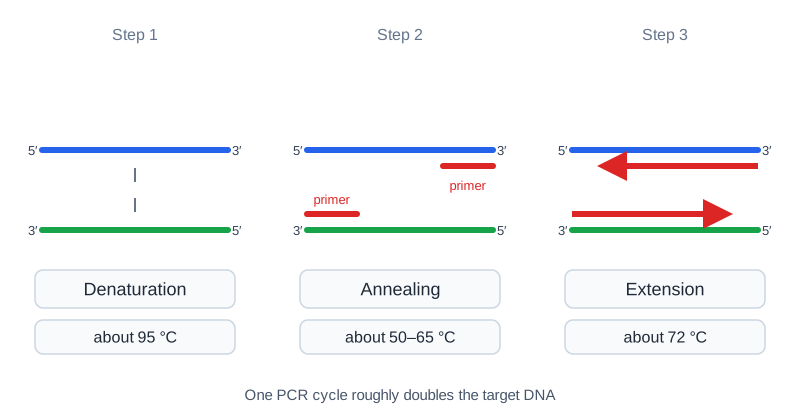
In PCR, which step takes place at about 72 °C?
Ligation
Denaturation
Annealing
Extension
Taq polymerase works best at about 72 °C. Denaturation is about 95 °C and annealing about 50–65 °C.
Why is a heat-stable polymerase used in PCR?
It survives the denaturing step at about 95 °C
It doesn't need primers
It works at 0 °C
It copies RNA
Taq polymerase is from the hot-spring bacterium Thermus aquaticus.
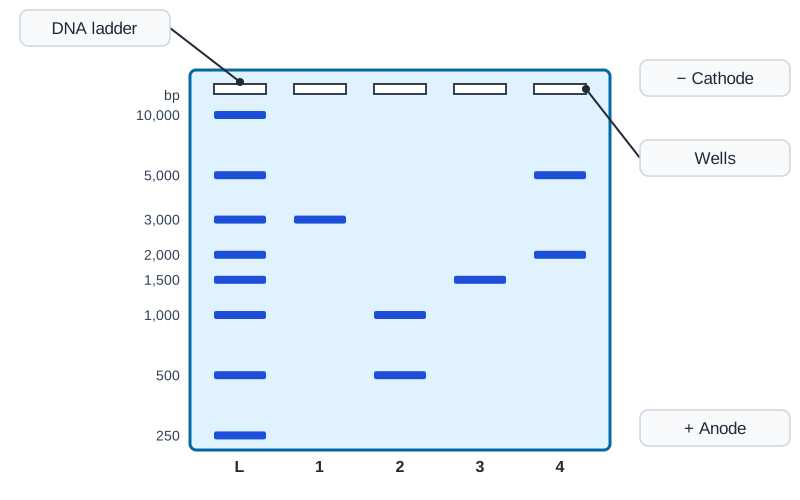
DNA on an agarose gel migrates toward the:
Wells
Cathode, because DNA is positive
Anode, because DNA is negative
Cathode, because DNA is neutral
The phosphate backbone is negatively charged, so DNA moves toward the positive electrode (anode).
On a gel, which fragments travel the farthest?
The circular ones only
The largest
The smallest
The ones with most GC content
Small fragments move more easily through the pores of the agarose.
Which enzyme seals the phosphodiester backbone of two annealed sticky ends?
DNA ligase
Helicase
Topoisomerase
Restriction enzyme
DNA ligase forms the covalent bond. Restriction enzymes cut the DNA.
A bacterial plasmid used for cloning needs all of the following EXCEPT:
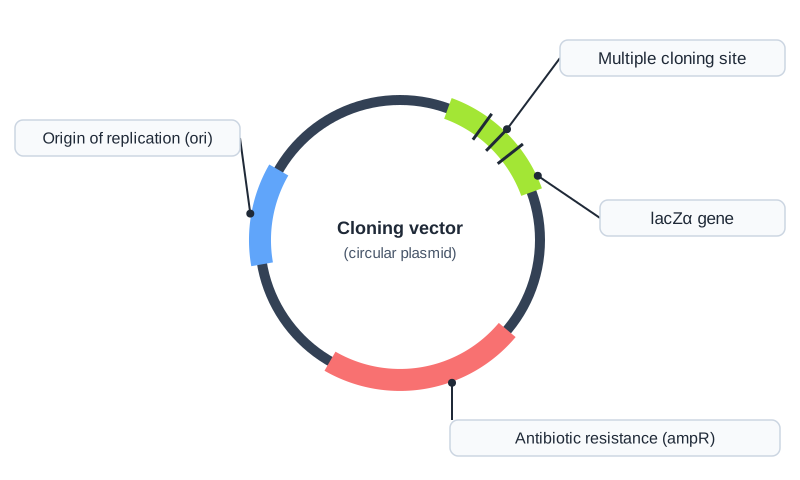
An origin of replication
A selectable marker
A multiple cloning site
A nuclear localization signal
Bacteria have no nucleus, so no nuclear localization signal is needed.
In blue-white screening, a white colony on X-gal usually indicates:
No plasmid
A plasmid with an insert that disrupted lacZα
A plasmid without an insert
A dead cell
White = recombinant (the insert broke lacZα). Cells without a plasmid would not grow on ampicillin at all.
Which type of blot is used to detect a specific protein?
Northern
Western
Eastern
Southern
Western blot uses antibodies. Southern detects DNA and Northern detects RNA.
A point mutation changes a codon from UAU (Tyr) to UAA. This is a:
Frameshift
Silent mutation
Missense mutation
Nonsense mutation
UAA is a stop codon, so the protein is truncated.
Deleting two nucleotides from the middle of a coding sequence will most likely cause:
A frameshift
No change in the protein
One amino acid to change
A silent mutation
Deleting a number of bases not divisible by 3 shifts the reading frame.
In Meselson and Stahl's experiment, after one generation in 14N medium, all the DNA had intermediate density. This ruled out:
Dispersive replication
Semiconservative replication
Conservative replication
Both conservative and semiconservative
Conservative replication would give one heavy and one light band. Intermediate DNA fits semiconservative (or dispersive); the second generation then ruled out dispersive.
Which protein is called the 'guardian of the genome'?
Cas9
Ras
p53
Taq
p53 halts the cell cycle for repair or triggers apoptosis.
In humans, one gene can produce multiple proteins mainly because of:
Crossing over
Alternative splicing
Binary fission
DNA replication
Different combinations of exons are joined in the mRNA.
