Quiz · Hard
Osmosis, water potential, transport mechanisms, membrane structure and signal transduction in exam-style questions.
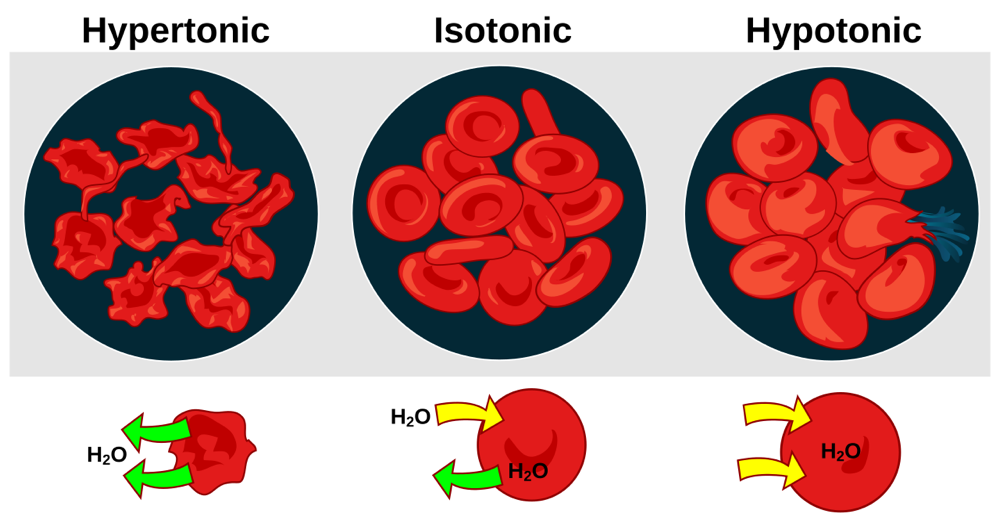
A red blood cell is placed in 0.9% NaCl (isotonic to the cell). If moved to distilled water, it will
Stay the same
Swell and burst (lyse)
Shrivel
Undergo plasmolysis
Distilled water is hypotonic, so water flows in. Animal cells lack a cell wall to resist.
A plant cell has ΨS = -0.6 MPa and ΨP = +0.4 MPa. What is Ψ and which way will water move if it is placed in pure water (Ψ = 0)?
Ψ = +1.0 MPa; water moves out
Ψ = -0.2 MPa; water moves into the cell
Ψ = -0.2 MPa; water moves out
Ψ = -1.0 MPa; water moves out
Ψ = ΨS + ΨP = -0.2. Water flows from higher (0) to lower (-0.2) water potential.
A potato core loses mass in a 0.5 M sucrose solution. Which conclusion is best?
Water potential was equal
The solution is hypotonic to the cells
The potato absorbed sucrose
The solution has lower water potential than the potato cells
Water left the cells, flowing toward lower water potential (higher solute concentration).
Which transport process requires a transmembrane protein but no energy input?
Primary active transport
Endocytosis
Simple diffusion
Facilitated diffusion
Facilitated diffusion moves substances down their gradient through channels or carriers.
Cells absorb glucose from the gut lumen by coupling it to Na+ entry. This is
Secondary active transport
Osmosis
Primary active transport
Facilitated diffusion
The Na+ gradient is created by the Na+/K+ pump (primary), and the symporter uses it.
Which treatment would most reduce membrane fluidity?
Raising temperature
Lowering temperature
Adding unsaturated phospholipids
Adding short fatty acid tails
Cold makes phospholipids pack tightly. Unsaturated tails and short tails increase fluidity.
Why do cells in tissues that absorb nutrients have many microvilli?
They decrease membrane permeability
They increase surface area-to-volume ratio for exchange
They anchor cells together
They increase cell volume only
More surface area per volume allows faster exchange.
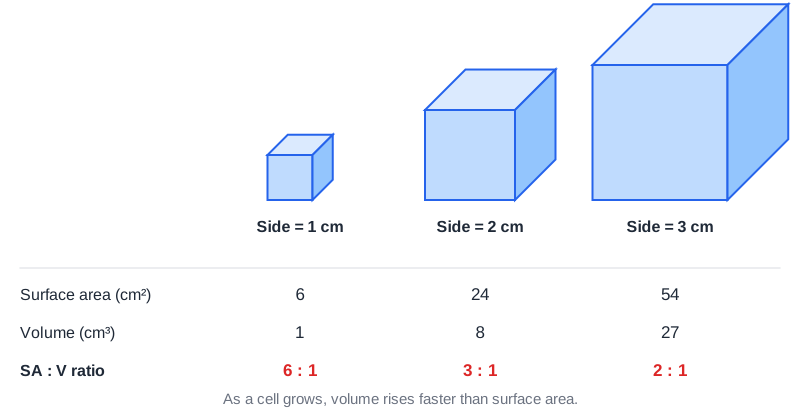
A cube-shaped cell triples its side length. How does its SA:V ratio change?
It triples
It becomes one-third of the original
It increases by 9 times
It stays the same
SA:V = 6/s, so tripling s divides it by 3.
A cell receives a signal that activates a kinase cascade. What is the main advantage of a cascade?
It converts the signal to a lipid
It removes the receptor
It amplifies the signal
It prevents any response
Each activated kinase activates many others, amplifying the signal.
A drug blocks the production of cAMP. A hormone that normally uses cAMP will
Enter the nucleus anyway
Fail to trigger its usual intracellular response
Be broken down by the drug
Be unaffected
cAMP is a second messenger; blocking it interrupts transduction.
Why can testosterone act on a cell without a plasma-membrane receptor?
It is carried in by endocytosis
It is lipid-soluble and binds an intracellular receptor
It is a protein
It is a second messenger
Steroid hormone-receptor complexes act as transcription factors.
Which structure allows direct cytoplasmic communication between animal cells?
Tight junctions
Cell wall
Gap junctions
Desmosomes
Tight junctions seal, desmosomes anchor, gap junctions are channels.
Which statement supports the endosymbiotic origin of mitochondria?
They are made by the Golgi
They lack membranes
They have linear chromosomes
They have their own circular DNA and 70S-type ribosomes
These features resemble bacteria.
Newly made secretory protein: choose the correct route.
Golgi, rough ER, lysosome
Nucleus, Golgi, mitochondria
Rough ER, Golgi, vesicle, plasma membrane
Smooth ER, nucleus, vesicle
Proteins are made on ribosomes at the rough ER, modified in the Golgi and exported by exocytosis.
Sodium-potassium pump per cycle
Moves 1 Na+ and 1 K+ using NADH
Moves 2 Na+ out and 3 K+ in using ATP
Moves 3 Na+ in and 2 K+ out without ATP
Moves 3 Na+ out and 2 K+ in using ATP
This produces a net outward positive charge, helping set the membrane potential.
