Quiz · Hard
Interpreting pedigrees, calculating recombination frequencies, X-linked crosses and chi-square tests.
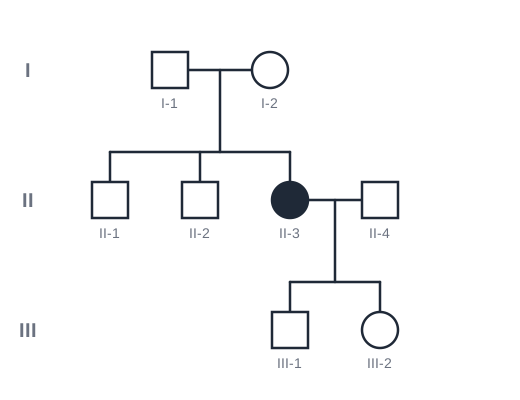
What is the most likely mode of inheritance in this pedigree?
X-linked dominant
Mitochondrial
Autosomal recessive
Autosomal dominant
Two unaffected parents have an affected daughter, so the allele is recessive; an affected daughter of an unaffected father rules out X-linked recessive.
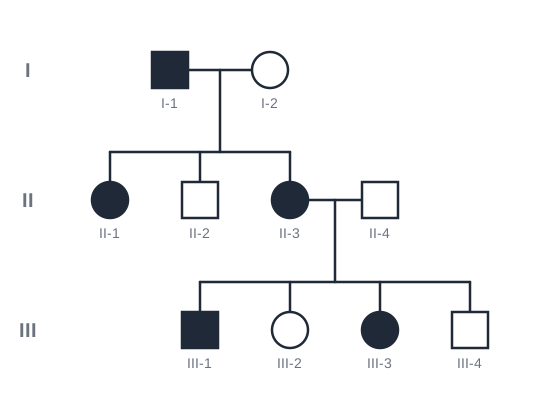
What is the most likely mode of inheritance in this pedigree?
X-linked recessive
Mitochondrial
X-linked dominant
Autosomal recessive
The affected father has affected daughters only, which fits X-linked dominant inheritance.
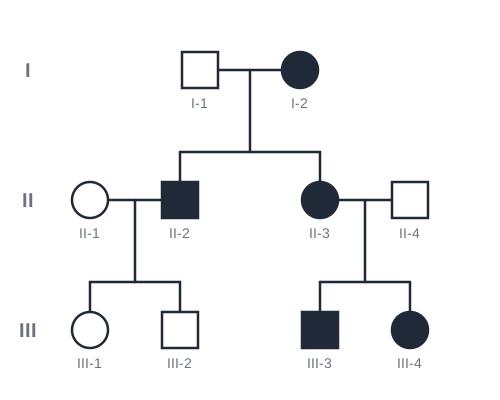
What is the most likely mode of inheritance in this pedigree?
X-linked recessive
Autosomal recessive
Mitochondrial
Autosomal dominant
Affected females pass the trait to all offspring; affected males do not pass it on.
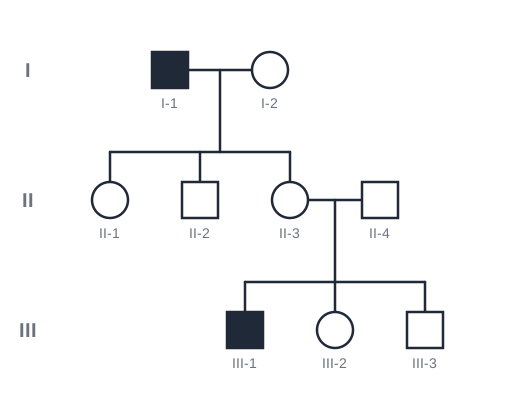
What is the most likely mode of inheritance in this pedigree?
X-linked dominant
Mitochondrial
X-linked recessive
Autosomal dominant
An affected male's affected grandson through a carrier daughter is a typical X-linked recessive pattern.
A woman whose father had hemophilia (X-linked recessive) marries an unaffected man. What is the probability their first child is a hemophiliac son?
1/4
1/8
1/2
0
She is an obligate carrier (XHXh). Half of sons are affected, and the chance of a son is 1/2 times 1/2 = 1/4.
In a testcross AaBb x aabb, 420 AaBb, 410 aabb, 90 Aabb, 80 aaBb. What is the recombination frequency?
83%
9%
50%
17%
Recombinants (Aabb and aaBb) = 170 of 1000, i.e. 17%.
Genes A and B are 20 map units apart. In a testcross of an AB/ab heterozygote, what proportion of offspring are Ab?
20%
5%
40%
10%
20% recombinants split equally between Ab and aB, so 10% each.
Three genes: A-B 10 cM, B-C 6 cM, A-C 16 cM. What is the order?
Cannot be determined
B-A-C
A-C-B
A-B-C
The two shorter distances sum to the longest, so B is in the middle.
A χ² test of a 9:3:3:1 dihybrid ratio gives χ² = 5.1 (critical value 7.81 at p = 0.05, 3 df). What should you conclude?
Fail to reject the null; the data fit 9:3:3:1
Accept that the genes are definitely unlinked
Reject the null; the genes are linked
The test is invalid
The statistic is below the critical value, so the deviation is within chance.
A χ² test with 2 degrees of freedom has χ² = 7.0 and critical value 5.99 at p = 0.05. Conclusion?
The null is true
Reject the null hypothesis
Fail to reject
The sample size is too small
The calculated value exceeds the critical value, so the difference is unlikely to be chance.
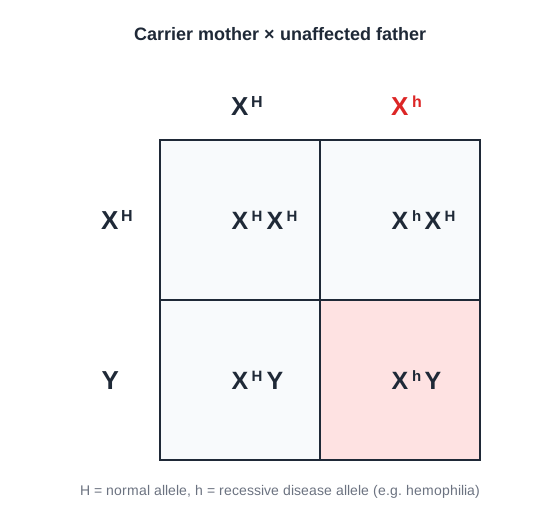
Which cross gives only normal-looking daughters but half affected sons?
Affected mother x unaffected father
Autosomal recessive carriers
Homozygous normal mother x affected father
Carrier mother x unaffected father (X-linked recessive)
Daughters get a normal X from the father; sons get either X from the mother.
A labrador's coat: B (black) dominant to b (brown), and E needed for pigment deposition; ee is yellow regardless of B. BbEe x BbEe gives what phenotype ratio?
9 black : 3 brown : 4 yellow
9:3:3:1
12:3:1
9:7
This is recessive epistasis. The 4 ee classes are yellow.
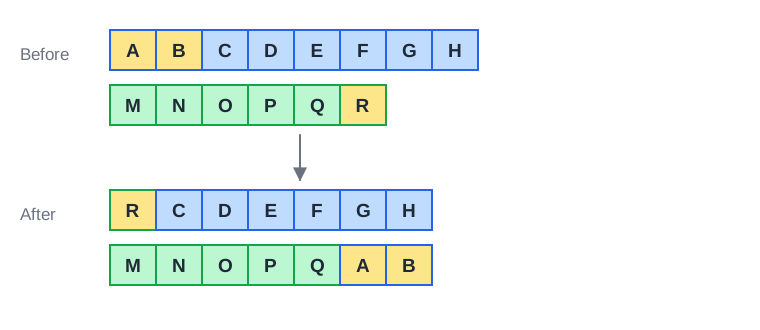
Which chromosomal change moves a segment to a non-homologous chromosome?
Duplication
Deletion
Inversion
Translocation
A reciprocal translocation exchanges segments between non-homologous chromosomes.
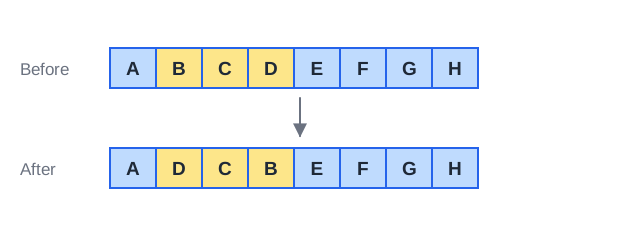
Which chromosomal change reverses the order of a segment on the same chromosome?
Deletion
Inversion
Duplication
Aneuploidy
Inversion alters gene order but not gene number.
A cross produces offspring with parental types in higher proportion than expected from independent assortment. What is the best explanation?
The genes are linked on the same chromosome
The genes are on different chromosomes
Both genes are on the Y chromosome
Epistasis between the genes
Linked genes are inherited together unless crossing over separates them.
A father with an X-linked dominant disorder (unaffected mother). Which offspring are affected?
All sons and no daughters
Half of the children
None of the children
All daughters and no sons
He transmits his X to all daughters and his Y to all sons.
