Quiz · Hard
Fission reactions and energy, chain reactions, moderators and control rods, PWR operation, fusion reactions in the Sun and tokamaks, medical isotopes, detectors and shielding.
In the fission reaction , how many neutrons x are released?
1
2
3
4
Nucleon number: 1 + 235 = 141 + 92 + x gives x = 3 (charge: 92 = 56 + 36).
About how much energy is released when 1 kg of U-235 undergoes complete fission?
J
J
J
J
200 MeV per atom × atoms ≈ J.
What is the purpose of the moderator in a thermal reactor?
To slow fast neutrons so they cause fission more easily
To carry heat to the turbine
To shield workers from gamma rays
To absorb neutrons and stop the reaction
Thermal neutrons (about 0.025 eV) are far more likely to fission U-235 than fast ones.
A reactor has an effective multiplication factor k = 1.05. What does this mean?
The fuel has been used up
The reaction is subcritical and dying out
The reaction is critical and steady
The reaction is supercritical and the power is rising
k > 1: each generation of neutrons is 5% larger than the last, so the power rises unless control rods are inserted.
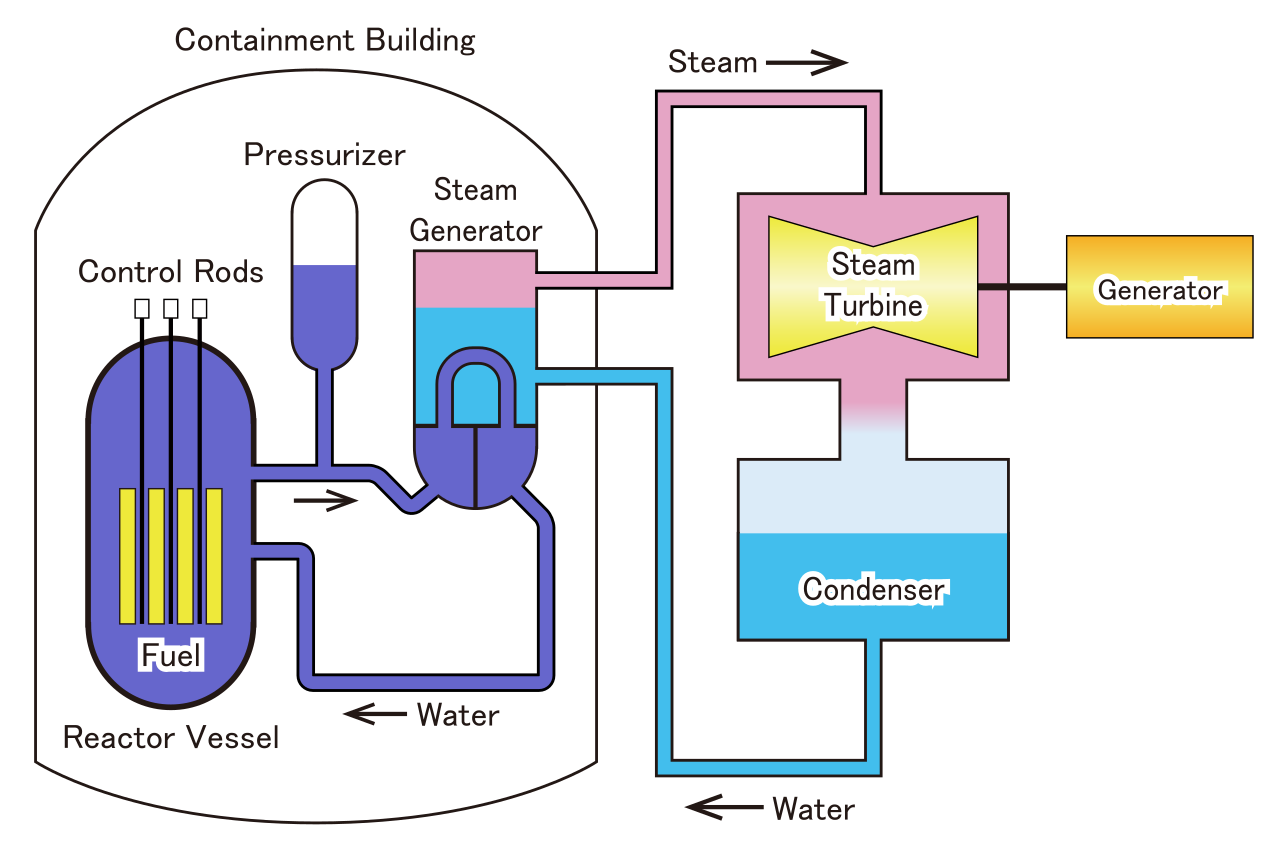
In the PWR diagram, which component keeps the primary-loop water from boiling at about 300 °C?
The control rods
The condenser
The pressuriser
The steam turbine
The pressuriser maintains a pressure near 15 MPa so the water stays liquid. Image: Σ64, CC BY 4.0, via Wikimedia Commons.
Why does a PWR use two separate water loops?
To double the power output
To keep radioactive primary water away from the turbine and condenser
To avoid using a moderator
To cool the control rods
The steam generator transfers heat across a barrier so the turbine steam is not contaminated. Image: Σ64, CC BY 4.0, via Wikimedia Commons.
In the D–T fusion reaction (17.6 MeV released), which product carries most of the energy?
The neutron (14.1 MeV)
Both equally
A gamma ray
The helium-4 nucleus (3.5 MeV)
Momentum conservation gives the lighter neutron about 80% of the energy.
Where does the tritium used in D–T fusion fuel come from?
It is bred from lithium by neutron bombardment
It is mined as tritium ore
It is the product of the p–p chain
It occurs abundantly in sea water
; tritium's 12.3-year half-life makes natural supplies tiny.
What is the net reaction of the proton–proton chain shown?
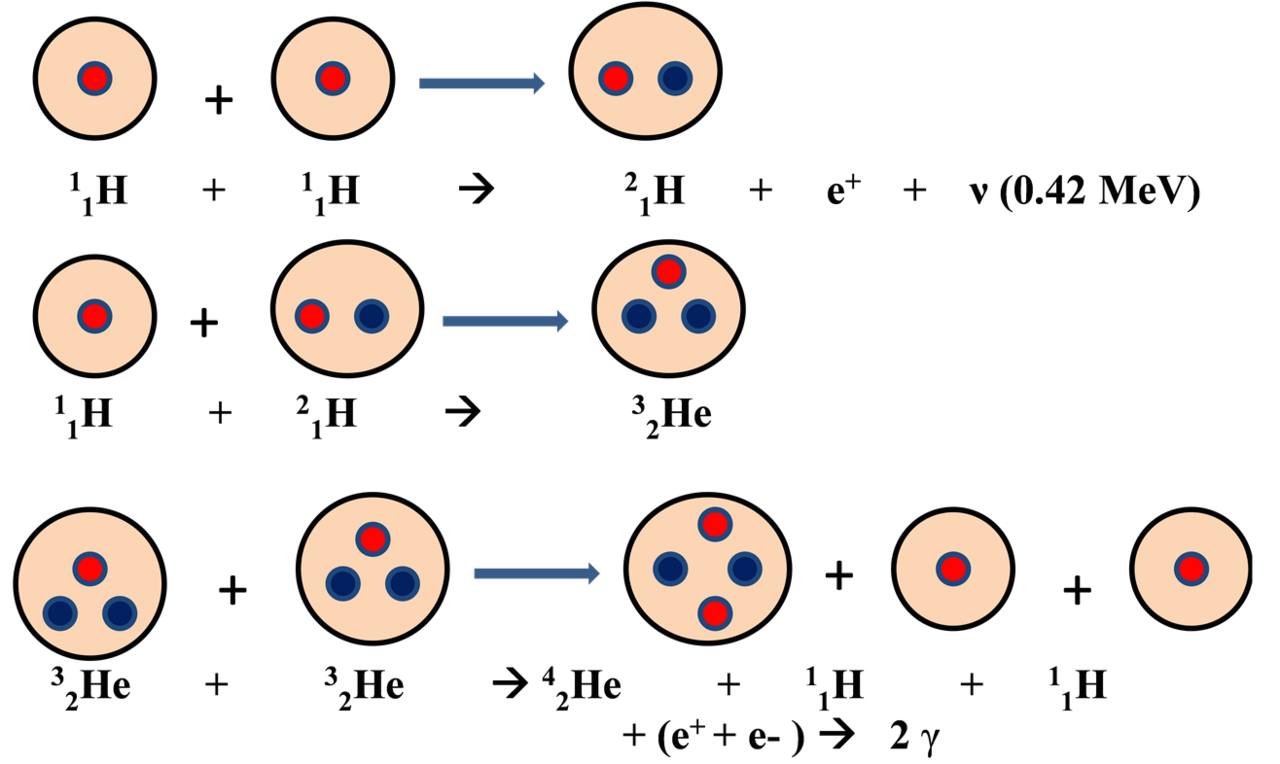
Four protons make one helium-4 nucleus, releasing about 26.7 MeV. Image: Nagendra Nath Mondal, CC BY 4.0, via Wikimedia Commons.
The Sun's luminosity is W. About how much mass does it convert to energy each second?
4 kg
4 thousand tonnes
4 million tonnes
4 billion tonnes
kg ≈ 4 million tonnes.
What happens to uranium-238 absorbed in a reactor core's neutron flux?
It fissions immediately
It becomes plutonium-239 after neutron capture and two beta decays
It decays to lead-206 within seconds
It is unaffected
.
What fraction of natural uranium is the fissile isotope U-235?
About 0.72%
About 7%
About 50%
About 99%
Natural uranium is 99.27% U-238; fuel for most power reactors is enriched to 3–5% U-235.
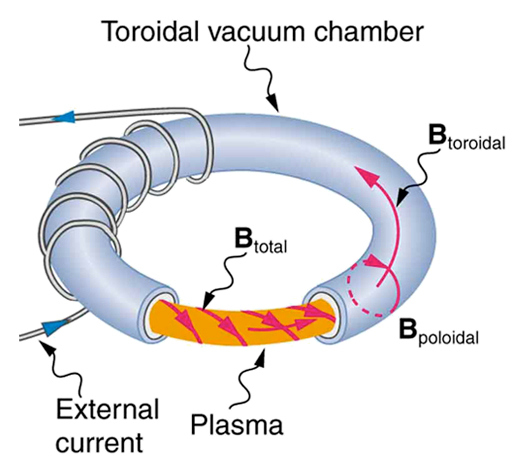
In this tokamak diagram, which magnetic field is mainly produced by the current flowing in the plasma itself?
The Earth's field
The field of the vacuum chamber
The toroidal field
The poloidal field
External coils give the toroidal field; the plasma current produces the poloidal field, and together they form helical field lines. Image: OpenStax, CC BY 4.0, via Wikimedia Commons.
Why must fusion fuel be heated to about 10⁸ K?
To lower the binding energy
To melt the fuel
So nuclei have enough energy to overcome their Coulomb repulsion
To make neutrons radioactive
Nuclei carry positive charge; fusion needs them to approach within about a femtometre, where the strong force takes over (helped by tunnelling).
Which radiation do most household smoke detectors rely on?
Neutrons from californium
Alpha particles from americium-241
Gamma rays from cobalt-60
Beta particles from strontium-90
Alpha particles ionise the air between two electrodes; smoke reduces the current.
Technetium-99m has a half-life of 6.0 hours. What fraction of a dose remains after 24 hours?
1/16
1/2
1/4
1/8
24 h = 4 half-lives, .
In PET imaging, each positron annihilation produces
Two neutrons
A single alpha particle
One 1.02 MeV photon
Two 511 keV photons emitted in opposite directions
The annihilation of e⁺ and e⁻ yields two back-to-back 511 keV photons, detected in coincidence.
A Geiger–Müller tube is best described as a detector that
Measures dose directly in sieverts
Measures the energy of each gamma photon precisely
Counts ionising events by producing a pulse for each
Measures neutron flux only
Each ionising event triggers a gas avalanche and one pulse of equal size, so it counts rather than identifies radiation.
A gamma ray source's intensity is reduced to 1/8 after passing through 6 cm of lead. What is the half-value layer?
1.5 cm
2 cm
3 cm
0.75 cm
1/8 = (1/2)³, so three half-value layers equal 6 cm, giving 2 cm each.
Which of the following was NOT a core meltdown or major accident at a nuclear power plant?
Chernobyl (1986)
Fukushima Daiichi (2011)
Three Mile Island (1979)
Hanford B Reactor start-up (1944)
Hanford B was the first full-scale plutonium production reactor; the other three were major accidents.
