Quiz · Medium
Thermal expansion, specific and latent heat, mixing problems, conduction and radiation calculations, and heating curve and thermal image questions.
200 g of water at 80 °C is mixed with 300 g of water at 20 °C in an insulated container. What is the final temperature?
44 °C
50 °C
56 °C
40 °C
Weighted by mass: (0.2·80 + 0.3·20)/0.5 = 44 °C. The simple average (50 °C) ignores the different masses.
What is 20 °C on the Kelvin scale?
253 K
293 K
68 K
20 K
T(K) = T(°C) + 273.15 ≈ 293 K. 68 is the Fahrenheit value.
A 100 m steel rail (α = 12×10⁻⁶ K⁻¹) warms by 30 K. By how much does it lengthen?
3.6 cm
36 cm
0.36 cm
3.6 m
m = 3.6 cm.
At which temperature is liquid water densest?
0 °C
100 °C
−4 °C
About 4 °C
Water contracts on cooling until about 4 °C and then expands, so ice floats and lakes freeze from the top.
When a bimetallic strip like the one shown is heated, it bends toward which metal?
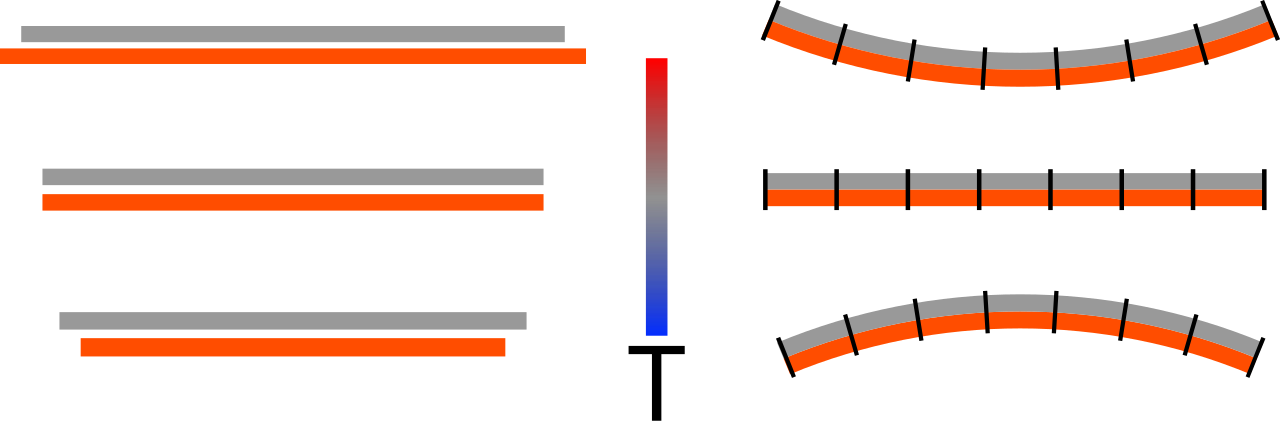
The one with the larger expansion coefficient
It does not bend
The one with the smaller expansion coefficient
Toward the hotter metal
The metal that expands more ends up on the outside of the curve, so the strip bends toward the metal that expands less. Image: ToobEZ, CC0, via Wikimedia Commons.
A 1.0 kW kettle heats 1.0 kg of water by 80 K. About how long does it take if there are no losses?
About 80 s
About 5.6 minutes
About 56 minutes
About 14 seconds
J, s ≈ 5.6 min.
A 0.50 kg copper block (c = 385 J/kg·K) at 100 °C is placed in 1.0 kg of water at 20 °C. The final temperature is closest to…
60 °C
35 °C
20.0 °C
23.5 °C
Water's specific heat is more than 10 times copper's and it has twice the mass, so the final temperature stays close to the water's initial 20 °C.
How much heat is needed to melt 0.10 kg of ice at 0 °C? (L_f = 334 kJ/kg)
334 kJ
3.34 kJ
33.4 kJ
41.9 kJ
kJ. 41.9 kJ is the heat to warm 0.1 kg of water from 0 to 100 °C.
A 20 g ice cube at 0 °C is dropped into 250 g of water at 25 °C. The final temperature is about…
12.5 °C
17 °C
23 °C
0 °C
Melting the cube takes 6.7 kJ and warming the meltwater a bit more; the 250 g of water cools by about 8 K. It does not drop to 0 °C because the ice is small.
Which mode of heat transfer can occur through a vacuum?
Radiation
Conduction
Convection
All three
Conduction and convection need matter; thermal radiation is carried by electromagnetic waves (sunlight reaches Earth through space).
A 2.0 m² window has 5.0 mm thick glass (k = 0.80 W/m·K). With a 20 K temperature difference across it, what is the conduction rate?
64 W
3.2 W
0.64 W
6400 W
W. Don't forget to convert mm to m.
An object's absolute temperature is doubled. By what factor does the power it radiates increase?
2
4
16
8
, so .
The Sun's surface is at about 5800 K. Using Wien's law, its emission peaks near which wavelength?
About 5 μm
About 500 nm
About 50 nm
About 9 μm
nm (green-blue visible light). 9 μm is the peak for a human body at 310 K.
On the heating curve below, why does the temperature stay constant at the plateau marked 'Boiling'?
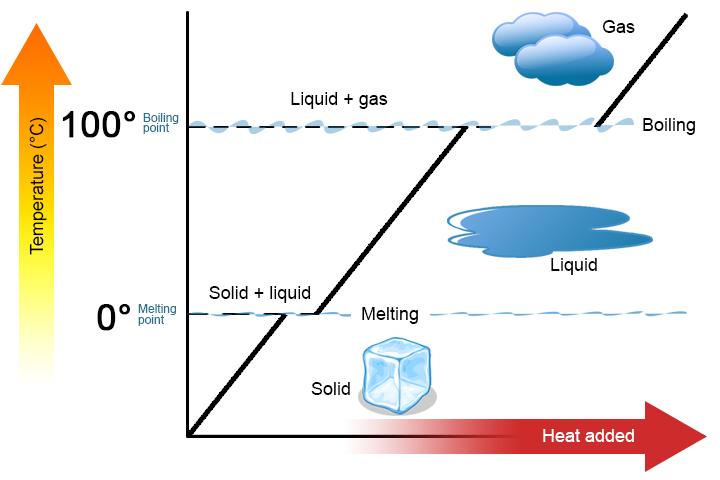
The added heat goes into latent heat of vaporization, not into raising the kinetic energy of the molecules
The thermometer stops working in steam
The heat source is switched off
The water has reached absolute zero
During a phase change the energy breaks intermolecular bonds (potential energy), so the temperature is constant. Image: C3bc-taaccct, CC BY 3.0, via Wikimedia Commons.
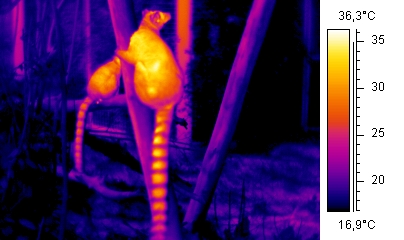
A thermal camera produced this false-colour image of a lemur. What does the camera actually detect?
Heat conducted from the animal to the camera
Visible light reflected from the fur
Ultraviolet radiation
Infrared radiation emitted by the surface
All objects emit thermal radiation whose intensity depends on temperature (T⁴); at room and body temperatures the peak is in the infrared. Image: Arno and Coen, CC BY-SA 3.0, via Wikimedia Commons.
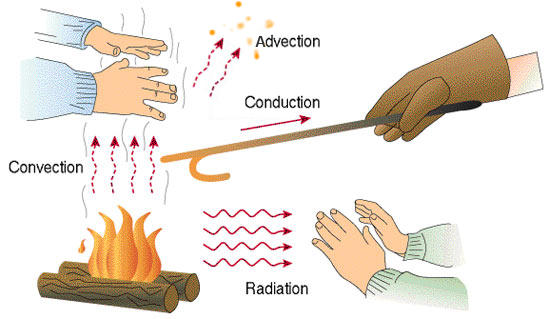
In the picture, the hands held beside the fire are warmed mainly by…
Conduction
Convection
Radiation
Advection
Hot air rises, so the sides are not heated by convection; there is no contact with the fire (no conduction). Infrared radiation travels sideways. Image: Kmecfiunit and Cmglee, CC BY-SA 4.0, via Wikimedia Commons.
Equal heat is supplied to 1 kg of water and 1 kg of aluminium (c = 900 J/kg·K), both initially at the same temperature. Which ends up hotter?
The water
The aluminium
They are the same
It depends on the initial temperature
: the lower specific heat gives a bigger temperature rise (about 4.7 times).
How does a vacuum flask keep drinks hot?
The vacuum prevents conduction and convection, and the silvered walls reflect radiation
The vacuum increases the specific heat of the liquid
The silver coating absorbs heat from the liquid
It stops evaporation only
Each of the three transfer routes is blocked or reduced.
The greenhouse effect occurs because the atmosphere absorbs and re-emits infrared radiation from Earth's surface.
True
False
True. Gases such as CO₂, CH₄ and water vapour are largely transparent to visible light but absorb infrared, warming the surface by about 33 °C.
The temperature of a mixture of ice and water at 1 atm rises steadily as heat is added.
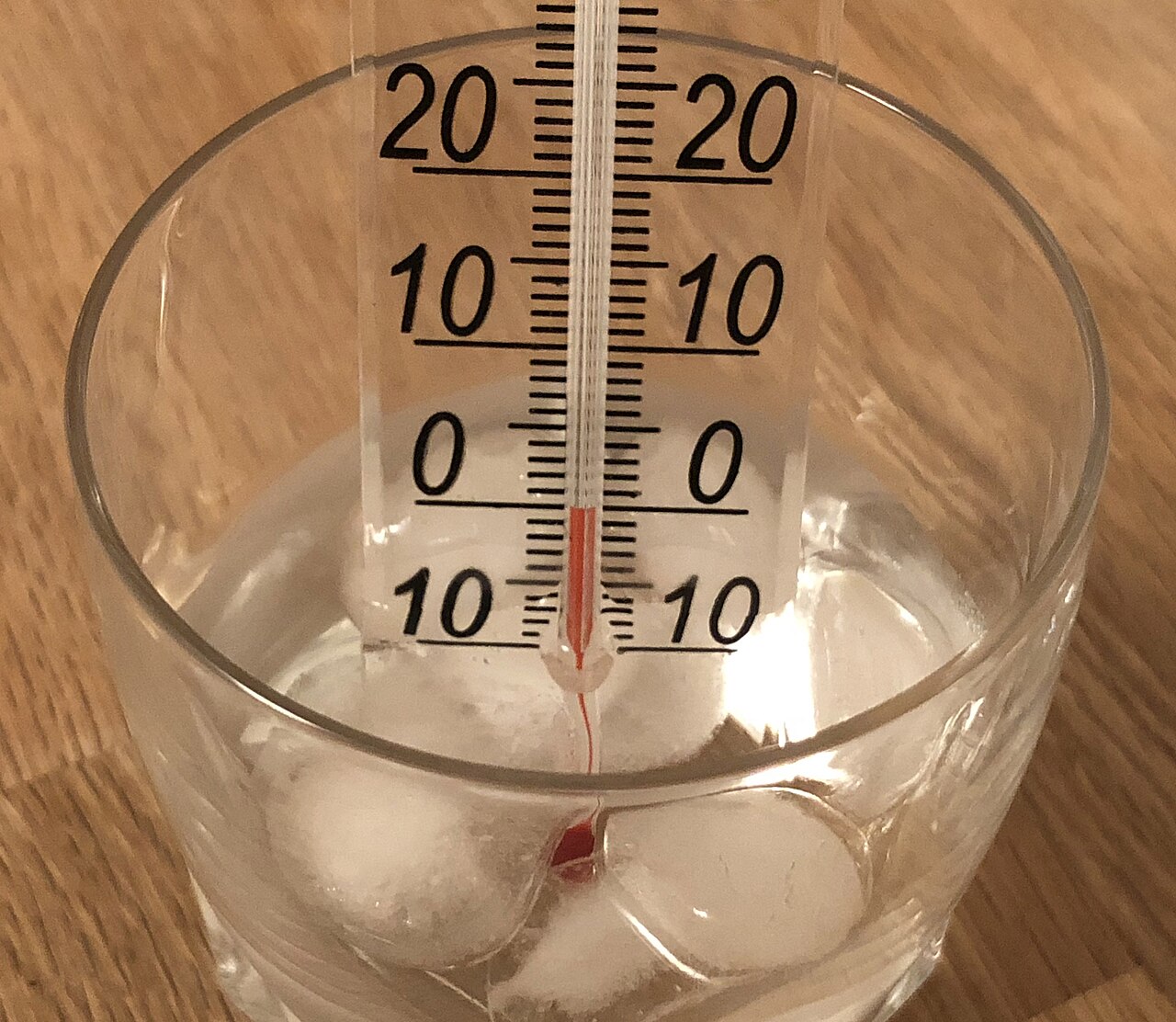
True
False
False. While both ice and water are present, the temperature stays at 0 °C; the heat melts ice (latent heat). Image: Ulflund, CC0, via Wikimedia Commons.
