Quiz · Hard
Numerical problems: mechanism-based rate laws, Arrhenius calculations, free energy and K, Nernst, Faraday's law, particle in a box and effusion.
The rate of a reaction triples when [A] triples and is unchanged when [B] doubles. What is the rate law, and what are the units of k if the rate is in M/s?
rate = k[A][B], k in M-1 s-1
rate = k[A][B]2, k in M-2 s-1
rate = k[A]2, k in M-1 s-1
rate = k[A], k in s-1
Rate is proportional to [A] (first order in A) and independent of [B] (zero order in B), so rate = k[A] and k has units of s-1.
The data show ln k is linear in 1/T with a slope of -7500 K. What is Ea?
620 kJ/mol
62 kJ/mol
90 kJ/mol
7.5 kJ/mol
Ea = -slope x R = 7500 x 8.314 = 62,355 J/mol = 62 kJ/mol. Remember to convert J/mol to kJ/mol.
A reaction has Ea = 75 kJ/mol. What is the ratio k(310 K)/k(300 K)?
About 2.6
About 1.3
About 7.5
About 0.4
ln(k2/k1) = (75000/8.314)(1/300 - 1/310) = 9021 x 1.075e-4 = 0.970, so the ratio is e^0.970 = 2.64. A 10 degree rise roughly doubles to triples the rate for typical activation energies.
Which is the rate law for this mechanism? Step 1: A + B ⇌ C (fast equilibrium). Step 2: C + B → D (slow).
rate = k[A]
rate = k[A][B]
rate = k[C][B]
rate = k[A][B]2
The slow step has rate k2[C][B]. C is an intermediate, so use the fast equilibrium: [C] = K[A][B]. Then rate = k2 K [A][B]2.
At 298 K the reaction N2(g) + 3H2(g) → 2NH3(g) has ΔH° = -92 kJ and ΔS° = -199 J/K. What is ΔG°, and is it spontaneous?
-92 kJ, spontaneous
+33 kJ, not spontaneous
-33 kJ, spontaneous
-151 kJ, spontaneous
ΔG° = -92 - 298(-0.199) = -92 + 59.3 = -32.7 kJ, about -33 kJ. Using ΔS in J without converting would give nonsense.
1.0 mol of an ideal gas expands isothermally and reversibly to twice its volume at 300 K. What is ΔS of the gas?
-5.76 J/K
+1730 J/K
0
+5.76 J/K
ΔS = nR ln(V2/V1) = 8.314 ln 2 = 5.76 J/K. For the ideal gas ΔU = 0, but entropy rises because the gas has more volume.
Which statement about a cell at equilibrium is correct?
E = 0 and Q = K
ΔG = ΔG° and E = 0
Q = 1
E = E°
At equilibrium the cell is dead: E = 0, ΔG = 0, and Q = K. E equals E° only when Q = 1.
A Zn-Cu cell has [Zn2+] = 1.0 M and [Cu2+] = 0.0010 M. E° = 1.10 V. What is E at 298 K?
1.19 V
1.10 V
1.01 V
0.92 V
E = 1.10 - (0.0592/2) log(1.0/0.0010) = 1.10 - 0.0296(3) = 1.01 V. Reversing Q would give the wrong sign: 1.19 V.
How long does it take to plate 1.00 g of silver from AgNO3 with a current of 0.500 A? (M = 107.87 g/mol)
About 7160 s
About 1790 s
About 895 s
About 3580 s
n(Ag) = 1.00/107.87 = 9.27e-3 mol. One electron per Ag+: Q = 9.27e-3 x 96485 = 894 C. t = Q/I = 894/0.500 = 1789 s, so about 1790 s.
A particle in a 1D box has its length doubled. By what factor does the n = 1 to n = 2 transition energy change?
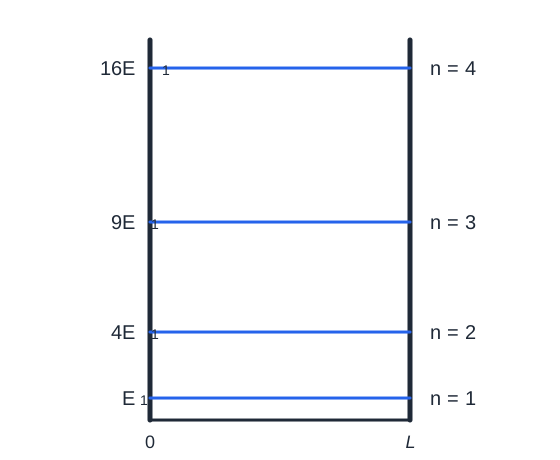
Increases by 4
Decreases to 1/4
Decreases to 1/2
Stays the same
E_n is proportional to 1/L2, so the gap becomes 1/4 as large for the longer box.
An absorbance of 0.30 is measured for a solution in a 1.0 cm cell. What percentage of the light is transmitted?
About 50%
About 5%
About 70%
About 30%
T = 10^(-A) = 10^(-0.30) = 0.50, so about 50%. Absorbance is a logarithmic scale.
Why does 1H35Cl absorb at a higher IR frequency than 2H35Cl (DCl)?
H forms a stronger bond than D
D is more electronegative
HCl has the larger dipole moment
HCl has the smaller reduced mass
Frequency is proportional to sqrt(k/mu). The force constant is essentially the same for both isotopes, but the lighter H gives a smaller reduced mass and a higher frequency.
Two gases, X and Y, effuse in a ratio rate(X)/rate(Y) = 2.0. If Y has M = 64 g/mol, what is M of X?
32 g/mol
16 g/mol
128 g/mol
8 g/mol
rate(X)/rate(Y) = sqrt(M_Y/M_X) = 2, so M_X = M_Y/4 = 16 g/mol.
For which reaction does ΔH° = ΔU° (approximately)?
H2(g) + Cl2(g) → 2HCl(g)
2H2O(l) → 2H2(g) + O2(g)
CaCO3(s) → CaO(s) + CO2(g)
N2(g) + 3H2(g) → 2NH3(g)
ΔH = ΔU + Δn(g)RT, and the first reaction has 2 mol of gas on both sides (Δn = 0). The others change the moles of gas.
What is the standard free energy change for a reaction with K = 1.0 x 10^5 at 298 K?
-285 kJ/mol
-28.5 kJ/mol
+28.5 kJ/mol
-5.0 kJ/mol
ΔG° = -RT ln K = -(8.314)(298)(11.51) = -28,520 J = -28.5 kJ/mol. The sign is negative because K > 1.
