Quiz · Medium
Identify lymphoid organs, white blood cells and antibody parts, and review innate vs. adaptive immunity.
Which type of immunity is gained by vaccination?
Natural passive
Artificial active
Artificial passive
Natural active
Vaccines make your own body produce antibodies (active), by an artificial route.
Which antibody crosses the placenta?
IgA
IgM
IgG
IgE
Only IgG crosses the placenta and gives the newborn passive immunity. IgA reaches the baby later through breast milk.
Helper T cells carry which surface marker?
CD8
CD4
CD19
CD56
CD4. Cytotoxic T cells have CD8. HIV targets CD4 cells.
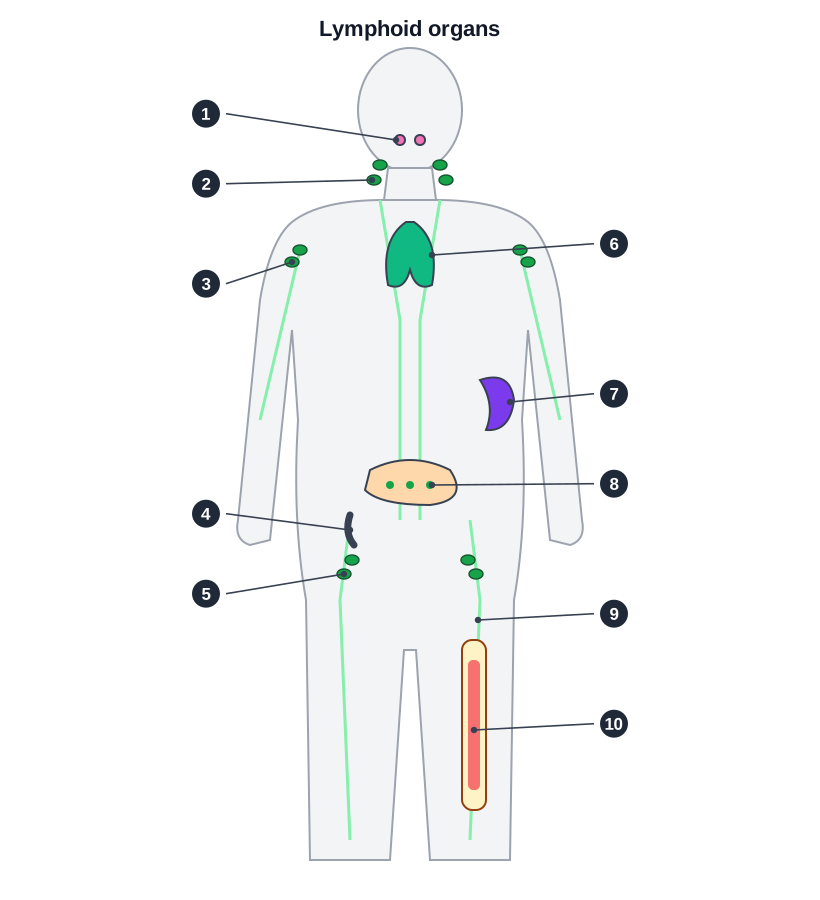
Which structure is labeled 7 in the diagram?
Thymus
Spleen
Appendix
Tonsils
The spleen is in the upper left abdomen and filters blood.
Which structure is labeled 6 in the diagram?
Thymus
Spleen
Cervical lymph nodes
Red bone marrow
The thymus lies behind the sternum in the upper chest and is where T cells mature.
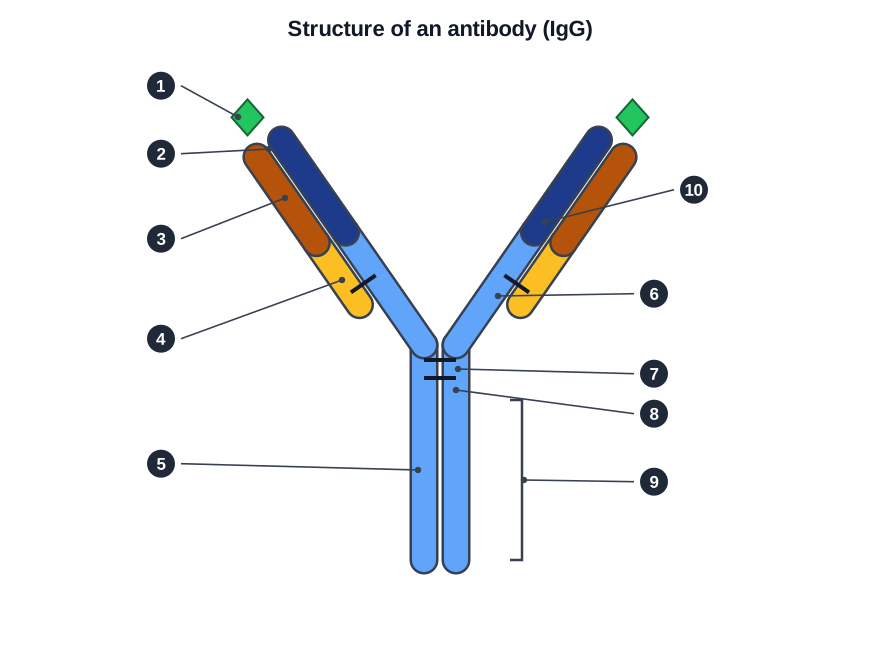
Which structure is labeled 9 in the diagram?
Fab region
Fc region
Hinge region
Variable region
The Fc (stem) region binds phagocyte receptors and complement; it is not the antigen-binding end.
Which structure is labeled 2 in the diagram?
Constant region
Hinge
Antigen-binding site
Disulfide bond
The variable ends of the heavy and light chains together form the antigen-binding site.
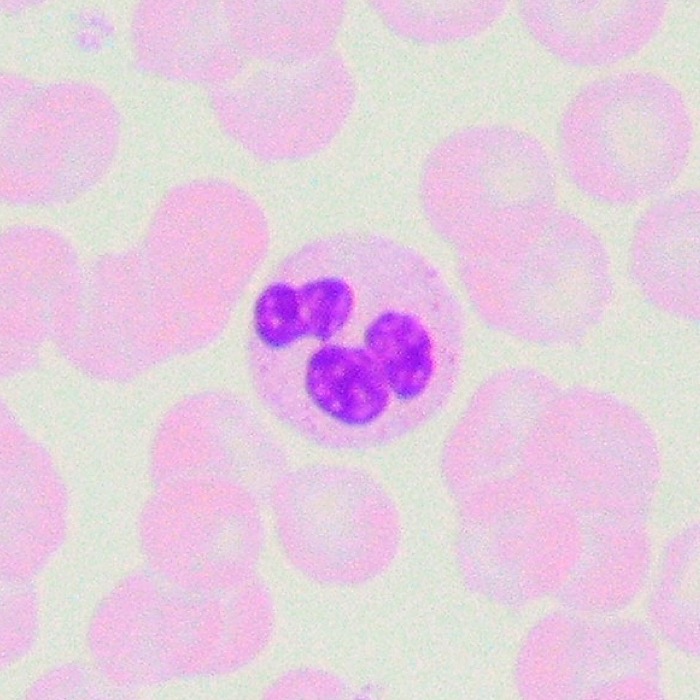
Which white blood cell is the most abundant in normal blood?
Lymphocyte
Neutrophil
Eosinophil
Monocyte
Neutrophils are about 40 to 70% of WBCs. Lymphocytes are second.
Image: Echinaceapallida, CC BY-SA 4.0, via Wikimedia Commons.
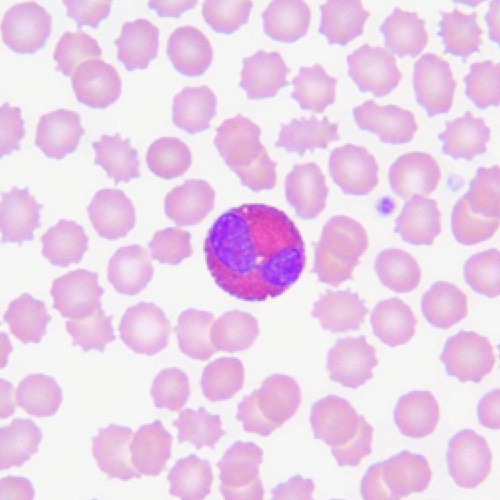
This cell has a bilobed nucleus and red-orange granules. Which is it?
Basophil
Eosinophil
Neutrophil
Monocyte
Eosinophils have red-orange granules and a bilobed nucleus; basophils have dark blue-purple granules.
Image: Echinaceapallida, CC BY-SA 4.0, via Wikimedia Commons.
Which cell type matures in the thymus?
B cell
T cell
Macrophage
Neutrophil
T cells mature in the thymus (T for thymus); B cells mature in the bone marrow.
Which cells present antigen to helper T cells using MHC II?
All nucleated cells
Red blood cells
Dendritic cells, macrophages and B cells
Neutrophils only
MHC II is limited to antigen-presenting cells. MHC I is found on all nucleated cells.
Which cell makes antibodies?
Plasma cell
Macrophage
NK cell
Eosinophil
Plasma cells are differentiated B cells specialized for antibody secretion.
What mediator released by mast cells causes redness, swelling and itching?
Histamine
Heparin
Perforin
Interferon
Histamine dilates vessels and makes capillaries leaky. Perforin is a cytotoxic cell protein; interferon is an antiviral cytokine.
True or false: Passive immunity creates memory cells.
True
False
False. Passive immunity supplies ready-made antibodies, so there are no memory cells and protection fades.
Which structure drains lymph from the head and neck?
Axillary nodes
Cervical nodes
Inguinal nodes
Peyer's patches
Cervical nodes drain the head and neck; axillary drain the arm and breast; inguinal drain the lower limb.
Which structure is labeled 4 in the diagram?
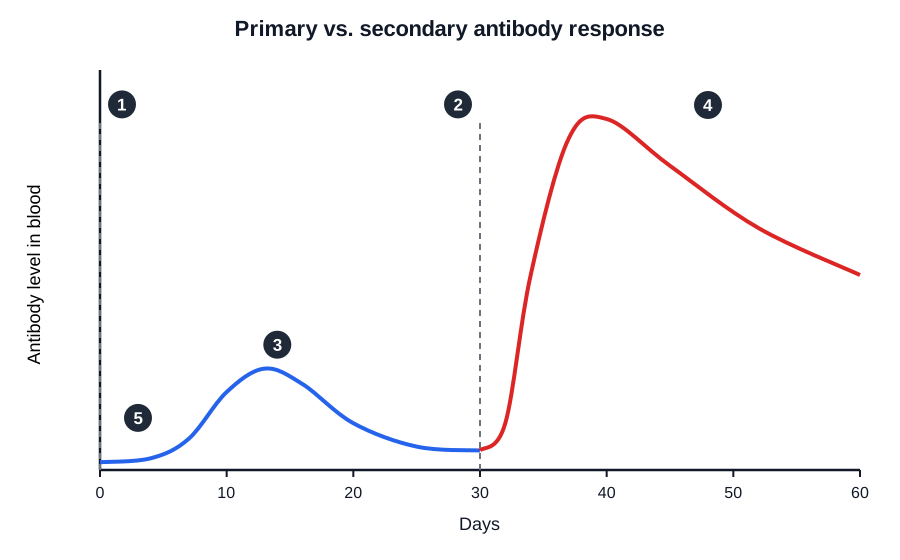
First exposure
Primary response
Secondary response
Lag phase
The secondary response is higher and faster because memory cells exist.
Which type of cell directly kills virus-infected cells after recognizing antigen on MHC I?
Helper T cell
Cytotoxic T cell
Plasma cell
Eosinophil
CD8+ cytotoxic T cells recognize MHC I and use perforin and granzymes.
Which is part of the innate immune system?
Memory B cells
Natural killer cells
Cytotoxic T cells
Antibodies
NK cells act without prior sensitization. Antibodies, memory B cells and cytotoxic T cells belong to adaptive immunity.
