Quiz · Medium
Basics of muscle structure, the sliding filament mechanism, fiber types and major muscles, including photo identification.
Which structure wraps an individual skeletal muscle fiber?
Endomysium
Epimysium
Perimysium
Sarcolemma
The endomysium surrounds each fiber, the perimysium surrounds a fascicle, and the epimysium surrounds the whole muscle. The sarcolemma is the fiber's own plasma membrane, not a connective tissue wrapping.
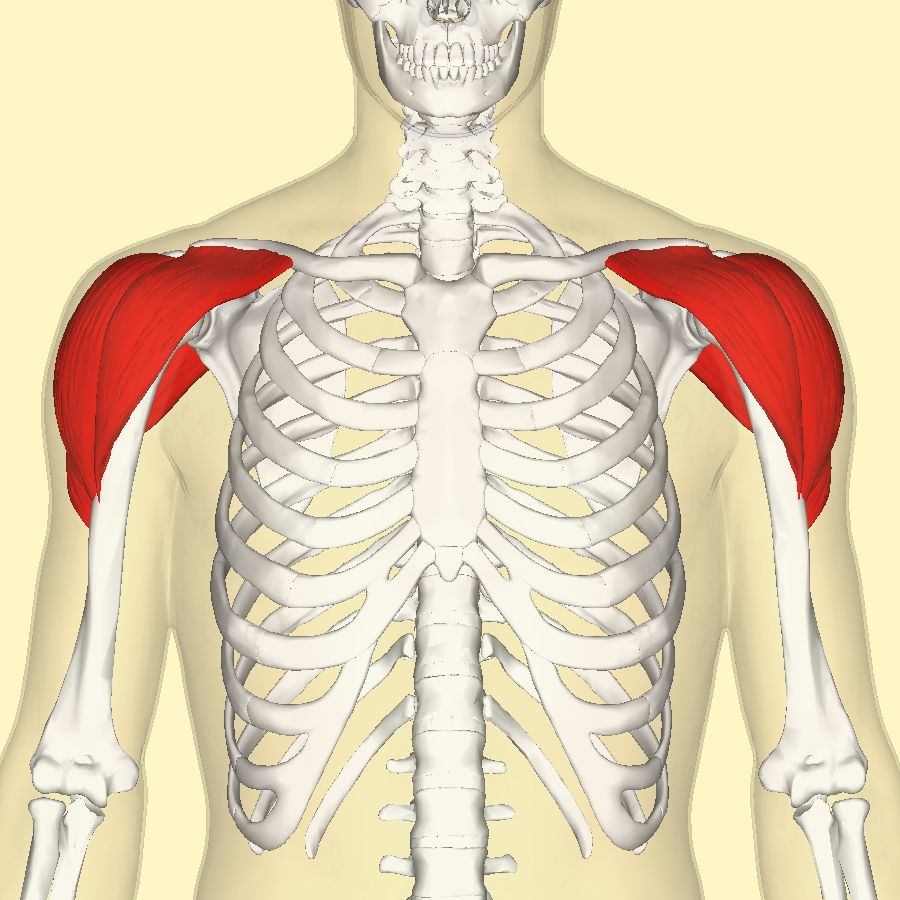
Which muscle is highlighted in the image?
Trapezius
Deltoid
Pectoralis major
Biceps brachii
The highlighted muscle caps the shoulder: the deltoid, which abducts the arm. Image: Anatomography, CC BY-SA 2.1 jp, via Wikimedia Commons.
What is the functional (contractile) unit of a skeletal muscle fiber?
Myofibril
Sarcoplasmic reticulum
Sarcomere
Motor unit
A sarcomere runs from one Z disc to the next. Myofibrils are chains of sarcomeres, and a motor unit is a neuron plus its fibers.
Which ion binds to troponin to begin skeletal muscle contraction?
Sodium
Potassium
Magnesium
Calcium
Ca2+ released from the sarcoplasmic reticulum binds troponin, moving tropomyosin away from the myosin-binding sites on actin. Sodium causes the end-plate potential but does not bind troponin.
Which neurotransmitter is released at the neuromuscular junction?
Acetylcholine
Norepinephrine
Dopamine
GABA
Motor neurons release acetylcholine onto nicotinic receptors on the motor end plate. Norepinephrine is released by most sympathetic postganglionic neurons.
During contraction, which band stays the same length?
I band
A band
H zone
Sarcomere
The A band is the length of the thick filaments, which do not change. The I band and H zone shrink, and the whole sarcomere shortens.
What is the role of ATP in the cross-bridge cycle?
It binds troponin to expose actin
It releases calcium from the SR only
It allows the myosin head to detach from actin and re-cock
It provides the power stroke directly by hydrolysis during binding
A new ATP binds myosin, which breaks the cross-bridge; hydrolysis then re-cocks the head. Without ATP the heads stay attached, as in rigor mortis.
Which muscle is the prime mover for flexing the elbow when the forearm is supinated?
Triceps brachii
Deltoid
Brachioradialis
Biceps brachii
The biceps is the main elbow flexor with the palm up. The triceps is the antagonist, and the brachioradialis is a synergist that works best in the neutral position.
Which image highlights the gastrocnemius?
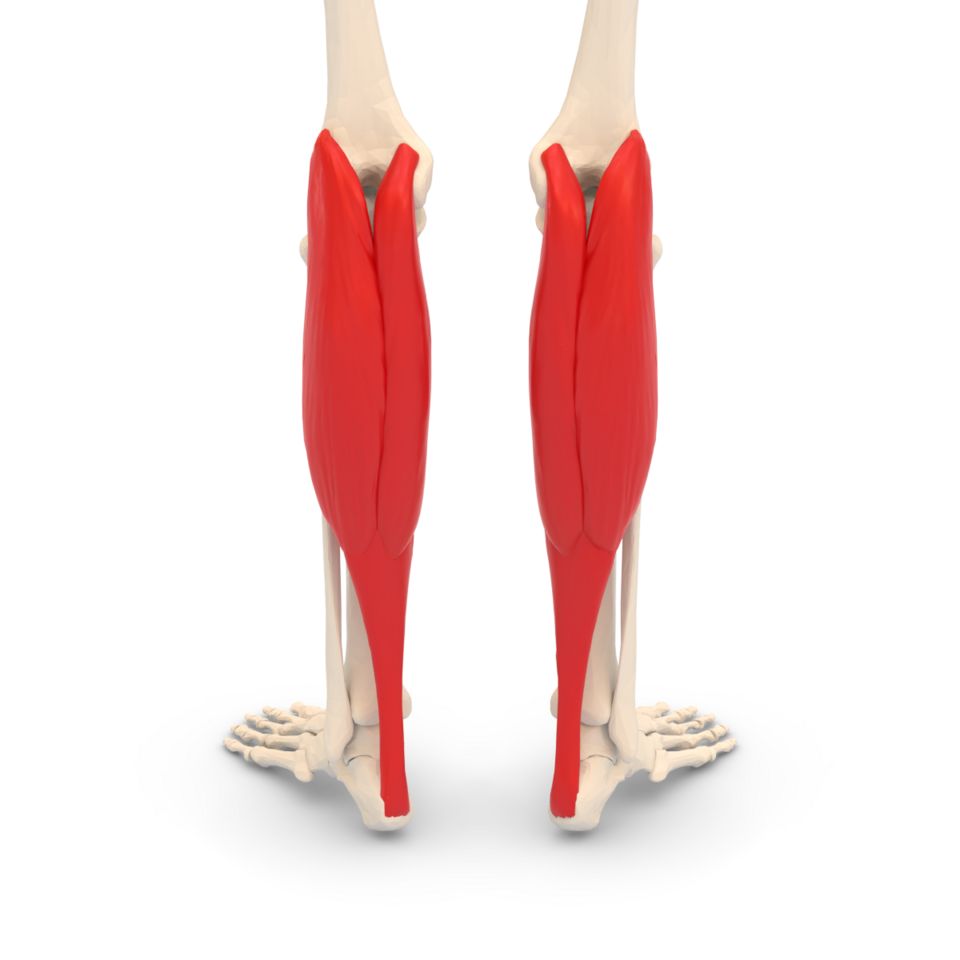
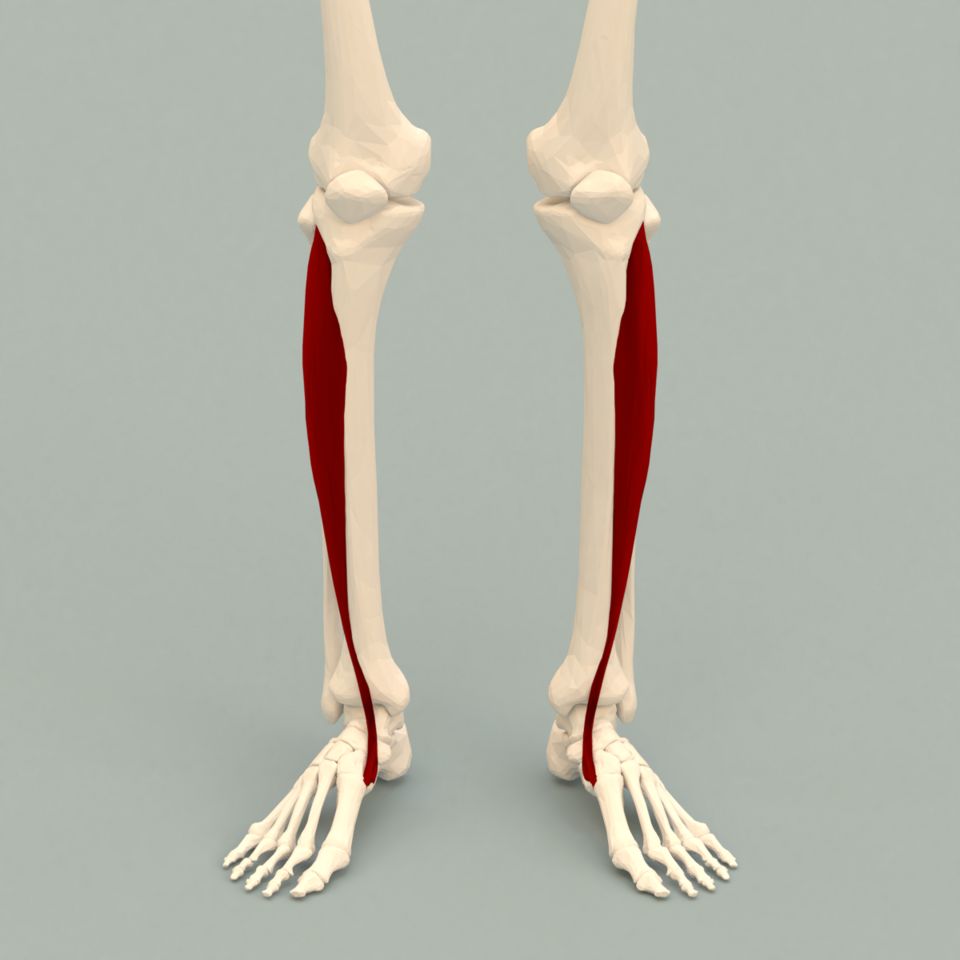
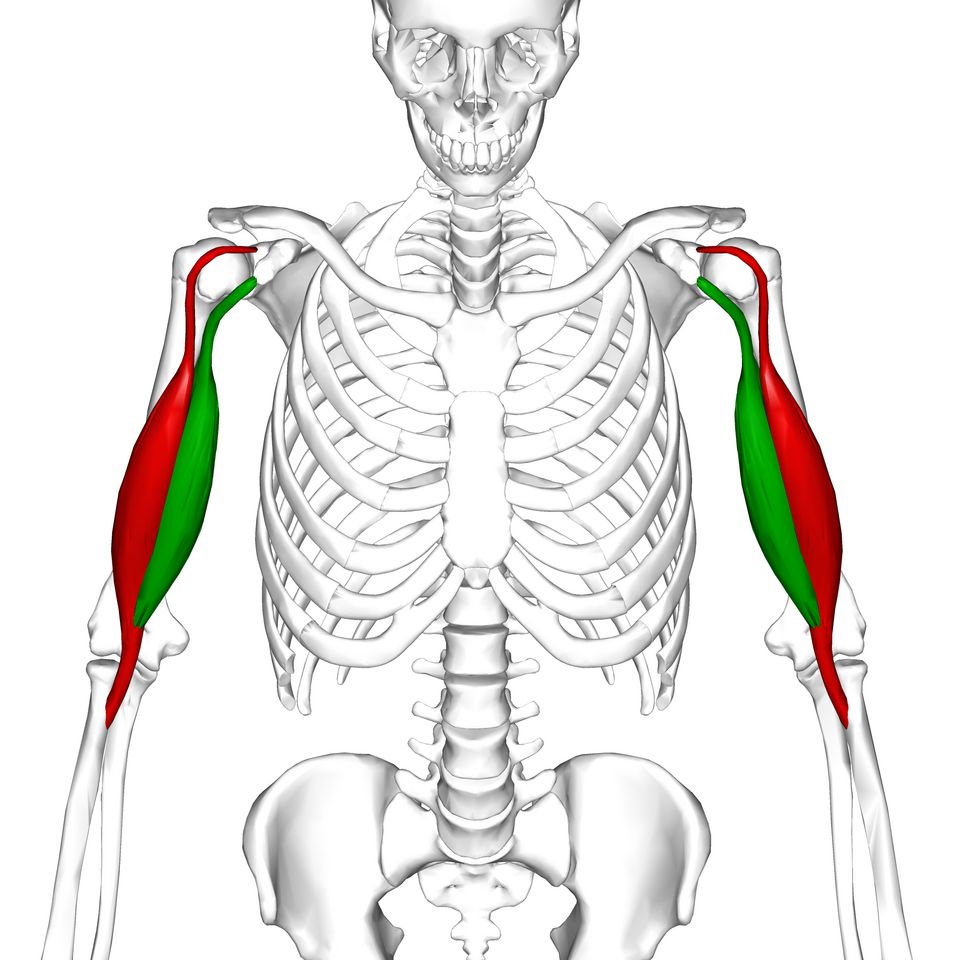
The gastrocnemius is the superficial calf muscle seen from behind. The tibialis anterior is on the front of the shin. Image: Database Center for Life Science (DBCLS), CC BY-SA 2.1 jp, via Wikimedia Commons.
Which muscle fiber type is most resistant to fatigue?
Type IIx (fast glycolytic)
Type I (slow oxidative)
Type IIa only
All types fatigue equally
Type I fibers have many mitochondria, capillaries and myoglobin. Fast glycolytic fibers produce high force but fatigue quickly.
Which muscle type has intercalated discs?
Skeletal muscle
Single-unit smooth muscle
Cardiac muscle
Multi-unit smooth muscle
Intercalated discs, with gap junctions and desmosomes, link cardiac cells mechanically and electrically.
The calcaneal (Achilles) tendon connects the calf muscles to which bone?
Talus
Tibia
Navicular
Calcaneus
Gastrocnemius and soleus attach to the calcaneus through the Achilles tendon, enabling plantar flexion.
Which muscle is highlighted?
Tibialis anterior
Gastrocnemius
Quadriceps femoris
Gluteus maximus
The long muscle on the front of the shin dorsiflexes and inverts the foot. Image: Database Center for Life Science (DBCLS), CC BY-SA 2.1 jp, via Wikimedia Commons.
Which muscle pair forms the rotator cuff group along with infraspinatus and subscapularis?
Deltoid and trapezius
Supraspinatus and teres minor
Pectoralis major and latissimus dorsi
Teres major and rhomboids
SITS: supraspinatus, infraspinatus, teres minor and subscapularis. Teres major is not part of the cuff, which is a common mix-up.
Which muscle is the main muscle of inspiration?
Rectus abdominis
Internal intercostals
Diaphragm
Trapezius
The diaphragm contracts and flattens, increasing thoracic volume. Internal intercostals help with forced expiration.
The quadriceps femoris is innervated by which nerve?
Sciatic nerve
Obturator nerve
Superior gluteal nerve
Femoral nerve
The femoral nerve (L2 to L4) supplies knee extensors. The sciatic supplies the hamstrings.
True or false: The sartorius is the longest muscle in the body.
True
False
The sartorius runs from the anterior superior iliac spine to the medial tibia, crossing the hip and knee.
Which muscle group flexes the knee?
Quadriceps femoris
Hamstrings
Tibialis anterior
Gluteus medius
The hamstrings flex the knee and extend the hip. The quadriceps is the antagonist.
Motor unit recruitment: which units are recruited first when force requirements are low?
Large motor units with fast fibers
All units at once
Small motor units with slow fibers
Only fast glycolytic units
The size principle: smaller neurons reach threshold first, so fine, fatigue-resistant units are used first.
