Quiz · Expert
Applied problems: merodiploid operon genotypes, blue-white screening, gel interpretation, PCR calculations, epigenetics and cancer genes.
A researcher starts a PCR with 1 copy of a target. After 5 cycles, what is the theoretical number of copies?
10
25
32
64
2^5 = 32. Many students multiply 5 x 2 = 10 by mistake.
A lacZ- mutant and a lacI- mutant (which has a normal lacZ gene) are grown without lactose. Which statement is correct?
Only lacI- makes beta-galactosidase
Neither makes it
Both make beta-galactosidase
Only the lacI- mutant makes (a nonfunctional?) ... see below
The lacI- mutant has no working repressor, so lacZYA is on all the time. The lacZ- mutant can't make a working enzyme at all, whatever the regulation.
A merodiploid cell has genotype lacI+ lacO+ lacZ- on the chromosome and lacI- lacO+ lacZ+ on a plasmid. With no lactose, is beta-galactosidase made?
Yes, because the plasmid lacZ+ is always expressed
Only if glucose is present
Yes, because the lacI- is dominant
No, because the lacI+ repressor acts in trans on both operators
The repressor is a diffusible (trans) product, so lacI+ from the chromosome represses the plasmid's operon too.
A mutation in the lac operator (lacO^c) on a plasmid carrying lacZ+, in a cell with a wild-type chromosome, results in:
Loss of the repressor
Constitutive expression of the plasmid's lacZ only (cis effect)
Constitutive expression of both lacZ genes
No expression anywhere
Operator mutations are cis-acting: they affect only the genes on the same DNA molecule.
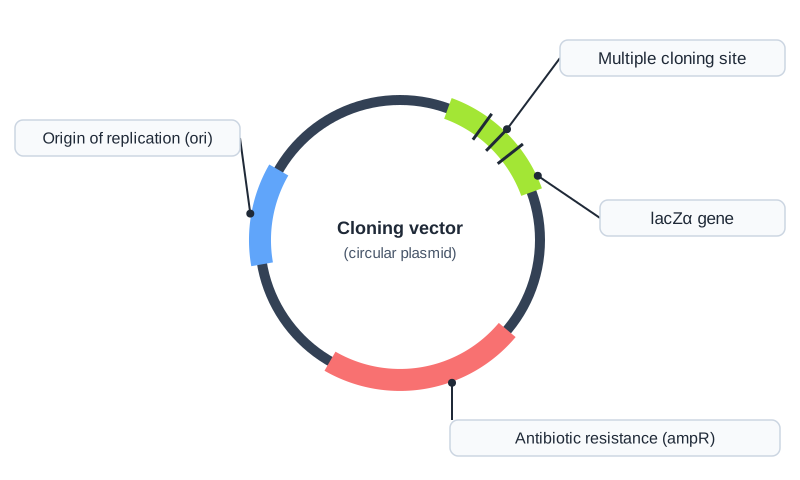
A plasmid vector has ampR and lacZα. Transformed cells are plated on ampicillin plus X-gal. You see blue colonies, white colonies and no growth in some regions. Which colonies carry the gene you cloned?
The blue colonies
The white colonies
No colonies; blue means dead
The regions with no growth
White colonies carry a plasmid (ampicillin resistance) whose lacZα was disrupted by the insert. Blue = empty vector. No growth = no plasmid.
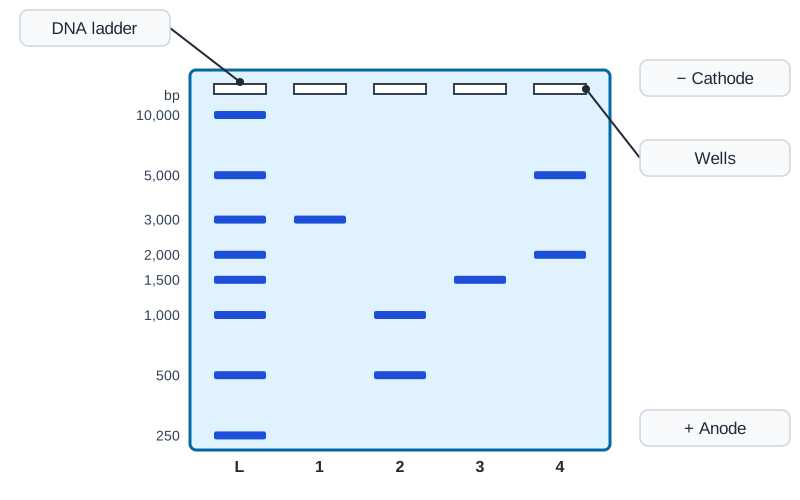
A DNA sample is cut with EcoRI, which cuts a linear 6,000 bp fragment at two sites, producing fragments of 1,000, 2,000 and 3,000 bp. On the gel, which band is closest to the wells?
All migrate equally
1,000 bp
2,000 bp
3,000 bp
The largest fragment moves the slowest and stays nearest to the wells.
A PCR gives no product. A student checks the program: denaturation at 72 °C, annealing at 55 °C, extension at 95 °C. What is the error?
The temperatures for denaturation and extension are swapped
The primers are too long
Taq does not need heat
The annealing step is not needed
Denaturation needs about 95 °C to separate strands; extension is about 72 °C for Taq.
Which of the following correctly describes how CRISPR-Cas9 makes a precise edit with a template?
Reverse transcriptase copies the guide RNA
NHEJ inserts the template
HDR uses the supplied template to repair the double-strand break
Cas9 ligates the template in
Homology-directed repair uses a homologous donor. NHEJ is error-prone and creates small insertions or deletions.
A mutation in a gene replaces a GAG codon (Glu) with GUG (Val). This resembles the mutation in sickle-cell disease. What type of mutation is it?
Frameshift
Silent
Missense
Nonsense
A single-nucleotide substitution that changes one amino acid is missense.
A eukaryotic gene is expressed in E. coli from genomic DNA but produces a nonfunctional protein. The most likely reason is:
E. coli can't splice out introns
The plasmid has no origin
The gene was transcribed into DNA
E. coli can't read the ATG start codon
Bacteria lack a spliceosome. Using cDNA solves this.
A cell line is treated with a drug that blocks histone deacetylases. Which result is most likely?
DNA is methylated
Replication stops
Chromatin condenses and genes are silenced
Histones stay acetylated, chromatin loosens and transcription increases
Deacetylases remove acetyl groups. Blocking them keeps histones acetylated, which opens chromatin.
Which of the following is the best explanation for why most cancers need several mutations?
Each cell has only one copy of every gene
Multiple checks (oncogene activation plus loss of tumor suppressors, repair and apoptosis) must fail
Mutations are always reversible
p53 is only expressed once
Cancer arises when the cell cycle drivers are activated and the brakes and repair systems are lost.
In a trp operon experiment, a mutant cannot bind tryptophan to the repressor. What would you expect when tryptophan is high?
The operon is repressed
The operon stays on and wastes energy
No mRNA is made
The cell dies from tryptophan
Without corepressor binding, the repressor cannot bind the operator. Genes stay on even with plenty of tryptophan.
The DNA of a species has 22% thymine. What percent is cytosine?
44%
56%
22%
28%
T = A = 22%, so A + T = 44%. G + C = 56% and C = 28%. Choosing 22% wrongly assumes C equals T.
Reverse transcriptase is added to purified mRNA from liver cells. The product is used for PCR. This is called:
RT-PCR (cDNA synthesis then PCR)
Sanger sequencing
Restriction mapping
Southern blotting
RT-PCR first makes cDNA from RNA, then amplifies it. Used to measure gene expression.
