Quiz · Hard
Growth models, survivorship curves, age structures, energy transfer calculations and nutrient cycles.
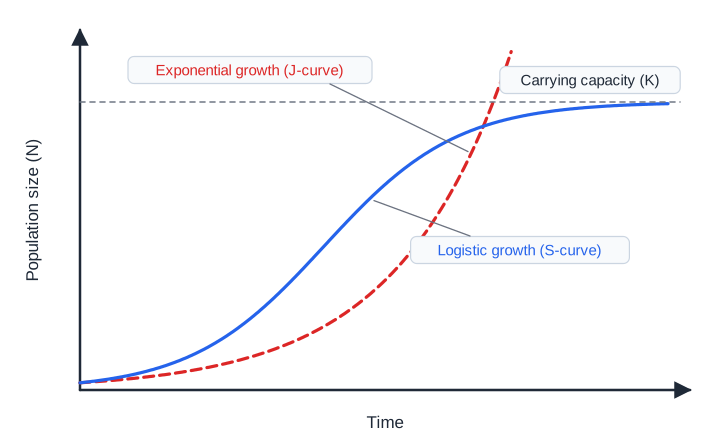
A population is growing logistically with K = 1,000. At which N is the population growing fastest?
100
500
900
1,000
The growth rate rN(K-N)/K is maximized at K/2.
Which situation would produce a J-shaped growth curve?
Bacteria in fresh medium with unlimited nutrients
A deer herd approaching carrying capacity
A population at K
Humans in a famine
Exponential growth occurs when resources do not limit growth.
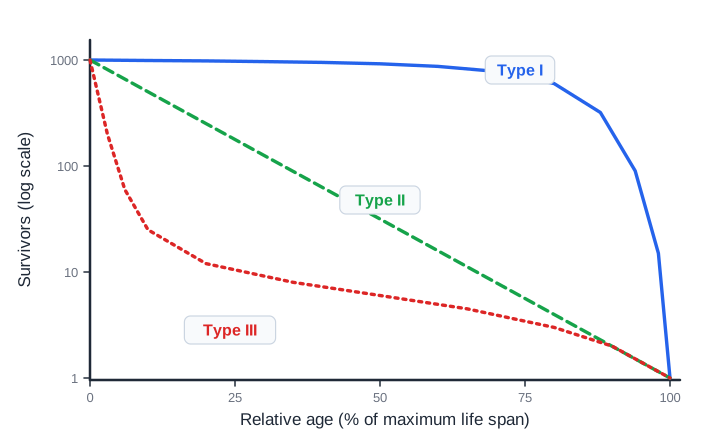
Which curve best describes an oyster, which produces thousands of larvae, most of which die young?
Type II
Type I
None
Type III
High juvenile mortality is typical of type III survivorship.
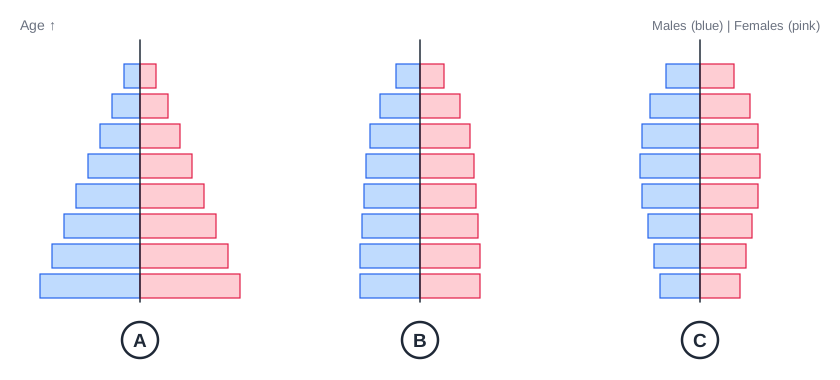
Pyramid A is wide at the base and narrow at the top. What does it predict?
Stable size
Rapid population growth
Zero growth
Decline
Many young individuals will reach reproductive age soon.
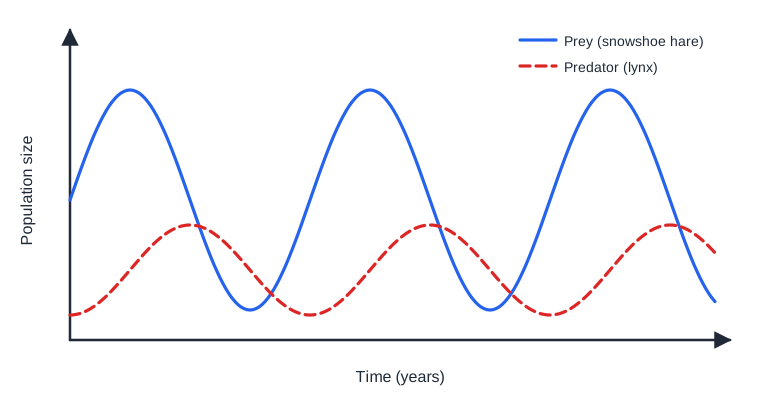
Hare and lynx numbers cycle with the lynx peak lagging behind the hare peak. Which explanation fits best?
Hares eat lynx
Lynx increase after prey are abundant, then reduce hares
Hares are density independent
Lynx migrate every year
Predator numbers respond to prey numbers with a delay.
Producers capture 50,000 kJ. Approximately how much reaches tertiary consumers?
500 kJ
5,000 kJ
50 kJ
5 kJ
Producers 50,000, primary consumers 5,000, secondary 500, tertiary 50 at 10% transfer.
Which is a main reason that only about 10% of energy transfers between trophic levels?
Carnivores waste food
Energy is destroyed
Most energy is lost as heat in respiration and in unconsumed or indigestible material
Plants store all energy
Energy is not destroyed, but it is converted to forms not available to the next level.
In a mark-recapture study, 80 are marked; a later sample of 60 contains 12 marked. Estimated N?
400
240
72
960
N = 80 x 60 / 12 = 400.
Which process converts nitrate to N2 gas?
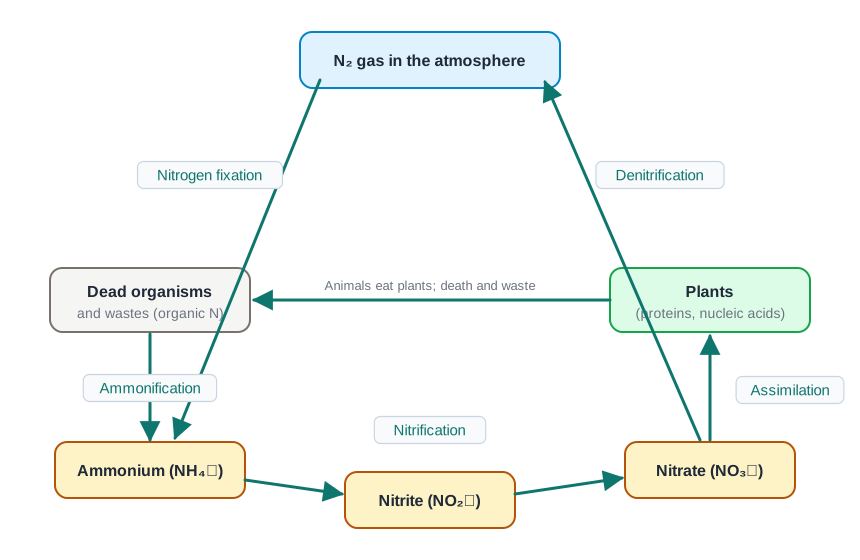
Assimilation
Denitrification
Nitrification
Ammonification
Anaerobic soil bacteria perform denitrification.
Waterlogged soil has little oxygen. Which nitrogen process is likely to increase?
Denitrification
Nitrogen assimilation
Nitrification
Photosynthesis
Denitrifying bacteria thrive in anaerobic conditions, so plants lose nitrate.
A farmer plants clover to improve soil. The benefit is best explained by
Nitrification only
Denitrification
Eutrophication
Nitrogen fixation in root nodules
Rhizobium fixes N2 to ammonium for the plant and later soil.
Fertilizer runoff causes an algal bloom and fish kill. Which sequence is correct?
Nutrient enrichment, algal bloom, decomposition by bacteria, oxygen depletion
Algal bloom, nutrient loss, fish increase
Acid rain, bloom, more oxygen
Oxygen depletion, nutrient enrichment, algal bloom
Decomposers use up dissolved oxygen as they break down dead algae.
Which is a density-dependent factor?
Disease spread in a crowded population
A volcanic eruption
A flood
A forest fire
Disease transmission rises with density.
Which pair describes K-selected species?
Few offspring with much parental care
Many offspring with no care
Short life span and early reproduction
Rapid exponential growth near K
K-selected species live near carrying capacity.
NPP is
GPP minus the energy producers use in respiration
Total biomass of consumers
Energy lost as heat by consumers
GPP plus respiration
NPP is the energy available to consumers.
Which would increase atmospheric CO2 the most in the short term?
Rainfall
Increased ocean photosynthesis
Burning fossil fuels
Planting forests
Combustion rapidly returns long-stored carbon to the atmosphere.
