Quiz · Easy
Planets, the Moon's phases and eclipses, seasons, tides, Kepler's laws and the Sun. Clears up the most common misconceptions in intro astronomy.
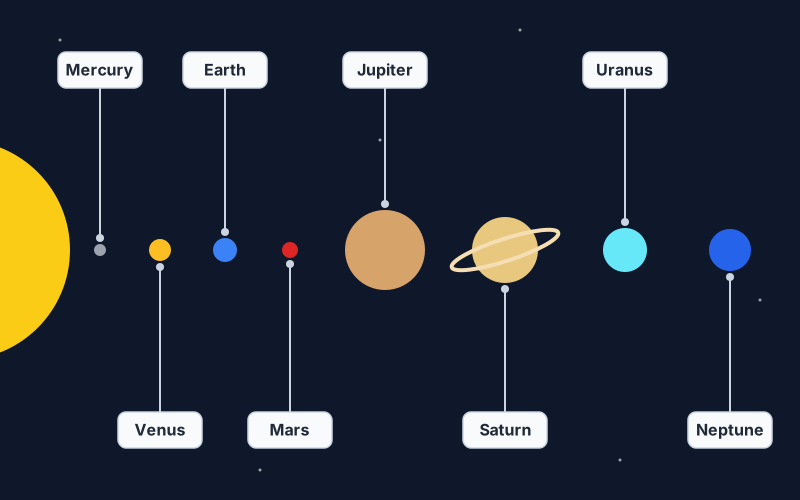
Which planet in the diagram is the largest?
Saturn
Neptune
Earth
Jupiter
Jupiter has about 11 times Earth's diameter and more than twice the mass of all the other planets combined. Saturn is second largest.
Which planet has the hottest average surface temperature?
Mercury
Mars
Jupiter
Venus
Venus averages about 465 °C because its thick CO₂ atmosphere traps heat in a runaway greenhouse effect. Mercury is closer to the Sun but has almost no atmosphere, so its night side gets very cold.
Which four planets are the rocky terrestrial planets?
Earth, Mars, Jupiter and Saturn
Mercury, Venus, Uranus and Neptune
Venus, Earth, Mars and Pluto
Mercury, Venus, Earth and Mars
The inner four are small, dense and rocky. The outer four are giant planets made mostly of gas or ices. Pluto is classified as a dwarf planet.
Where is the main asteroid belt?
Between Earth and Mars
Beyond Neptune
Between Jupiter and Saturn
Between Mars and Jupiter
The main belt lies between Mars and Jupiter. The Kuiper Belt, home to Pluto and many icy bodies, is beyond Neptune.
What causes Earth's seasons?
Earth's changing distance from the Sun
Changes in the Sun's energy output
The tilt of Earth's axis (about 23.5°) relative to its orbit
The Moon's position
The tilt makes sunlight hit each hemisphere more directly and for longer days during its summer. Distance is not the reason: Earth is actually closest to the Sun in early January, during the Northern Hemisphere's winter.
Why does the Moon go through phases?
We see different portions of its sunlit half as it orbits Earth
Earth's shadow covers different parts of it
The Moon produces less light at certain times
Clouds block parts of it
The Sun always lights half of the Moon. As the Moon orbits, our viewing angle changes, so we see more or less of the lit half. Earth's shadow only falls on the Moon during a lunar eclipse.
A lunar eclipse can only happen during which phase?
New moon
First quarter
Full moon
Waxing crescent
A lunar eclipse needs Earth between the Sun and Moon, which only happens at full moon. A solar eclipse needs the Moon between Earth and Sun, so it happens at new moon. Eclipses do not happen every month because the Moon's orbit is tilted about 5°.
What is one astronomical unit (AU)?
The distance light travels in one year
The Earth-Moon distance, about 384,000 km
The diameter of the solar system
The average Earth-Sun distance, about 150 million km
1 AU is about 1.5 × 10⁸ km. A light-year, the distance light travels in a year, is about 63,000 AU and is used for distances to stars.
About how long does sunlight take to reach Earth?
About 1 second
About 1 hour
About 8 minutes
About 1 day
. We always see the Sun as it was about 8 minutes ago. Moonlight takes about 1.3 seconds.
An asteroid orbits the Sun at an average distance of 4 AU. Using Kepler's third law, what is its orbital period?
4 years
16 years
2 years
8 years
For orbits around the Sun, with P in years and a in AU. , so years. Farther objects take disproportionately longer.
What mainly causes ocean tides on Earth?
Wind blowing across the oceans
Earth's rotation alone
The difference in the Moon's gravitational pull across Earth
The Sun's heat expanding the water
The Moon pulls harder on the near side of Earth than on the far side, creating two bulges, so most coasts get about two high tides a day. The Sun adds a smaller effect: spring tides when they line up, neap tides at right angles.
How does the Sun produce its energy?
Nuclear fusion of hydrogen into helium in its core
Burning hydrogen gas with oxygen
Nuclear fission of uranium
Gravitational collapse alone
In the core, at about 15 million K, hydrogen nuclei fuse into helium. A tiny loss of mass becomes energy through . Chemical burning could power the Sun for only a few thousand years.
Which two planets are classified as ice giants?
Uranus and Neptune
Jupiter and Saturn
Saturn and Uranus
Mars and Neptune
Uranus and Neptune are made largely of water, ammonia and methane ices around a rocky core. Jupiter and Saturn are gas giants, made mostly of hydrogen and helium.
Why was Pluto reclassified as a dwarf planet in 2006?
It does not orbit the Sun
It is not round
It has not cleared other objects from its orbital neighborhood
It has no moons
The IAU defines a planet as orbiting the Sun, massive enough to be round, and having cleared its orbit. Pluto meets the first two but shares its zone with many Kuiper Belt objects. It has five known moons.
Which planet rotates tipped on its side, with an axial tilt of about 98°?
Venus
Neptune
Saturn
Uranus
Uranus was probably knocked over by a giant impact early in its history, so its poles take turns pointing at the Sun. Venus is the planet that spins backward (retrograde), a different oddity.
Why does Mars look red?
It is hotter than the other planets
Its atmosphere is made of red gases
Iron oxide (rust) in its surface dust and rocks
It reflects light from Jupiter
Iron-rich minerals have oxidized, coating the surface in reddish dust that also gets lifted into the thin atmosphere. Mars is actually cold, averaging about −60 °C.
Why do we always see the same side of the Moon?
The Moon does not rotate
The Moon rotates once on its axis in the same time it takes to orbit Earth
Earth's rotation hides the other side
The far side is always dark
The Moon is tidally locked: its rotation period equals its orbital period (about 27.3 days). The far side is not permanently dark; it gets sunlight during our new moon.
