Quiz · Medium
Shifts vs. movements, surpluses and shortages, price controls, and elasticity calculations with the midpoint method. Scenario questions for AP Micro and intro econ.
In this market, the government sets a minimum price ABOVE P*. What happens?
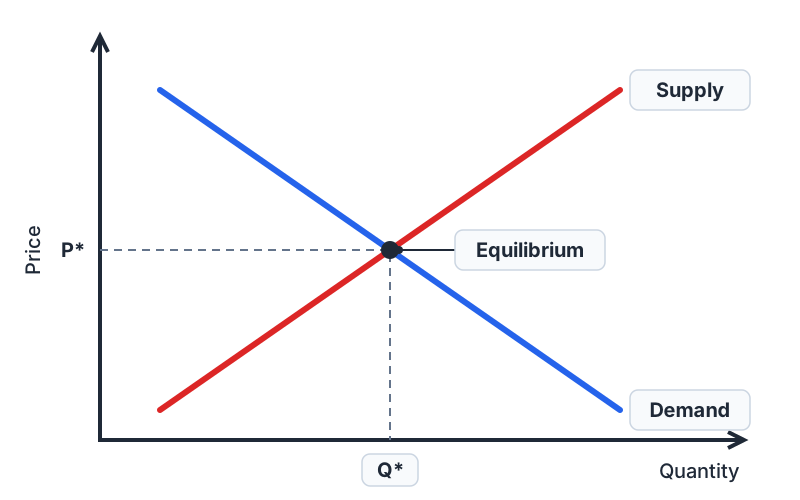
A shortage, because quantity demanded exceeds quantity supplied
A surplus, because quantity supplied exceeds quantity demanded
Nothing, because the market returns to P*
Demand shifts right until it meets the new price
Above equilibrium, sellers want to sell more and buyers want to buy less, so Qs > Qd: a surplus. A binding price floor (like a minimum wage) does not shift either curve.
Now the government sets a maximum price BELOW P*. What happens?
A surplus of the good
Supply shifts right
A shortage, because quantity demanded exceeds quantity supplied
Equilibrium quantity rises above Q*
A binding price ceiling (like rent control) keeps price below equilibrium, so Qd > Qs. The quantity actually traded FALLS to the quantity supplied at that price.
Consumer incomes rise. For a normal good, what happens to the equilibrium price and quantity?
Price rises, quantity rises
Price falls, quantity rises
Price rises, quantity falls
Price falls, quantity falls
Higher income shifts demand right for a normal good, so both price and quantity increase. For an inferior good, demand would shift left instead.
The price of pizza rises, and people buy fewer pizzas. Economists describe this as:
A decrease in demand (leftward shift)
A decrease in supply
An increase in demand
A decrease in quantity demanded (movement along the curve)
A change in the good's OWN price moves you along the demand curve. Only other factors (income, tastes, prices of related goods, expectations, number of buyers) shift the curve.
A new technology lowers the cost of producing solar panels. What happens in the solar panel market?
Supply shifts left; price rises
Supply shifts right; price falls and quantity rises
Demand shifts right; price rises
Demand shifts left; price falls
Lower production costs increase supply. With demand unchanged, a rightward supply shift lowers price and raises quantity.
The price of coffee rises sharply. What happens to the demand for tea?
It increases, because tea is a substitute
It decreases, because tea is a complement
Quantity demanded of tea falls along the curve
Nothing, because only tea's own price matters
When the price of a substitute rises, consumers switch, shifting demand for the other good to the right.
The price of hot dogs rises. What happens to the demand for hot dog buns?
It increases, because buns are a substitute
Supply of buns decreases
It decreases, because buns are a complement
It is unchanged
Complements are used together. People buy fewer hot dogs, so they need fewer buns, and demand for buns shifts left.
A firm raises its price by 10%, and quantity demanded falls by 20%. Demand is:
Inelastic, with elasticity 0.5
Unit elastic, with elasticity 1
Perfectly inelastic
Elastic, with elasticity 2
. Since 2 > 1, demand is elastic: buyers respond strongly to price.
A theater raises ticket prices by 10%, and attendance falls by only 5%. What happens to total revenue?
It falls, because demand is elastic
It rises, because demand is inelastic
It stays the same, because demand is unit elastic
It cannot be determined
Elasticity = 5% / 10% = 0.5 (inelastic). When demand is inelastic, raising the price raises total revenue because the price increase outweighs the lost sales.
Price rises from $4 to $6 and quantity demanded falls from 120 to 80. Using the midpoint method, the price elasticity of demand is:
0.5
1.0
1.5
2.0
and . So |E| = 40/40 = 1, unit elastic. Using simple percent change from the start would wrongly give 33%/50%.
The cross-price elasticity between two goods is -0.6. The goods are:
Complements
Substitutes
Unrelated
Both inferior goods
Negative cross-price elasticity means a price rise in one lowers demand for the other: complements. Positive means substitutes.
When incomes rise by 10%, purchases of instant noodles fall by 4%. The income elasticity is -0.4, so instant noodles are:
A luxury good
A normal necessity
An inferior good
A Giffen good for certain
Negative income elasticity = inferior good. Between 0 and 1 is a normal necessity; above 1 is a luxury. A Giffen good is a rare inferior good with an upward-sloping demand curve, which this information cannot show.
Demand and supply BOTH increase. What can we say for sure?
Price rises; quantity is uncertain
Price falls; quantity rises
Both price and quantity rise
Quantity rises; the change in price is uncertain
Both shifts push quantity up. But demand pushes price up while supply pushes it down, so the price change depends on which shift is bigger.
Demand is and supply is . What are the equilibrium price and quantity?
P = 20, Q = 60
P = 30, Q = 40
P = 25, Q = 50
P = 20, Q = 40
Set Qd = Qs: 100 - 2P = 20 + 2P, so 80 = 4P and P = 20. Then Q = 100 - 2(20) = 60. Check with supply: 20 + 2(20) = 60.
Maya was willing to pay $50 for concert tickets but bought them for $35. Her consumer surplus is:
$35
$50
$85
$15
Consumer surplus = willingness to pay - price paid = $50 - $35 = $15. On a graph, it is the area below demand and above the price.
A tax is placed on gasoline, which has very inelastic demand and fairly elastic supply. Who bears most of the tax burden?
Sellers
Buyers
It is always split 50/50
The government
The less elastic side of the market bears more of a tax because it cannot easily walk away. Who legally pays the tax does not change the economic incidence.
A minimum wage is set above the equilibrium wage in a competitive labor market. The model predicts:
A shortage of workers
A surplus of labor (unemployment)
No effect on employment
An increase in the number of workers hired
In the labor market, workers supply labor and firms demand it. A binding price floor makes more people want jobs than firms want to hire.
Which good is likely to have the MOST inelastic demand?
A specific brand of cereal
Restaurant meals
Insulin for a diabetic patient
Airline tickets for vacations
Necessities with no close substitutes have inelastic demand. A specific brand has many substitutes, and vacations and restaurant meals are easy to postpone or skip.
