Quiz · Medium
Marginal and average product, short-run and long-run costs, cost minimization, returns to scale and the shutdown rule.
Output with 0, 1, 2, 3 workers is 0, 10, 24, 33. The marginal product of the third worker is:
11
14
33
9
MP = change in output = 33 - 24 = 9. The value 11 is the average product of the third worker (33/3). MP first rises (10, 14) and then falls (9).
In the figure, point B (at L2) is where:
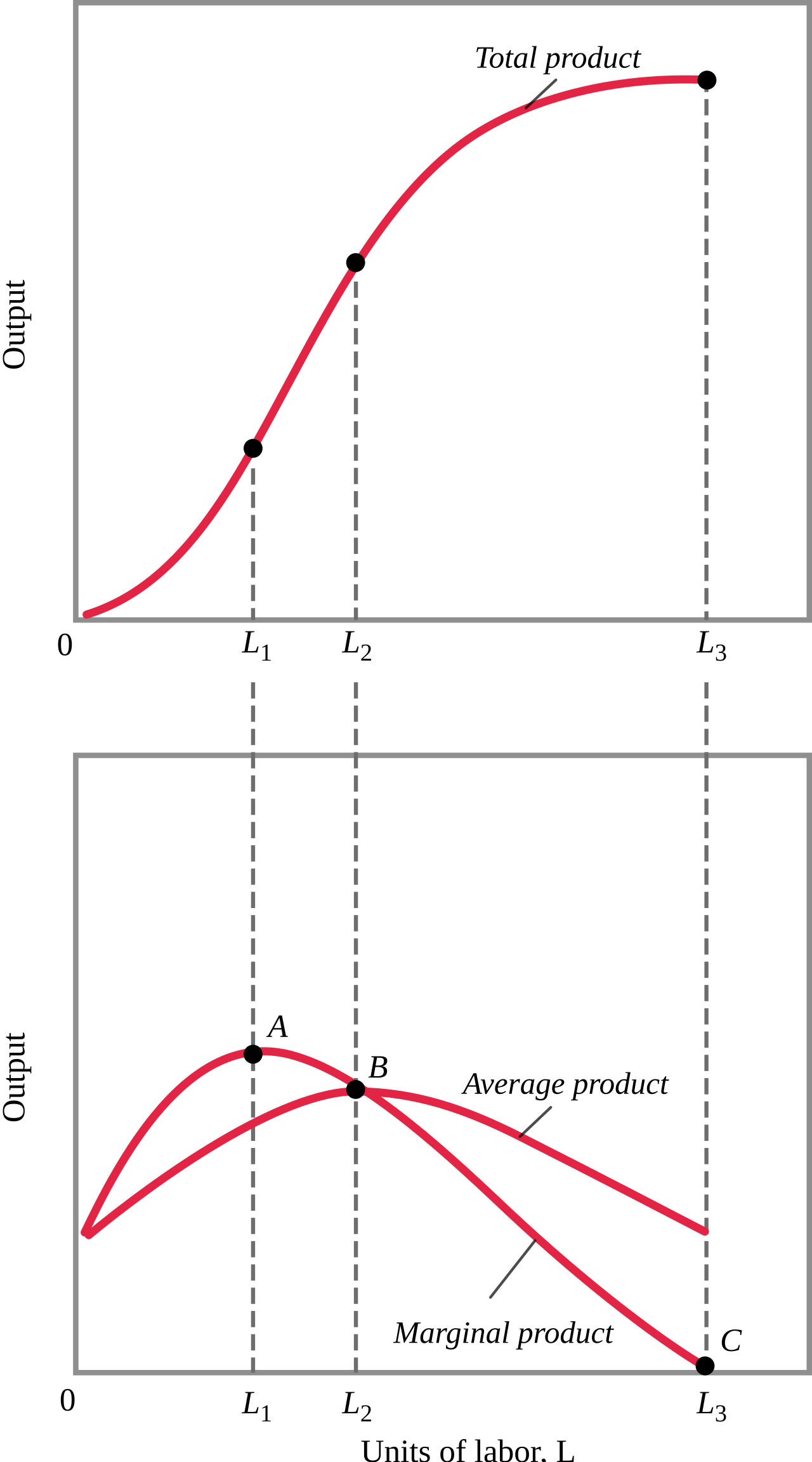
Marginal product equals average product
Total product is at its maximum
Marginal product is at its maximum
Marginal product is zero
MP crosses AP at the maximum of AP, which is point B. MP reaches its own maximum earlier at A, and is zero at C.
The law of diminishing marginal returns applies when:
All inputs increase in the same proportion
Technology improves
At least one input is held fixed while another increases
Price falls
It is a short-run law: adding a variable input to a fixed input eventually yields smaller increases in output. Scaling all inputs is a returns-to-scale question.
Total cost is $300 at Q = 10 and $320 at Q = 11. Which statement is true?
MC of the 11th unit is $20, so ATC must be rising
MC of the 11th unit is $20, below ATC, so ATC is falling
MC of the 11th unit is $29.09, the new ATC
MC of the 11th unit is $320
MC = 320 - 300 = $20. ATC at Q = 10 is $30, so the 11th unit costs less than the average and pulls it down, to 320/11 = $29.09.
A firm's fixed cost rises, and nothing else changes. Which curves shift?
MC and ATC
ATC and AFC only
MC, AVC and ATC
AVC and MC only
Fixed cost enters AFC and ATC (ATC = AFC + AVC) but not variable cost or marginal cost.
The government imposes a $2 per-unit tax on output. Which curves shift up?
Only ATC
Only AFC
Only MC
MC, AVC and ATC
A per-unit tax adds to the cost of every unit, so MC rises by $2, and therefore AVC and ATC rise as well. Fixed cost is unchanged, so AFC does not shift.
In the figure, which output corresponds to the minimum of average variable cost?
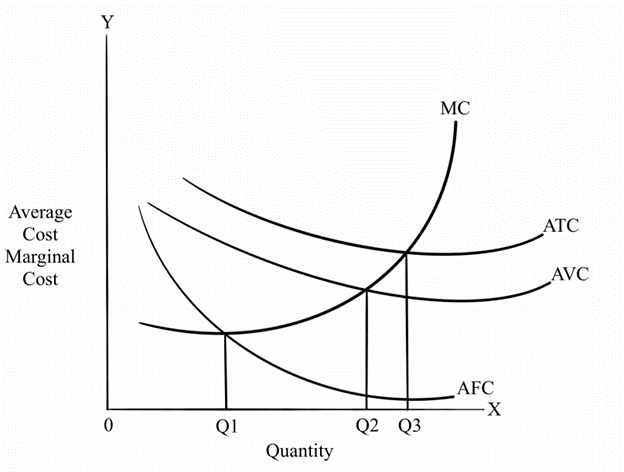
Q2
Q1
Q3
Zero
MC crosses AVC at its minimum, which happens at Q2. Q1 is the minimum of MC and Q3 is the minimum of ATC.
Image: Sharpie7Man, CC BY-SA 4.0, via Wikimedia Commons.
In the figure, ATC is at its minimum at:
Q1
Q2
Q3
It has no minimum
MC crosses ATC at Q3, so average total cost is lowest there. It comes after the AVC minimum because AFC keeps falling.
Image: Sharpie7Man, CC BY-SA 4.0, via Wikimedia Commons.
With labor the only variable input, the wage is $30 and the marginal product of labor is 6. Marginal cost is:
$6
$24
$180
$5
. $180 multiplies instead of dividing.
A firm doubles all inputs and output rises by 60%. The firm has:
Decreasing returns to scale
Increasing returns to scale
Constant returns to scale
Diminishing marginal returns
Inputs rise 100% and output only 60%, so output grows less than proportionally: decreasing returns to scale. Diminishing marginal returns describes changing one input at a time.
. If both K and L triple, output:
Triples
Rises sixfold
Rises ninefold
Is unchanged
, so output rises ninefold: increasing returns to scale.
A firm is cost-minimizing. , , w = $5, r = $4. What should it do?
Keep inputs as they are
Use more labor and less capital
Use more capital and less labor
Cut output
and . Labor gives more output per dollar, so substitute toward labor until the ratios are equal.
In the isocost-isoquant diagram, the points where each isocost line touches an isoquant show:
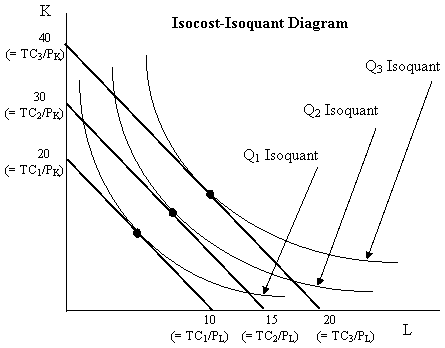
The maximum output for any cost
The least-cost input combination for each output
Constant returns to scale
The firm's break-even points
Tangency means MRTS = w/r: for a given output (isoquant) the lowest cost (isocost) combination of inputs.
A competitive firm faces P = $12. At its profit-maximizing output, ATC is $10 and AVC is $8. Its economic profit per unit is:
$4
$12
-$2
$2
At the P = MC output, profit per unit is P - ATC = 12 - 10 = $2. The $4 uses AVC, which leaves out fixed cost.
A competitive firm has P = $6, AVC = $7 and ATC = $10 at its MC = P output. In the short run it should:
Shut down
Produce, since P > 0
Produce, to cover fixed costs
Raise its price
Revenue per unit ($6) is below variable cost per unit ($7), so every unit adds to the loss. Shutting down limits the loss to fixed cost. A price taker cannot raise its price.
Same firm, but P = $8.50 with AVC = $7 and ATC = $10. In the short run it should:
Shut down
Exit the industry immediately
Produce and cover part of its fixed cost
Raise output until P = ATC
P exceeds AVC, so each unit contributes $1.50 toward fixed costs. Producing loses less than shutting down, though in the long run it should exit if prices stay below ATC.
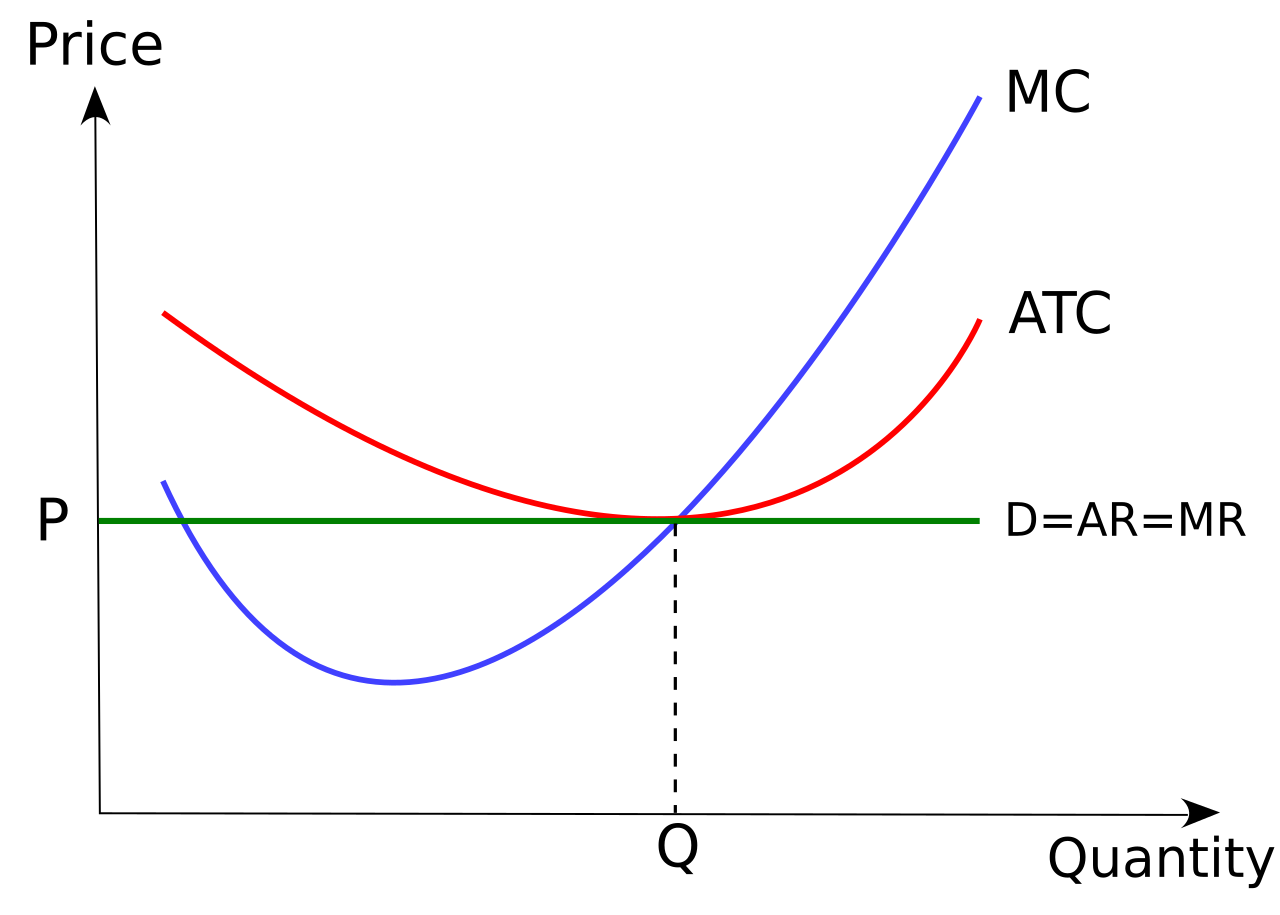
Which statement about the long-run equilibrium of a perfectly competitive firm is correct?
P > MC and economic profit is positive
P = MC and ATC is falling
MR > MC
P = MC = minimum ATC and economic profit is zero
Entry and exit drive profit to zero, so P = ATC, and since the firm maximizes profit P = MC, so ATC is at its minimum.
Image: Trampled and Bluemoose (English Wikipedia), derivative work by Jarry1250, CC BY-SA 3.0, via Wikimedia Commons.
The long-run total cost curve lies on or below the short-run total cost curve because:
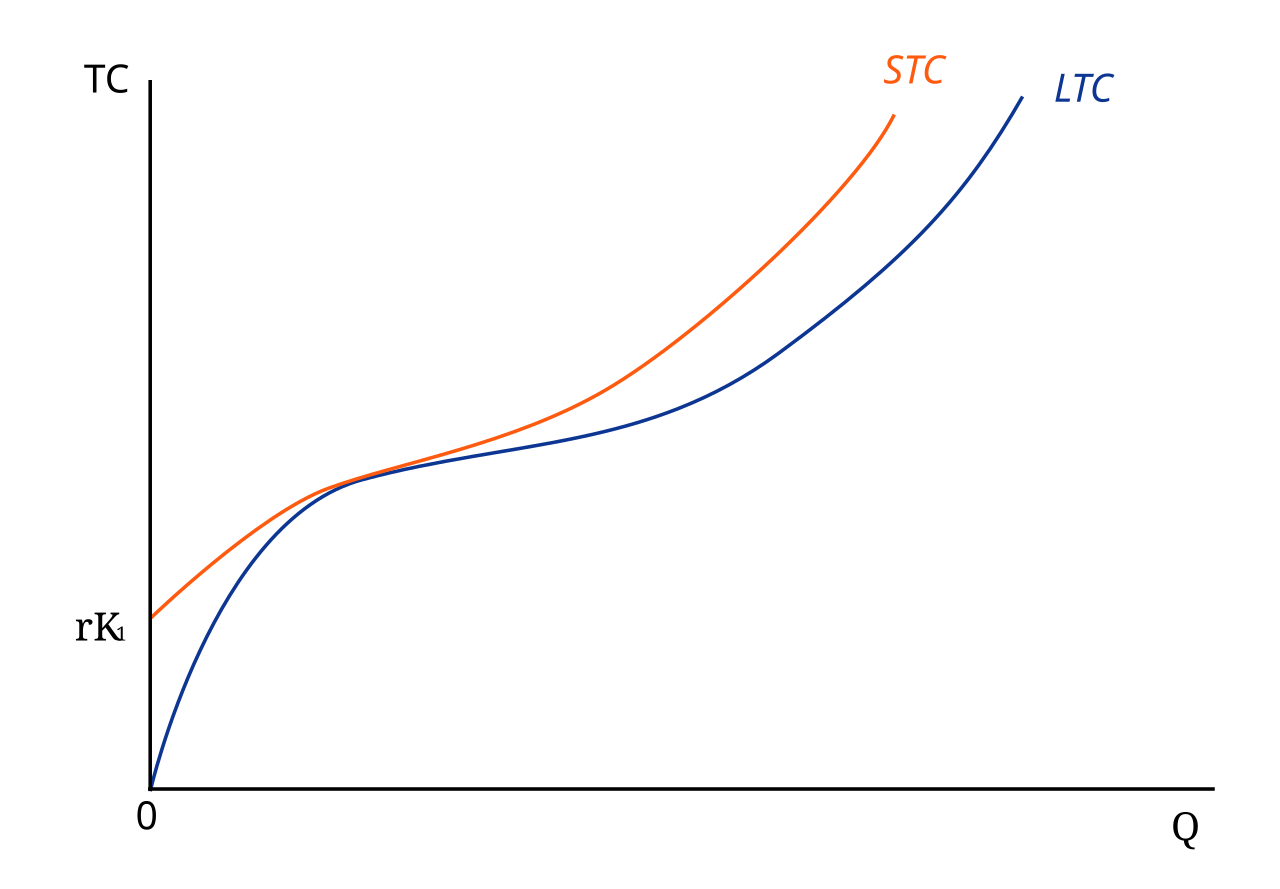
In the long run all inputs, including capital, can be adjusted to minimize cost
Firms earn higher profits in the long run
Prices fall over time
Fixed costs rise with output
With capital fixed, the short-run plant may not be right for that output. In the long run the firm can choose the best plant size, so it can do no worse than its short-run plant.
Image: Kwj2772, CC BY-SA 4.0, via Wikimedia Commons.
A firm's LRAC falls as output rises from 100 to 500 and rises beyond 800. Which is the most accurate conclusion?
Economies of scale at all outputs
Diseconomies of scale at all outputs
Economies of scale up to some output, constant or diseconomies afterwards
Diminishing marginal returns only
A falling LRAC means economies of scale. A rising one means diseconomies. Between 500 and 800 it is flat or near flat (constant returns).
A producer has TC = 100 + 5Q + Q². Marginal cost at Q = 8 is:
13
21
204
5
MC = dTC/dQ = 5 + 2Q = 5 + 16 = 21. The 13 is the average variable cost at Q = 8 (5 + Q), and 204 is total cost (100 + 40 + 64).
Which is NOT a source of economies of scale?
Specialization of labor
Poorer communication in a larger organization
Bulk purchasing discounts
Spreading fixed cost over more output
Communication and coordination problems cause diseconomies of scale, the opposite of economies.
Marginal cost is below average total cost. Therefore:
ATC is rising
ATC is at its minimum
AVC is at its minimum
ATC is falling
When the marginal unit costs less than the average, it pulls the average down. ATC falls whenever MC < ATC.
In which of these cases should a profit-maximizing firm ignore a cost when choosing its output?
A sunk cost of $100,000 for a plant it cannot resell
Wages for extra workers
Raw materials for extra units
Overtime pay
Sunk costs cannot be recovered whatever the firm does, so they do not affect the marginal decision. Wages, materials and overtime are all marginal costs.
